Amid conflict in northern Ethiopia, children share their dreams for the future
Three children affected by the conflict in Afar, Amhara and Tigray share their hopes for peace and a better future.

After a year since the conflict broke out in Tigray in November 2020 and expanded to neighbouring Afar and Amhara regions, thousands of schools have been damaged or destroyed while many other schools are sheltering IDPs depriving children of their rights to an education.
Overall, it is estimated that close to 3 million boys and girls across Tigray, Afar and Amhara regions have missed out on learning opportunities.
The safe re-opening of schools this year will require both providing temporary school structures (such as tents) and identifying alternative shelters to which IDPs can relocate so boys and girls can go back to school.

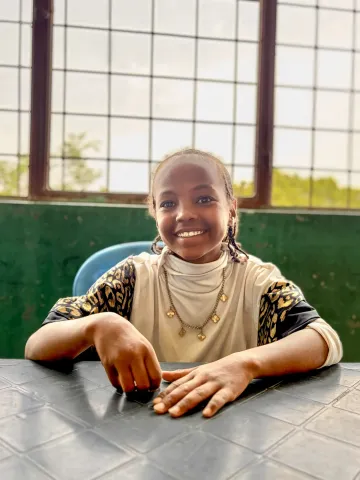
Peace for me is going to school, be with friends and playing,” says Asya Ahmed, 11, who is displaced because of the conflict and now staying in Chifra town in Afar region.

“When I hear the gunshots, I was so frightened,” says Asya. “People in the neighbourhood were running away…We walk up to a place called Askuma. Then we spend one day there and the next day, we came to Chifra.”
Asay and her family rented a small place in Chifra town. But the young girl misses being with her best friends with whom she plays hopscotch.

Asya is not sure when she will be back home. She also worries about her education if she will enroll in school or not in the new academic year. She would be in grade 4 if all goes well. Yet the conflict changed all that. “I don’t want to miss out on my education. I want to go back to school.”
Asya hopes to become a doctor so that she treats people with illnesses.

In Tigray region, Temesgen Haile, a bright 11-year-old, who is wise beyond his years, is also extremely vulnerable. He smiles when he talks about how Mekelle University had promised to help him power the model airplane his science team designed at school.

"When I think of my days at school, it is like a dream," says Temesgen who wants to be a scientist.
Temesgen's home, for now, is a classroom lined with mattresses, rather than desks and chairs, at the Hawelti Secondary School in Mekelle.

Temesgen says he feels safe at the camp. “All the people living here are my parents. They are taking care of me.”

In Amhara region, Meseret Tekuar, 16, left her town with her two younger brothers leaving their mother behind after fighting broke out. They went to Dessie to seek shelter and they are staying in a school with many children who are separated from their parents.

“When the conflict started, bullets were raining at our house. Someone in the neighbourhood was also killed. We were with our grandparents and we flee for safety,” says Meseret.
“I think about my mother. We hear lots of rumours that people are killed there [ Kobo]. That worries me a lot,” she says.

Meseret was attending school in the 7th grade, but she is not sure if she would be able to continue her education in Dessie or elsewhere. Though she doesn’t know where her childhood friends are, Meseret makes new friends who have gone through a similar fate of displacement.
Between January and July 2021, UNICEF and partners reached over 64,600 children in Tigray, Afar and Amhara regions through the integrated education and child protection (Bete) programme which attempts to integrate fundamental services in health, primary education, childcare and psychosocial development.
In addition, school equipment was also sent to emergency affected schools in Amhara region in September, 2021 and 4,000 solar radios were sent to Afar to provide distance education for 16,000 conflict affected pastoralist children.
“Peace for me is being with family, friends and people you are familiar with. Peace means going to school and spending time with teachers and friends,” says Meseret.
For children in emergencies, education is about more than the right to learn. Schools protect children from the physical dangers around them – including abuse exploitation and recruitment into armed groups. They provide children with lifesaving food, water, health care and hygiene supplies. And they offer psychosocial support, giving children stability and structure to help them cope with the trauma they experience every day.