UNICEF Emergency Director, Manuel Fontaine, visits drought stricken Somali region and calls for an immediate scaled up humanitarian response to save millions of children
Nearly 10 million people, including 4.4 million children, are in urgent need of humanitarian assistance in drought-impacted areas

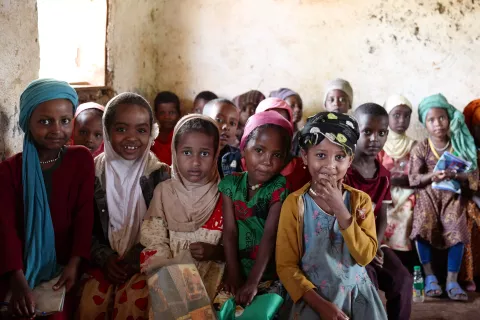
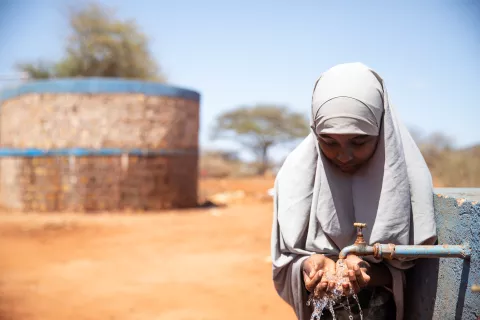
SOMALI REGION, ETHIOPIA, 19 July 2022 – Four consecutive failed rainy seasons have brought on severe drought in Ethiopia’s lowland regions of Afar, Oromia, the Southern Nations, Nationalities, and Peoples’ (SNNPR) and Somali regions. Water wells have dried up and millions of livestock have died, resulting in mass displacement.
“The impact of the drought on children is devastating,” said Manuel Fontaine, UNICEF Director for Emergency Operations. “In Somali region alone, over 900,000 people have been displaced. Drought not only means lack of water. It means that children are going hungry and thirsty every day. They are forced to walk miles in search of food and water and often they have to drink from contaminated water sources. This leads to malnutrition and other killer preventable diseases like diarrhea.”
Malnutrition rates are increasing at an alarming rate due to the drought. Across the four drought-impacted regions, an estimated 600,000 children will require treatment for severe acute malnutrition by the end of the year. In Somali region, there has been a 43 per cent increase in severely acute malnutrition admissions for under 5 children in May 2022 compared to May 2021.
“This climate-induced crisis is a malnutrition crisis for children and not just in Ethiopia but across Africa,” said Fontaine. “While UNICEF and partners are already on the ground providing lifesaving nutritional support for severely malnourished children, USAID’s recent $200 million contribution to UNICEF globally is a timely game changer and we are very grateful. This funding will significantly scale up our nutrition response across the world.”
The ripple effect of the war in Ukraine is also set to tip more families in Africa over the edge and will exacerbate food insecurity with increasing fuel prices and reduced availability of wheat imports. Ethiopia imports 67 per cent of their wheat from Russia and Ukraine.
“This means prices of cooking oil, bread and wheat flour are reaching new records in local markets and even families not living in humanitarian crisis cannot meet their daily food needs.” said Fontaine.
UNICEF’s drought response appeal for impacted areas in Ethiopia is USD $65 million in addition to the overall humanitarian appeal of USD $351 million. This specific funding will target more than 2 million vulnerable people in Afar, Oromia, SNNPR and Somali regions.
###
Note to editors:
Photo is available: here
About UNICEF
UNICEF works in some of the world’s toughest places, to reach the world’s most disadvantaged children. Across 190 countries and territories, we work for every child, everywhere, to build a better world for everyone. For more information about UNICEF and its work for children, visit www.unicef.org.
For more information and interviews, please contact:
Dheepa Pandian, Chief of Communication, UNICEF Ethiopia, [email protected], +251 91 125 5109
Malene Jensen, Regional Chief of Communication, UNICEF Eastern Southern Africa, [email protected] +254 797 04829
Christopher Tidey, Communication Specialist, UNICEF New York, [email protected] +1 917 340 3017
Media contacts
About UNICEF
UNICEF promotes the rights and wellbeing of every child, in everything we do. Together with our partners, we work in 190 countries and territories to translate that commitment into practical action, focusing special effort on reaching the most vulnerable and excluded children, to the benefit of all children, everywhere.
For more information about UNICEF and its work for children, visit www.unicef.org.