Children's Month
Water, Sanitation and Hygiene for Every Child

Did you know? Over 55,000 people in Eswatini have no toilets and practise open defecation.
Did you know? Simple hand hygiene habits, such as washing hands with running clean water and soap, can reduce diarrhoeal diseases by 33%.
Did you know? More than 300 children under five die from diarrhoeal diseases in Eswatini every year.
Did you know? In Eswatini, diarrhoeal disease, driven by unsafe water and sanitation, remains a leading killer of young children.
Every June, Eswatini joins the rest of the continent in marking the Day of the African Child (DAC). This year's commemoration carried a message that could not be more fundamental: a child's right to clean water, a safe toilet and the means to stay clean and healthy. Eswatini recognizes June as children’s month and uses it to intensify advocacy on children’s issues- a month of advocacy and action for children.
The Day of the African Child was established in 1991 by the Organisation of African Unity, now the African Union, to honour and advance children's rights across the continent. For 35 years it has served as an annual moment of reflection and advocacy, with a theme chosen each year by the African Committee of Experts on the Rights and Welfare of the Child. For 2026, that theme is “Ensuring universal access to water, sanitation and hygiene for every child.” In Eswatini, June was observed as a month-long advocacy campaign around this theme, led by the Children’s Services Department in the Deputy Prime Minister’s office, ministry of education, ministry of natural resources and energy, ministry of Tinkhundla, NGO children’s consortium, municipalities and UNICEF.
Water, sanitation and hygiene, known as WASH, are not conveniences. They are the foundation on which a child's health, dignity, education and protection all rest. Yet across Eswatini, that foundation remains out of reach for far too many children.
The objectives for this year’s advocacy month were clear: embed WASH in the policies and budgets that shape children's lives, raise awareness of WASH as a right, ensure that girls, children with disabilities and other vulnerable groups are included in WASH planning, and hold leaders accountable through concrete, measurable commitments.
Advocacy activities carried this message through radio, television and print media, and took partners directly into communities. A visit to the Mangwaneni informal settlement in Manzini allowed stakeholders to witness WASH conditions first-hand; in its wake, the Manzini Municipal Council has since introduced metered taps in the area, a tangible early outcome of the month's advocacy. In schools, children were sensitised on correct handwashing and toilet use and encouraged to become advocates for good hygiene at home, while twenty children used an art workshop to express the distances they walk for water, the barriers faced by children with disabilities, and the need for sanitary bins in school toilets.
The commemoration culminated on 4 June at UN House, where 120 children from schools and partner organisations across the country joined 80 guests from government and civil society. The programme featured performances on the meaning of water in children's lives, a song affirming that disability is not a barrier, and a live handwashing demonstration. Welcoming the children, the Regional Administrator, HRH Princess Tsandzile, reaffirmed the principle of leaving no one behind.
A panel of government, United Nations, municipal, civil society and parliamentary representatives responded to children's questions and commitments, including a pointed question from a student on menstrual poverty and school absenteeism. UN Resident Coordinator Mr George Wachira reminded participants that children's wellbeing depends on more than water and sanitation alone, it also requires education, protection and health, noting that 2026 marks the 50th anniversary of the African Child movement, rooted in the 1976 Soweto uprising. The Deputy Prime Minister's Office reiterated its commitment to children's welfare and welcomed the newly established Children's Participation and Consultative Forum, fifteen children selected to represent their peers' voices in decision-making.
In Children’s Own Words
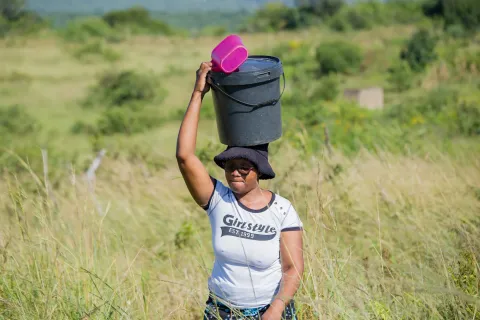
A discussion held with children in the Mantambe area brought these realities into sharp focus. Girls described walking about a kilometre each day to collect water from a stream, a responsibility that falls disproportionately on them and leaves less time for rest, study and play. Many households have no toilet at all, and where toilets exist, soap and water for handwashing are often unavailable, leaving children to fall ill with cholera and diarrhoea and to miss school as a result.
“We wish the Government could provide taps closer to our homes... this would help reduce the burden on children, especially girls, who are mostly responsible for collecting water.” Children, Mantambe discussion
For children living with disabilities, the barriers are compounded by toilets that cannot accommodate wheelchairs and unpaved paths that turn to mud in the rain. Adolescent girls face additional hardship during menstruation, often without sanitary materials, clean water or private space. Children also drew a clear line between urban and rural experience, those in towns generally reach a tap close to home, while rural children, even where taps exist, may still walk far and carry heavy loads. Asked how they would like to be heard, they were direct, through letters and dialogue with leaders, not only through songs and drama, which they feel are too often treated as entertainment rather than a message to act on.
The Work Ahead
For the girls who walk a kilometre for water each morning, for children with disabilities who cannot safely reach a toilet, and for every child in Eswatini who deserves to grow up healthy, safe and heard, that change cannot come soon enough. Ensuring universal access to water, sanitation and hygiene is not only a commitment for one advocacy month; it is a shared responsibility that government, communities, civil society and children themselves must carry forward together, throughout the year.