A Community Transformed
Clean Water. Healthy Children.

From burden to belonging
On Eswatini's eastern border, a mother of six once walked three kilometres for water she could not even be sure was safe. Today she leads her community's soap-making training. Her story is what water security makes possible.
For most of her life, Thabsile Khoza's day began with distance.
The nearest reliable water source — a borehole — sat about three kilometres from her home in eBhandeni, on the dry eastern edge of Eswatini where the land runs up against the Mozambican border. That distance had to be crossed on foot and repeated across the days and the seasons, with six children depending on whatever she could carry back. The walk took her through tall grass, the bucket balanced on her head, the same journey every household here knew by heart.
There was closer water, from a natural spring. But it was contaminated and unsafe to drink. Thabsile knew it. Her whole community knew it. Without an alternative, they drank it anyway.
In a community where roughly half the population are children, that was not a small risk. Unsafe water is one of the surest ways for waterborne illness to take hold, and for the youngest, it can be fatal.
A community under pressure
eBhandeni's story is not unique in Eswatini, but it is sharper here than in most places. This is one of the country's most water-stressed, climate-exposed communities — remote, underserved, and short of rain. And water insecurity never stops at thirst. It reaches into everything.
It reaches into school, where girls miss class to fetch water. Into livelihoods, where livestock die without enough to drink. Into dignity itself, where families cannot keep up the basic hygiene that protects their health. Across Eswatini, well over half the population lives below the national poverty line, and acute food insecurity touches hundreds of thousands of people. In a place like eBhandeni, those pressures compound. Addressing water here is not a single fix. It is a gateway to health, to safety, and to dignity.
What changed
The intervention that reached eBhandeni was built on three connected pillars, and it was designed to last — implemented through Eswatini's own government ministries rather than
around them, with support from the Government of Japan and the implementing partner COSPE.
The first pillar was the water itself. A spring was protected — secured, covered, and connected to a storage tank and a community standpipe — bringing clean water within reach of more than 100 households. Designated livestock watering points kept animals away from the human supply. COSPE constructed a well, adding another access point. For families near the protected spring, the three-kilometre walk simply ended.
The second pillar was ownership. Community water committees were trained to manage and maintain the systems themselves, so that today's infrastructure keeps working long after the project period closes.
The third pillar reached into Thabsile's own hands.
The woman who now leads the training
When the soap-making project began, it was a response to something simple and hard: many eBhandeni households could not afford handwashing or liquid soap at all. The most they could manage was laundry soap. So the Ministry of Health and UNICEF brought in a trainer to teach the community to make their own.
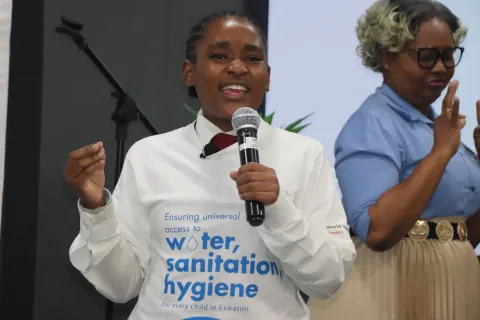
Thabsile learned. And then she kept going. On the day we visited, it was Thabsile herself standing at the front of the community hall, measuring the bright green liquid into a jug, pouring it carefully into bottles, showing the other women how to stir the mixture and add the fragrance — the trainee became the trainer of others.
"The soap-making project has taught us the importance of hygiene," she says. "We take pride in producing it ourselves, rather than relying entirely on shops. The money we earn helps our households purchase what we need."
That last point matters as much as the hygiene. The soap protects her children's health and stocks the local schools, but the surplus is sold, and the income goes toward school fees, food, and the daily essentials. Thabsile grows vegetables too. Piece by piece, she is building a household resilience that did not exist before this programme reached her community.
Her story is not exceptional in eBhandeni. It is the programme working as intended — not delivering charity, but restoring capability.
A model built to last
The way the programme was built is the reason it is likely to endure. Every pillar was delivered with a government ministry: the Ministry of Natural Resources and Energy brought the water-supply expertise and tied the work into a larger national pipeline project extending water
toward the communities along the Mozambican border; the Ministry of Health led the soap-making training and folded hygiene messaging into the existing health system; the Ministry of Agriculture advised on livestock and livelihoods. COSPE built infrastructure. Japan funded it.
"This area is severely water-stressed in every respect," says Musawenkhosi Mwelase of the Department of Water Affairs in the Ministry of Natural Resources and Energy. "The soap-making programme represents a highly impactful intervention for the community. Beyond promoting better hygiene practices, it also strengthens household independence and creates opportunities for families to support themselves."
Looking ahead
The work in eBhandeni has shown what becomes possible when water security is treated as a foundation rather than a finishing line. More than 100 households now have protected, clean water. Families make their own soap. Children wash their hands at school. A community that once walked three kilometres is beginning to know what it feels like to have enough.
But the job is not done, and Thabsile is clear about what remains. The community well still needs a proper cover, to keep out contamination and protect children from accidents. The existing borehole needs a pump system to carry water closer to the households that the protected spring does not yet reach. These are not wishes. They are the logical next steps of a programme that has already earned the community's trust through results.
Continued investment in eBhandeni will not start from zero. It will build on infrastructure already in place, on trained water committees, on active hygiene networks, and on a community that has proven it can own and sustain change. The foundation has been laid. The next phase can go further — toward a community where reliable, safe, dignified water is not a privilege, but a given.
Thabsile still knows the weight of a full bucket and the length of that walk. But more and more of her days now begin somewhere else: at the front of a room, teaching her neighbours how to protect their own families. From burden to belonging.
The eBhandeni WASH programme is implemented by UNICEF Eswatini in collaboration with the Ministry of Natural Resources and Energy, the Ministry of Health, and the Ministry of Agriculture, with the implementing partner COSPE. UNICEF Eswatini extends its sincere appreciation to the Government of Japan, whose support through the FY2024 Supplementary Budget made this programme possible.