Protecting Children from El Niño 2026: Readiness and Early Action Across Eastern and Southern Africa

About
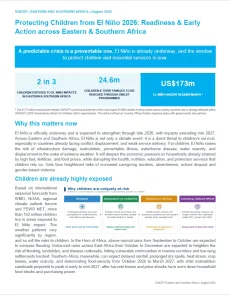
A record-breaking El Niño is already underway and expected to strengthen substantially through late 2026, with impacts extending into 2027. UNICEF estimates that more than 162 million children — two in three across Eastern and Southern Africa — will be exposed to its adverse effects, from extreme drought in some areas to massive flooding in others, threatening children's nutrition, health, education, safety, and access to safe water and sanitation.
UNICEF has identified Somalia, Ethiopia and South Sudan as priorities for intensified early action, given the scale and complexity of existing crises, while scaling up readiness across ten further countries in the Horn of Africa, East Africa and Southern Africa. Working with governments, local organisations, and other humanitarian and UN partners, UNICEF is scaling up preparedness and anticipatory action across four areas: protecting children from immediate risks by pre-positioning supplies and strengthening outbreak readiness and child protection; keeping essential services running through continuity planning for health, water, education and protection systems; acting before disaster strikes by using forecasts and triggers to activate anticipatory action; and protecting families by scaling shock-responsive social protection and anticipatory cash, while strengthening national systems for future shocks.
This work is being undertaken through UNICEF's existing 2026 Humanitarian Action for Children (HAC) framework, within which UNICEF urgently requires US$173 million to reach 24.6 million children and their families across priority countries. Early, flexible financing remains critical: every US$1 invested in disaster risk reduction can save up to US$15 in future recovery costs, making early action now the most effective way to protect children's futures.