Students to represent interests of peers through National Student Council
The UNICEF supported body will bridge the gap between students in Barbados and decision makers at the highest levels in education and youth development

Bridgetown, Barbados 20-April-2023
Sixteen-year-old Renee Holford is determined to represent the interests of children and adolescents at the highest levels in Barbados.
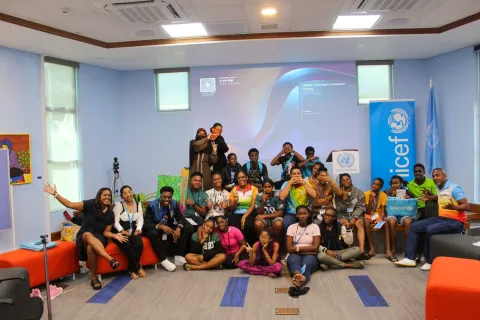
The Christ Foundation sixth-former was elected the country’s first ever National Student Council president in April during the ‘Presidents’ Symposium’ at the Hilton Barbados Resort.
UNICEF supported the Ministry of Education with this initiative, understanding the need for children to be active participants in finding solutions to the issues that affect them.
“I feel like this was an important step because the student councils at the different schools are not regularly heard."
The National Students’ Council was established to consolidate perspectives from students across the island and present them at national decision-making spaces.
Renee underscored the importance of leveraging the power of a united student voice when sitting at the table with education officials. She will have the support of 1st vice president Omari Cheltenham, 2nd vice president Keiara Worrell and secretary-treasurer Feverish Young.
“In order for us to have a voice based on the presidents of the different student councils, we first have to come together and let them talk to us and tell us what we need to be putting out there to the adults who make the decisions for us,” Renee explained.
UNICEF Representative for the Eastern Caribbean Pieter Bult noted that the importance of children’s participation was written into the United Nations’ Convention on the Rights of the Child.
However, he believes perspectives of children too often become an afterthought and praised Barbados’ Ministry of Education for supporting the initiative.
“It requires effort to engage with children. It’s a different culture. It requires a different kind of language and different perspectives to engage with children, but this is exactly why we should engage with children,” said Bult.
“Student associations are one vehicle for us to engage with children at a more institutional level. You can count on our continuing support.
Chief Education Officer Dr Ramona Archer-Bradshaw said National Students’ Council leaders would be held to a high standard.
“Any leader that we have should be able to represent your interests and not his or her interests alone,” she said.
The Chief Education Officer lauded the efforts of student leaders in promoting peace, leading national debates and engaging in projects like tree-planting to help the environment.

She challenged them to look more seriously at promoting the United Nations Sustainable Development Goals (SDGs) in their schools.
“As you embark on your activities, you will realise that these student councils not only help to promote student engagement and help with leadership, but they also help to contribute to the overall development of the school,” said Dr Archer-Bradshaw.
“While you will learn skills such as communication and critical thinking and teamwork and problem solving and decision making, you are positively contributing to organising activities that lead to your sustainable development or sustaining of our world,” she added.