Caribbean youth demand action on mental health
Solutions presented at International Youth Day discussion
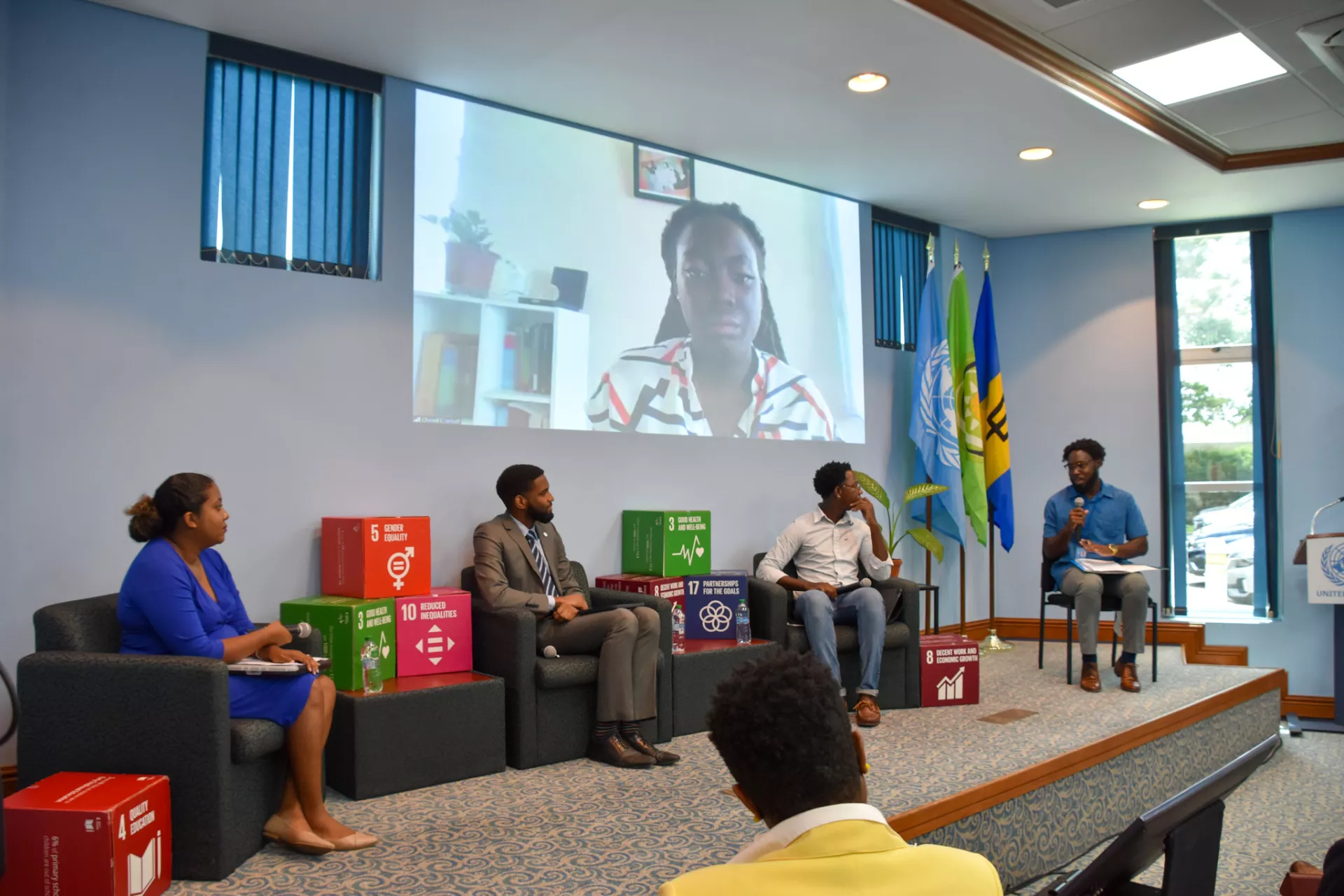
BARBADOS-17 August 2022 - Governments, intergovernmental institutions, non-governmental organisations and private sector groups in the Eastern Caribbean have received a broad range of proposed reforms to improve the mental health of children and youth across the sub-region.
Youth mental health advocates Christa Soleyn, Chaneil Imhoff, Pierre Cooke Jr and David Johnson Jr. made the observations as they addressed an International Youth Day panel hosted by the UN Barbados and the Eastern Caribbean and UNICEF Eastern Caribbean offices, under the theme Breaking Generational Barriers: A Discussion on Youth Mental Health.
Ms Soleyn, who is a clinical psychologist, called for all guidance counselors in primary and secondary schools to be trained psychologists up to the master’s level and for provisions to be made for more mental health services up to the tertiary level.
She however acknowledged that many of the generational issues which continue to arise, exists because of parents who much like their children, lack critical psychological and emotional support. This assessment was backed by a 2020 study conducted at the University of the West Indies.
“The gap is not only parents not listening or adults not listening to the needs of young people, but also that they don’t know how to. Our parents are struggling, and we can put the guidance counselors in schools like I want us to, we can put in the support systems, but we have to address parents, and this is not about crying down parents, but empowering parents,” Soleyn contended.
As part of this empowerment drive, the clinical psychologist called for greater financial and capacity support from governments and donor agencies, for NGOs across the region that have established relationships with vulnerable groups.
Aspiring Antigua and Barbuda politician and mental health advocate Chaneil Imhoff opted to focus on the importance of updating outdated legislation that addresses mental health issues.
“Legislatively, we have to update our laws to reflect our growing society. I can say for Antigua and Barbuda, the last time we had updated mental health legislation was in 1957. Neither of my parents were even born yet in 1957 so that alone shows that we have a long way to go and a lot of work to do,” said Ms Imhoff.
“We don’t have any strategies that deal with mitigation, we don’t have anything to deal with de-stigmatisation, deinstitutionalization, and reintegration into society and even finding resources for people who haven’t even gone there yet to maintain good mental health throughout your adolescence. So, we have very similar issues and it's helpful to talk among each other as Caribbean brothers and sisters to see how we are similar, how we are different… and how we can work together to solve these,” she added.
UN Youth Advisory Group member, who is the sitting Prime Minister of the Barbados Youth Parliament, Pierre Cooke Jr., reflected on an uptick in suicides in his home country, particularly affecting young men.
His call was for more work to be done in breaking down generational barriers that encourage unrealistic perceptions of masculinity.
“We have a Caribbean concept of what it means to be a man in terms of providing for the home, this very bravado persona, and the expectation that you will be big and tough. You don’t cry, you don’t cry in front of your main boys, you don’t share these really soft emotions because that is ‘girl’ behaviour,” Cooke Jr. said of the flawed concept.
“Across the region we have developed this culture where the identity of being masculine in our society is attached to being a bit emotionless, numbing your emotions. And so, when young persons or young men find themselves in situations where they feel hopeless, or they are overcome with certain emotions, who do they go to?
“It will always take courage for a young man to stand up and say ‘I don’t feel so good. I’m feeling a little depressed, I am feeling a little down, I might need to see a therapist or something. But we need to create that kind of society in the Caribbean where young men feel comfortable speaking about what they are feeling, where young men don’t feel as if they must live up to this very unattainable standard of masculinity in order to be seen as a man in society,” he added.
President/Founder of Let’s Unpack it, David Johnson identified ageism as one of the major barriers deterring young people from seeking help.
The outspoken medical student drew links between mental health issues and many other challenges including the physical health and economic prosperity of a nation.
“If you are growing up in a household where you’re being told that you don’t pay bills in this house, so you’re not allowed to have an issue, then naturally I am not going to that person to seek help.
“We must be careful that we do not engage in conversation at a very superficial level where we exclude young people from even making contributions to changes that they want to see."
“We must be careful that we do not engage in conversation at a very superficial level where we exclude young people from even making contributions to changes that they want to see."