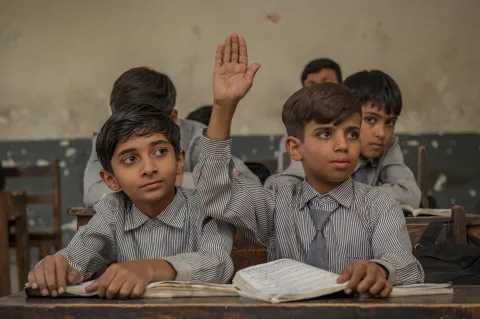
As I write this, the Philippines is grappling with the aftermath of Typhoon Man-yi, its 16th typhoon this year. Over the past 11 months, children have been caught in a relentless cycle of destruction – displaced from their homes time and again, and separated from their homes and their vital access to education.
Sadly, this is the new reality of girls and boys growing up in East Asia and the Pacific, the most disaster-prone region in the world. Yet throughout my recent mission to the Philippines, I heard story after story of extraordinary resilience, of families adapting to the ever-growing challenges of climate change with determination and hope.
Youth at the helm: shaping a resilient future through disaster risk reduction
In Manila, I attended the Asia-Pacific Ministerial Conference on Disaster Risk Reduction. Amid the bustle of 7,000 ministers and delegates from across the region, the energy and insights of young people truly stole the spotlight.
Meeting members of the UNICEF-supported Young People’s Action Team (YPAT), who played an active role in the conference, was undoubtedly the highlight of my visit. When I asked these young leaders how we can expand, amplify, and sustain their efforts across the region, 23-year-old Gabriel Veigaunavinaka’s response resonated deeply with me:
“We are living the challenges of climate change and offering solutions that reflect our perspective, but we need more organizations and governments to see us as partners, not just beneficiaries.”
Gabriel couldn’t be more right. It's clear that simply listening to young people and applauding their insights is not enough. We need to bring them into the heart of the action – whether it’s assessing disaster risks, shaping policies that truly work on the ground, or crafting bold, innovative solutions for the future. We already have excellent examples of how girls and boys are helping make communities safer and more resilient to disasters – from conducting hazard and risk mapping, to raising awareness about climate and disaster impacts, to using technology for alerts and early warning for their schools and communities.
BARMM: Progress amidst challenges
As I flew south, I reflected on how Philippines embodies the intersection of post-conflict, climate change, and child rights challenges. Once ranked fifth globally for unvaccinated children, it has, in just 12 months, dropped out of the top 20. It has brought proper sanitation to over 1 million people in the underserved Bangsamoro Autonomous Region in Muslim Mindanao (BARMM). So much progress has been made, and yet fragility and vulnerability remain.
One image from my visit to BARMM remains deeply etched in my memory: the hundreds of destroyed buildings in Marawi, their walls riddled with bullet holes—a haunting reminder of the violent siege in 2017. Even today, the city still resembles a "ground zero." Emerging from nearly five decades of conflict, which ended with the establishment of the autonomous region in 2019, BARMM faces significant challenges in infrastructure, governance, and social services, resulting in a lag in child rights and development compared to the rest of the Philippines.
In Cotabato, I met Melissa, a 27-year-old mother of three, who was attending a UNICEF Alternative Learning System class on financial literacy. In the classroom there was a feeling of quiet determination as young women and men listened intently, with focused expressions. Next to Melissa were other young mothers who had left school due to early marriage or pregnancy, and are now balancing education and parenthood with remarkable perseverance.
The Philippines ranks 12th globally in child marriages, with nearly 10% of marriages involving girls under 18. While sub-national data are not available, proxy indicators show child marriage is a significant issue for girls aged 15-19 in BARMM.
“I’ve had to leave this program three times,” Melissa said, her voice steady but emotional. “Each time, it was to give birth and care for one of my babies. But I keep coming back because I want to finish my diploma – for myself and for my children, so I can better support them in their studies, and they can go on to have a better life.”
Melissa’s determination to complete her education, despite countless interruptions, is a powerful testament to the transformative impact of education. It showcases the critical role UNICEF plays in a fragile context like BARMM, offering young people the chance to reclaim their dreams and build brighter futures for themselves and their families.
In a small health centre in Wao, Lanao del Sur, I met 64-year-old grandfather Romeo, who shared his heartfelt reflections with members of his community. “In the past, the whole area used to be a toilet, with people relieving themselves pretty much everywhere,” he said, as nods of agreement rippled through the room. “Thanks to the new household toilets and the awareness activities around proper sanitation, we no longer have to walk long distances – sometimes through mud or rain – to find a place to go, and the whole community is much cleaner and safer from disease.”
“We all take care of the toilets now. The attitude toward safe water and sanitation has completely changed,” he said. “Our life is more comfortable, and our children will grow up in a clean and safe environment.”
Romeo’s words carried more than just gratitude. For him and the others gathered, this was also about dignity. “Having safe, accessible sanitation isn’t just about comfort,” he added, his voice steady with pride. “It’s about our dignity and that of our children. This achievement is something that makes me proud of what we’ve accomplished as a community, something that will last for generations to come.”
Melissa’s and Romeo’s stories embody the spirit of BARMM – a region striving for progress amid immense challenges. Through UNICEF’s partnership with local authorities, significant milestones have been achieved: stunting rates have dropped from 45% in 2015 to 39% in 2019; over 600 communities have achieved Zero Open Defecation status; and 1,869 children associated with armed forces have been reintegrated into society.
Yet, much remains to be done. Children in BARMM still experience higher levels of deprivation than children elsewhere in the Philippines. Challenges like high child mortality, widespread stunting, insufficient basic sanitation, early pregnancies, child marriages, and serious violations of children’s rights continue to persist and need to urgently be addressed.
The Philippines as dynamic example of UNICEF’s approach in East Asia and Pacific
On the return flight, I reflected on how my visit to the Philippines showcased UNICEF’s regional approach in action. It highlighted the transformative impact of education, the vital role of youth in disaster risk reduction, and the importance of sustainable public and private partnerships. These efforts, driven by our dedicated and very capable UNICEF Philippines team, are rooted in empowering local actors to advance progress while keeping children at the heart of sustainable development.
On the flight, this vision came to life in a truly heartwarming way. Cebu Pacific, a long-standing UNICEF partner, had organized an onboard quiz about children’s rights, led by Behzad Noubary, UNICEF Philippines’ Deputy Representative, and followed by a spare change collection. Seeing passengers enthusiastically participate and hearing the cabin crew share their appreciation for UNICEF reminded me of the deep trust and connection we’ve built in the Philippines through decades of work for children. It was a powerful moment that reinforced my hope that, through collective efforts, we can create a brighter, more equitable future for every child.
June Kunugi is the UNICEF Regional Director for East Asia and the Pacific.