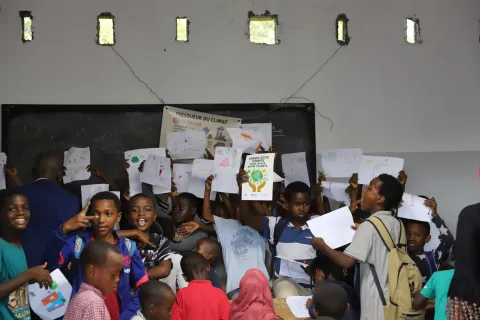
Scientific advocacy conference on the integration of children’s rights into climate policies
Organized by the Ministry of Environment and the Indian Ocean Climate Network, with UNICEF support and KOICA funding, the event—held alongside the launch of COY21—brought together officials, partners, researchers, and over 200 youth

- Français
- English
On the afternoon of December 4, 2025, the Retaj Hotel in Moroni was filled with an atmosphere that was both studious and stimulating. After a morning led by the youth of the Indian Ocean Climate Network (RCOI), who enthusiastically and seriously took the reins of the COP simulation, the Scientific Advocacy Conference brought together government officials, partners, researchers, and engaged youth in a dynamic dialogue on climate and children’s rights, combining expertise, commitment, and a concrete willingness to address climate challenges in the Comoros.
The conference aimed to respond to the growing impacts of climate change on children’s rights by strengthening their resilience and integrating their needs and rights into climate policies, based on scientific data, children’s testimonies, and institutional expertise.
The opening speeches set the tone for the conference, highlighting a central message: for effective climate action, children and youth must be at the heart of policies and decision-making.
The Coordinator of the Indian Ocean Climate Network (RCOI) opened the proceedings by urging authorities to fully recognize the engagement of young people: “Youth are not only beneficiaries but also agents of change and bearers of concrete solutions.”
Mustapha Ben Messaoud, UNICEF Representative in the Comoros, drew on data from the Climate Landscape Analysis for Children (CLAC) to emphasize that Comorian children are among the most exposed to climate risks, yet remain insufficiently considered in public policies: “Behind every climate statistic, there is a child: a child who is thirsty, falls ill, or can no longer go to school.”
Dr. Ali Mohamed, representing the Ministry of Youth, stressed that young people constitute an immediate force for transformation: “There can be no resilient Comoros without youth who are protected, educated, and engaged in preserving our environment.” Meanwhile, the Minister of Environment, Tourism, and Fisheries, Aboubacar Ben Mahamoud, emphasized the collective responsibility to act in the face of the climate emergency: “We are here to understand in depth the impacts of climate change on children so we can respond in a targeted way and act more swiftly.”
Dr. Edith Boni Ouattara, UNFPA Country Director in the Comoros, broadened the perspective by highlighting the human and health dimensions of the climate crisis: “Protecting children’s rights in climate action also means protecting their mothers and ensuring safe births, even after a cyclone.”
Finally, giving children the floor left a strong impression. A young participant in the COP simulation reminded everyone that action begins at an early age: “Even when we are small, we can do great things for our planet.”
Panels: Governmental and Scientific Perspectives for Child-Centered Climate Action

The government panel highlighted the main challenges and strategies to strengthen climate resilience in the Comoros, with a particular focus on the protection and participation of children.
Aboubacar Ben Mahamoud, Minister of Environment, Tourism, and Fisheries, noted that the country faces limited technical and financial capacities, with difficulties accessing international funding for large-scale projects. He emphasized, however, that the Comoros are on the front lines of climate change, and that preparedness is not optional but an urgent necessity for the survival and development of the country: “While awaiting international solidarity, it is essential to strengthen collective awareness and local action,” he stressed.
Bacar Mvoulana, Minister of National Education, underscored the central role of education in sustainable resilience: “Our ambition is to make Comorian children not just beneficiaries but fully engaged actors in ecological transformation.” His strategy rests on three pillars: integrating climate education into school curricula, strengthening teachers’ pedagogical skills, and involving students and communities.
International partners complemented these perspectives by highlighting the human and social dimensions of the climate crisis.
The UNFPA Country Director in the Comoros illustrated the tangible impacts of climate disruption: “Climate change in the Comoros is not a theory… for us, it is a pregnant woman walking through mud to reach a health center; it is a newborn struggling with an infection; it is an adolescent who has lost their home.” She emphasized that UNFPA responds with additional midwives, mobile clinics, and adapted care to protect both mother and child.
The UNICEF Representative in the Comoros stressed that the organization’s collaboration with the country is based on several complementary axes to strengthen resilience to climate change. He particularly highlighted the importance of influencing public policies to systematically consider children’s needs and recognizing the central role of youth as agents of ecological transformation: “These young people are extremely capable, aware, and proactive,” he affirmed, noting that UNICEF supports youth engagement. UNICEF also protects communities through early warning mechanisms, improved access to safe water, and school adaptation to climate risks, while raising awareness on public health. “We, as an organization, also have a duty to reduce our carbon footprint by prioritizing green energy and limiting the use of fossil fuels,” he stressed.
The scientific panel focused on the vulnerability of children to climate change and on ways to strengthen their protection and that of communities. Discussions addressed the most recurrent climate impacts in the Comoros and their direct effects on children, drawing on data from the National Institute for Research in Agriculture, Fisheries, and Environment (INRAAP). Researchers from the National Center for Documentation and Scientific Research (CNDRS) emphasized the importance of local knowledge in anticipating and reducing these risks, while university teams demonstrated how research can contribute to community resilience and offer concrete recommendations to better protect children. A central point was also the sustainable management and restoration of mangroves, recognized as an essential lever for protecting children living in coastal areas from increasing climate risks.
Another highlight of the conference was the designation of the Climate Champions for Children, individuals from public, scientific, community, or governmental spheres, tasked with becoming spokespersons for children’s climate resilience in the Comoros.
The conference concluded with a gala dinner, celebrating local initiatives and the role of partners in promoting children’s climate resilience.