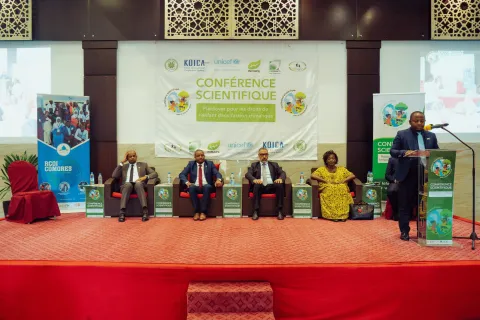
Comoros: Communities mobilize to strengthen their climate resilience
With funding from UNICEF and the Korea International Cooperation Agency (KOICA), Comoros is expanding initiatives to protect children and prepare communities for climate shocks

- Français
- English
Stronger cyclones, recurrent floods, water shortages, coastal erosion — Comoros is already experiencing the effects of climate change, and children remain the most vulnerable in the face of these crises.
To address this emergency, the Government of the Union of the Comoros and UNICEF, with financial support from the Korea International Cooperation Agency (KOICA), have launched a large multi-year project (2024–2027) aimed at strengthening preparedness, prevention, and community adaptation across the three islands.
These initiatives combine the strengthening of social services, active youth engagement, climate awareness for children in schools, and participatory actions that help communities better anticipate and manage increasing risks. Several key interventions already illustrate this momentum
Training students to understand and take action on climate change
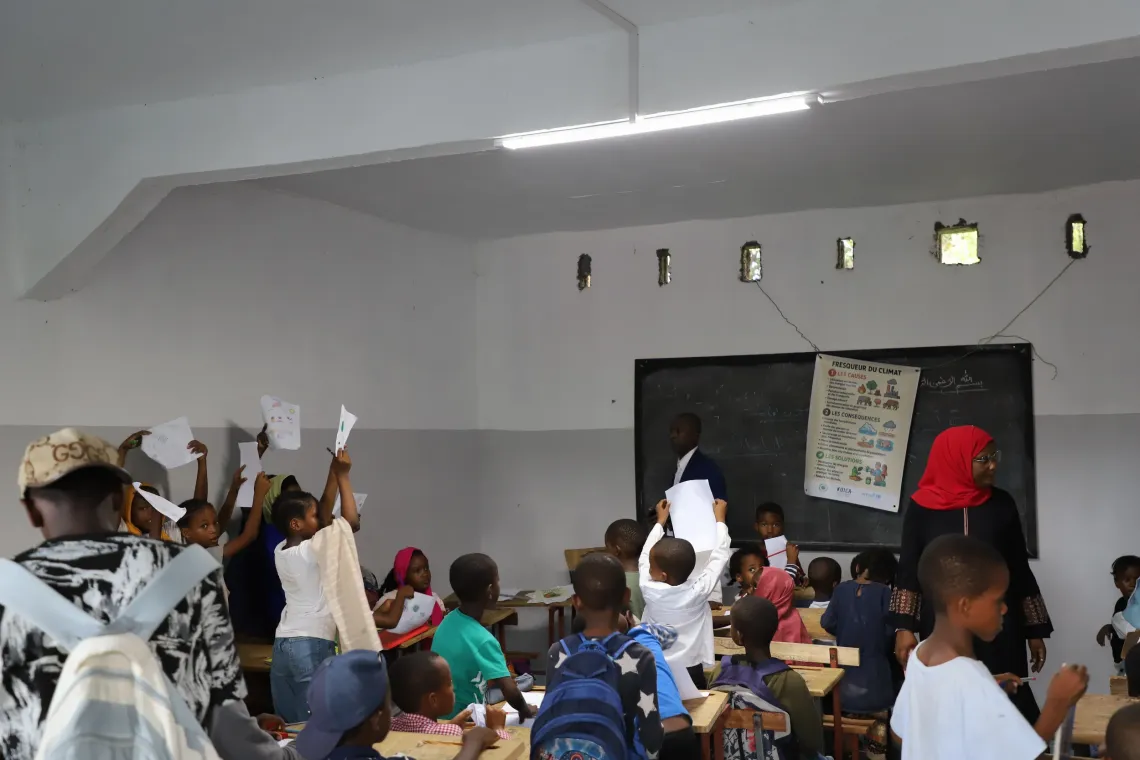

With the support of UNICEF and financial backing from KOICA, the Ministry of National Education has launched a large climate-change awareness campaign in 120 preschool and primary schools across the islands of Ngazidja, Anjouan, and Mohéli, in areas most exposed to climate risks.
A team of trainers, composed of pedagogical inspectors, members of adolescent clubs, and two resource persons, who originally designed the climate cards, trained Ministry of Education staff on the awareness tools developed to explain the effects of climate change.
Over several days, these staff members visited schools to teach children about the causes and consequences of climate change. With colorful posters and playful game cards designed specifically for their age group, students learned about the specific risks facing the Comorian population—including themselves—such as cyclones, coastal erosion, and water shortages.
These educational tools helped children learn while having fun, making it easier to remember simple actions that help protect the planet. The sessions, both playful and interactive, combine skits, games, storytelling, drawing workshops, and guided discussions. Each visit ends with a collective pledge and tree-planting in the schoolyard, allowing children to learn by taking action.
Awareness-raising has inspired children to turn their new knowledge into words and concrete actions: “Today I learned that cutting down trees makes you an enemy of the planet. But when you plant them, you become its friend,” says Zaïda, a 5th-grade student at EPP Dzahadjou Oichili.
This extensive campaign, carried out over nearly twenty days across all three islands, aims to reach more than 28,563 preschool and primary school students to promote eco-friendly behavior from an early age. The initiative is accompanied by the development of a curriculum and educational booklets to integrate climate-change topics into school programs starting next year. The success of this effort relies on close coordination between regional directorates, local teams, and school councils, ensuring effective coverage of the targeted areas.
In the same spirit, the program includes upgrading the infrastructure of eleven selected schools, which will receive complete IT kits (computers, printer-photocopiers, projectors), connectivity systems, solar panels, and metal cabinets to store school materials. These supplies will allow schools to function in all circumstances and provide students and teachers with access to the digital educational platforms developed under the project, thereby strengthening the impact of awareness activities and the adoption of good practices.
Community Dialogue: Understanding Risks to Take Better Action

Resilience starts closest to the communities. In this spirit, the Directorate General of Civil Security (DGSC), with support from UNICEF and funding from KOICA, has launched a series of community dialogues in the villages most exposed to risks in Ngazidja, Anjouan, and Mohéli.
These meetings, organized as open debates, discussion groups, and participatory analyses, allow residents to identify both their vulnerabilities and their capacities for action. The use of risk maps, personal testimonies, and visual tools promotes a shared understanding of local hazards.
The discussions bring together village chiefs, women leaders, youth, local authorities, and community associations. Together, they define concrete solutions such as establishing monitoring committees, reforesting and restoring mangroves, improving evacuation routes, and strengthening early-warning systems.
In Anjouan, this dialogue represented a major step in local consultation and coordination for risk reduction. The discussions revealed a collective willingness to act proactively to strengthen community resilience. Participants committed to clearly identifying high-risk areas, defining roles and responsibilities of various actors, building municipal capacity to anticipate and manage emergencies, and promoting prevention through community preparedness and awareness.
The exchanges also highlighted key concerns of local associations. The AFAM Association, for example, emphasized the impact of landslides and floods on families and the importance of educating youth and women on sustainable practices. Similarly, the … (FSA) Association raised concerns about blocked drainage channels and poor waste management, underlining the need for regular cleaning campaigns in partnership with authorities.
Key recommendations include creating municipal disaster management services with trained staff, banning manual extraction of posolane, regularly maintaining drainage systems to prevent floods, and improving coordination between municipalities, the DGSC, NGOs, and local actors. Participants also proposed building safe spaces for disaster-affected people and establishing municipal civil protection focal points. As one association representative stressed: “Creating secure shelters and a community-based civil protection system is essential to protect the most vulnerable.”
In Ngazidja, discussions highlighted several major concerns: the proliferation of illegal waste dumps, which increase the risk of epidemics; pollution from the growing number of crushing plants in the Hamanvou commune; bushfires; rising water levels in the village of Bandamadji; and coastal erosion.
Concrete recommendations included strengthening waste collection and treatment to eliminate illegal dumps and secure the Itsoundzou landfill; enforcing strict environmental standards for crushing plants; conducting awareness campaigns and creating community teams to prevent bushfires; restoring coastal ecosystems (mangroves, vegetation) and regulating harmful activities; and institutionalizing dialogue between authorities and communities, training local actors in risk management tools, and involving residents in action plans.
“Many young people don’t know how to respond to disasters. Today, we have the means to prepare,” emphasizes Ahmed Hatub, a geography student. Moinchani Mohamed Chami adds that “extreme events occur frequently” and stresses the importance of spreading information so that everyone knows how to prepare and respond.
Conducted simultaneously across the three islands, these dialogues not only identified priority risks but also laid the foundation for a coordinated strategy to strengthen community resilience to climate change and improve the well-being of children and families.Resilience starts closest to the communities. In this spirit, the Directorate General of Civil Security (DGSC), with support from UNICEF and funding from KOICA, has launched a series of community dialogues in the villages most exposed to risks in Ngazidja, Anjouan, and Mohéli.
These meetings, organized as open debates, discussion groups, and participatory analyses, allow residents to identify both their vulnerabilities and their capacities for action. The use of risk maps, personal testimonies, and visual tools promotes a shared understanding of local hazards.
The discussions bring together village chiefs, women leaders, youth, local authorities, and community associations. Together, they define concrete solutions such as establishing monitoring committees, reforesting and restoring mangroves, improving evacuation routes, and strengthening early-warning systems.
In Anjouan, this dialogue represented a major step in local consultation and coordination for risk reduction. The discussions revealed a collective willingness to act proactively to strengthen community resilience. Participants committed to clearly identifying high-risk areas, defining roles and responsibilities of various actors, building municipal capacity to anticipate and manage emergencies, and promoting prevention through community preparedness and awareness.
The exchanges also highlighted key concerns of local associations. The AFAM Association, for example, emphasized the impact of landslides and floods on families and the importance of educating youth and women on sustainable practices. Similarly, the … (FSA) Association raised concerns about blocked drainage channels and poor waste management, underlining the need for regular cleaning campaigns in partnership with authorities.
Key recommendations include creating municipal disaster management services with trained staff, banning manual extraction of posolane, regularly maintaining drainage systems to prevent floods, and improving coordination between municipalities, the DGSC, NGOs, and local actors. Participants also proposed building safe spaces for disaster-affected people and establishing municipal civil protection focal points. As one association representative stressed: “Creating secure shelters and a community-based civil protection system is essential to protect the most vulnerable.”
In Ngazidja, discussions highlighted several major concerns: the proliferation of illegal waste dumps, which increase the risk of epidemics; pollution from the growing number of crushing plants in the Hamanvou commune; bushfires; rising water levels in the village of Bandamadji; and coastal erosion.
Concrete recommendations included strengthening waste collection and treatment to eliminate illegal dumps and secure the Itsoundzou landfill; enforcing strict environmental standards for crushing plants; conducting awareness campaigns and creating community teams to prevent bushfires; restoring coastal ecosystems (mangroves, vegetation) and regulating harmful activities; and institutionalizing dialogue between authorities and communities, training local actors in risk management tools, and involving residents in action plans.
“Many young people don’t know how to respond to disasters. Today, we have the means to prepare,” emphasizes Ahmed Hatub, a geography student. Moinchani Mohamed Chami adds that “extreme events occur frequently” and stresses the importance of spreading information so that everyone knows how to prepare and respond.
Conducted simultaneously across the three islands, these dialogues not only identified priority risks but also laid the foundation for a coordinated strategy to strengthen community resilience to climate change and improve the well-being of children and families.
Listening Circles to Strengthen Community Dialogue

In Mohéli, an innovative approach is complementing prevention efforts: listening circles.
Inspired by the essential role of community radios, which reach more than 20% of households each week according to the 2022 Multiple Indicator Cluster Survey (MICS), these spaces bring together municipal authorities, women leaders, youth, associations, and village committees to discuss climate risks and identify local solutions.
In Fomboni, discussions focused on floods and waste management. In Nioumachoi, attention was given to coastal erosion and sand extraction. Some villages are already sharing best practices, as noted by Wazir Hamza, a municipal councilor: “We have planted trees around the beach to protect our coasts.”
These circles are supported by a significant media component. Discussions are broadcast on the Comoros Radio and Television Office (ORTC) and Radio Mohéli, informing a wide segment of the population and encouraging citizen participation. Facilitators trained through the project ensure professional moderation of the debates.
This mechanism goes beyond simple discussion: it serves as a platform to track community initiatives, strengthen the link between institutions and citizens, and support the development of local risk-reduction projects.
By combining education, preparedness, and community action, Comoros is strengthening its resilience to climate change and protecting children, ensuring a safer and more sustainable future for all.Listening Circles to Strengthen Community Dialogue
In Mohéli, an innovative approach is complementing prevention efforts: listening circles.
Inspired by the essential role of community radios—which reach more than 20% of households each week according to the 2022 Multiple Indicator Cluster Survey (MICS)—these spaces bring together municipal authorities, women leaders, youth, associations, and village committees to discuss climate risks and identify local solutions.
In Fomboni, discussions focused on floods and waste management. In Nioumachoi, attention was given to coastal erosion and sand extraction. Some villages are already sharing best practices, as noted by Wazir Hamza, a municipal councilor: “We have planted trees around the beach to protect our coasts.”
These circles are supported by a significant media component. Discussions are broadcast on the Comoros Radio and Television Office (ORTC) and Radio Mohéli, informing a wide segment of the population and encouraging citizen participation. Facilitators trained through the project ensure professional moderation of the debates.
This mechanism goes beyond simple discussion: it serves as a platform to track community initiatives, strengthen the link between institutions and citizens, and support the development of local risk-reduction projects.
By combining education, preparedness, and community action, Comoros is strengthening its resilience to climate change and protecting children, ensuring a safer and more sustainable future for all.