Child Safeguarding
Keeping children safe in business
All children, wherever they live and whatever their circumstances, have the right to be protected, nurtured, and free from all forms of violence, abuse, neglect, maltreatment, and exploitation as set out in the United Nations Convention on the Rights of the Child (UNCRC).
Child safeguarding is a key component of responsible business practices.
Most companies, their employees or affiliates come into contact with children in their business activities, and they have a legal and moral duty of care to do all they can to protect children from harm.
This toolkit will:
- Guide companies or all sizes and from all sectors to identify potential safeguarding risks to children,
- Outline steps to set up child safeguarding policies and plans to keep children safe in business activities.
What is Child Safeguarding for Business?
Child Safeguarding considers the risk that organisations, including companies present to children, including:
Prevention: Proactive measures to ensure all business activities are safe for children, building policies and guidelines, communicating safeguarding responsibilities to all employees, and building reporting processes.
Response: the actions a company needs to take in response to a risk or concern about a particular child, in order to protect them from further harm.
Building a strong culture that prioritizes keeping children safe is the heart of safeguarding in business.
Watch the video in SP
Download the full report and annexes
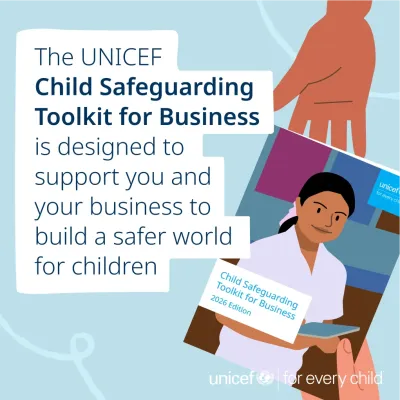
Child Safeguarding Toolkit for Business (2026) ENG | FR | SP | CH | PT | AR | PL
Child Safeguarding Toolkit for Business (Mexican adaptation)
Child Safeguarding Toolkit for Business Self-Assessment | SP
Annex 1 – Risk Assessment Template | SP
Annex 2 – Gap Analysis Template | SP
Annex 3 – Child Safeguarding Policy Checklist | SP
Developing a child safeguarding programme
Developing an effective child safeguarding programme includes five key steps:
Step 1. Conduct a child safeguarding risk assessment that reveals the ways in which employees and partners acting on behalf of the company come into contact with children.
Step 2. Conduct a gap analysis of existing policies, processes, and governance structures and develop additional structures and guidance to fill relevant gaps in safeguarding children.
Step 3. Develop a policy commitment that outlines your company’s commitment to keep children safe from abuse and maltreatment by its employees and partners acting on its behalf.
Step 4. Develop an implementation plan to meet the commitments outlined in the safeguarding policy.
Step 5. Establish a reporting structure for safeguarding concerns and support employees to take action when they identify a concern.
A1
Carrying out at an assessment is the first step to understanding the risks your business activities might pose to children’s safety and wellbeing. This includes through any interaction with the company, its employees or its representatives.
The goal of this assessment is to identify all contact that individuals in your company have with children as part of their job responsibilities, and to consider the potential risks of each type of contact.
Conducting a gap analysis of your existing policies, processes and governance structures that support the safeguarding of children, will help you to identify where your gaps are and develop additional structures to fill those gaps.
This step will help your business to understand the extent to which child safeguarding has been integrated into its risk management approach. This includes:
- Understanding the legal requirements with respect to protecting children in the context of your business operations,
- Have a better idea of how your company is meeting your safeguarding responsibilities in practice.
Develop a policy commitment that outlines your company’s commitment to keep children safe from harm. Your company’s safeguarding policy should:
- Include a statement of commitment
- Articulates what will be done to protect children from harm
- Highlights governance structures and responsibilities for safeguarding
- Communicate reporting structures and how your company will respond to safeguarding concerns.
In addition to the policy, a Code of Conduct for employees and partners clearly states the expected and inappropriate behaviours around children, which all company personnel should read and sign.
Develop an implementation plan to meet the commitments outlined in the safeguarding policy.
To communicate that safeguarding is a priority for your company, senior management must take ownership of and continually support embedding safeguarding into all company activities. This includes:
- Developing a governance structure and nominating a child safeguarding focal point.
- Establishing a network of child safeguarding leads across your business.
- Centre safeguarding into human resources activities, including recruitment and training.
- Raising awareness to promote a safeguarding culture in which all concerns are responded to.
Signs of a strong and positive safeguarding culture:
- Colleagues prioritise safeguarding training and engage in awareness raising programmes
- Colleagues proactively reach out to the safeguarding lead with questions and start risk assessing activities themselves
- Child rights and safeguarding messages are integrated into communications
- Safeguarding materials and resources are distributed, and colleagues know where to find them
- Reporting mechanisms are clear, and colleagues know how to use them
- There is a practice of continual learning and improving safeguarding activities
Establish a reporting structure for safeguarding concerns and support employees to take action when they identify a concern.
Establish a reporting structure for actual and potential cases of abuse to be received and processed.
The most important message for all company personnel is:
- Any concerns that arise should always be reported
- The employee should not decide whether harm has taken place
- What matters is that the concern is passed onto the right person
All employees need to know who their designated safeguarding lead is, and this person’s duty to escalate concerns. Your company should also build a clear mechanism for individuals to report actual and potential safeguarding concerns about children, and communicate the structure for processing concerns, including:
- When there is a concern about a child, how both the organsiation and an employee should respond.
- The employee responsible for receiving the reported concerns, and taking action after receiving a report.
- The overarching principles behind the reporting system.
When it comes to responding to the concern, the focus should always be on the child’s immediate safety and wellbeing.
All employees should be taught how to take relevant action when a concern is or needs to be reported.
This step highlights the concrete actions that a company should take after a child safeguarding concern has been raised. This includes:
- What action to take in an emergency
- Who to report a concern to
- How to ensure there is accountability when responding to a safeguarding concern
Documenting the concern and action steps and storing the information securely.
Conclusion
Successful child safeguarding in business operations and work practices is an ongoing journey that involves continuous review and revision of policies and implementation.
At the heart of the effort is a company culture that identifies child safeguarding as a business priority and recognizes that the responsibility of putting child safeguarding policies into practice lies with every individual involved in your company.