

The Urgent Need for Child Road Safety
Road crashes kill more children and young people aged 10–19 than any other cause in Cambodia. But road deaths can be stopped. Action protects lives now.

- English
- Khmer
In Cambodia, life moves on wheels of every kind. Motorbikes weave through traffic carrying entire families. Colourful tuk-tuks ferry passengers through busy intersections. Cars and trucks share narrow streets with cyclists and pedestrians. From two wheels to four, vehicles fill roads that buzz with constant movement as people travel to work, children head to school, and vendors transport goods to the market.
With motorbikes making up 85 per cent of all vehicles on Cambodia’s roads1, families are more exposed to danger than in most countries. Unlike cars with protective shells, motorbike riders face traffic with only helmets for protection—and too many ride without even that basic safety gear. This overwhelming reliance on two-wheeled transport means that when crashes happen, the consequences are often deadly.
But too many of these daily journeys end in tragedy.
Road crashes kill more children and young people aged 10–19 than any other cause in Cambodia.2 Every day, five people die on Cambodia’s roads. Children and young people pay the heaviest price.
These numbers are futures cut short. They are families broken forever. They are communities left grieving and economic loss.
The time to act is now.
The Numbers Tell a Devastating Story
Cambodia faces a road safety emergency.
- Road crashes are the top killer of young people age 15–29.2
- For children aged 10–14, road crashes are the second biggest killer.3
- Five people die on Cambodia’s roads every single day.1
- 85 per cent of vehicles on the road are motorbikes—many carrying children without helmets.
- In 2023, 3,317 road crashes killed 1,590 people and injured 4,515 others.
- Road crashes cost Cambodia US $466.8 million in 2019 —1.7 per cent of the country’s GDP.1
Behind each number is a child who should be in school. A teenager planning their future. A family that will never be whole again. Many victims die waiting for help that comes too late.
Progress Saves Lives
Even during this crisis, Cambodia proves that action saves lives. From 2023 to 2024, road crashes dropped by 14 per cent to 2,844. Deaths fell by 5 per cent to 1,509. Injuries dropped by 17 per cent to 3,720.
This progress shows that when Cambodia acts, children live. But we must understand why children still face such danger. Only then can we save more lives.
Why Cambodia’s Roads Are Deadly for Children
Cambodia is growing fast. More vehicles crowd roads that weren’t built for today’s traffic. With 85 per cent of vehicles being motorbikes (compared to much lower rates in most countries), children face unique threats:
- Limited safety knowledge means children can’t spot road dangers or protect themselves.
- Improper use of roads means no safe spaces for people walking, cycling, or riding motorcycles.
- Missing safety measures around schools puts children at greatest risk.
- Widespread helmet neglect leaves children’s heads unprotected in a country where motorcycles rule the roads.
- Adults neglecting safety measures put children who rely on them at risk of road crashes.
This creates a generation where simply walking to school can be deadly. Cambodia now fights back with proven solutions that save lives.
Cambodia's Road Safety Solutions
Cambodia's national road safety efforts, led by the National Road Safety Committee, Ministry of Public Works and Transport, and other government institutions with support from UNICEF, tackles this crisis through some measures:
Solution 1: Teaching life-saving skills to every family
Knowledge turns dangerous roads into safer spaces. Cambodia's campaign teaches children, parents, and communities through:
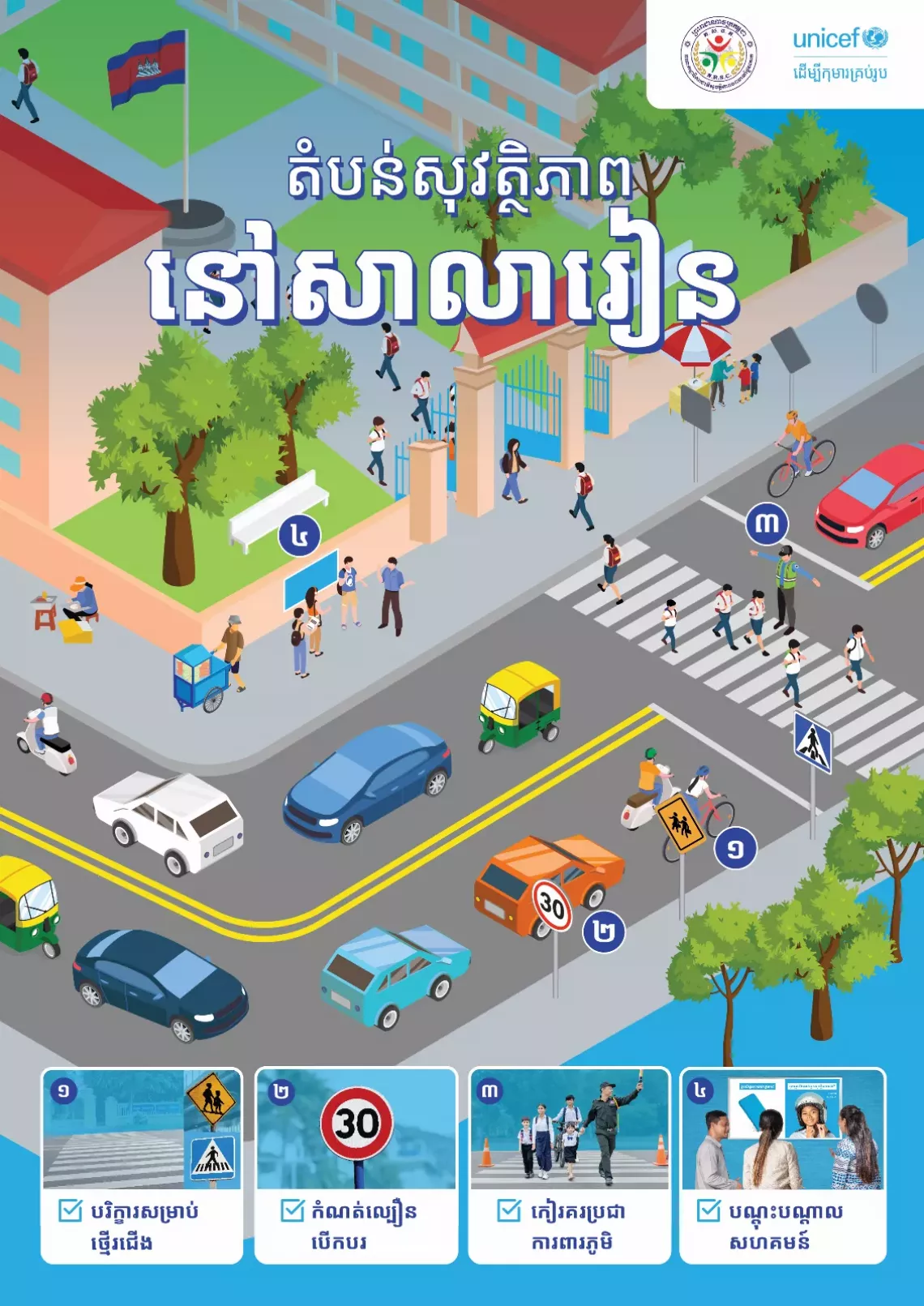
- Safe School Zone programme that pioneers the establishment of road safety around school zone.
- On-site education that targets school community which includes teachers, students, parents and caregivers as well as local authorities to have better knowledge and change their at-risks behaviours.
- Online awareness raising using social media platforms to get message across.
Solution 2: Creating Safe School Zones where children gather
Cambodia protects children where they gather most. The measures should include:
- 30 km/h speed limits in school zones with strict enforcement students enter and exit school.
- Clear zebra crossings, speed calming, street markings, and traffic signs at every school zone.
- Trained safety monitors at crossings, using school staff and local volunteers.
Solution 3: Enforcing road traffic laws that protect lives
Strong laws mean nothing without strong enforcement. Cambodia saves lives by actively enforcing critical safety regulations:
- Mandatory helmet use for all motorbike riders, with real consequences for those who don't comply.
- Zero tolerance for phone use while walking, biking, riding motorbikes, or driving any vehicle.
- Strict speed enforcement in school zones and residential areas where children live and play.
- Regular safety inspections to ensure vehicles meet safety standards.
- Immediate penalties for dangerous driving behaviors that put children at risk.


5 Essential Practices That Protect Lives Today
Every parent, driver, and community member must act now:
1. Stop, Look and Listen
Train children to stop completely before crossing roads, look both ways for traffic, and listen for vehicles they can't see. Practice this even when roads look empty. Automatic habits save lives when seconds matter.
2. No Helmet, No Ride
Every person on a motorbike must wear a proper helmet. With 85 per cent of Cambodia's vehicles being motorbikes, helmets aren't optional. Good helmets reduce serious head injuries by up to 70 per cent. No helmet? Don't get on the motorbike.
3. Watch Young Children Like Hawks
Never let children under 7 near roads alone. Hold their hands tightly when crossing streets. Keep children on the side away from traffic. Practice safety at home too—driveways can be dangerous.
4. Stay Visible, Stay Alive
Dress children in bright colours, especially when it's dark or rainy. Make sure bicycles have helmets, lights, and reflectors. Drivers can only protect what they can see.
5. Remove Distractions, Save Lives
Eyes on the road—put phones away while walking, biking, riding motorbikes or driving three or four wheels. Take off headphones near traffic. Focus completely on the road. Teach teenagers to say no to risky behaviour around roads.
These personal actions save lives today. But lasting change needs bigger solutions.
Beyond Individual Action: Advocating for Systemic Change
Individual safety practices save lives, but lasting protection requires systemic improvements. Support community efforts to:
- Enforce 30 km/h speed limits on streets near schools
- Build separate paths for people walking and cycling
- Teach road safety in schools with hands-on training
- Strengthen helmet laws with proper enforcement for all motorbike riders
Road deaths can be stopped. Action protects lives right now.
Cambodia's progress proves that when the country acts decisively, deadly roads become safe passages. Together, we can build a country where no parent fears for their child's safety on the roads. Slow down, stay alert, and take action—because road safety starts with you!
Campaign materials—including posters, billboards, TV spots, and social media content—are available for download and ready to use: https://unicef.link/43aFDXx
Learn more about road safety :
1 Road Traffic Accidents in Cambodia 2021
2 Global status report on road safety 2023
3 Cambodia Road Safety Programme (2024)