New teaching methods transform learning for young students
A new early grade learning method that introduces new teaching and learning materials, classroom management techniques and educational games help children get the best possible start in school

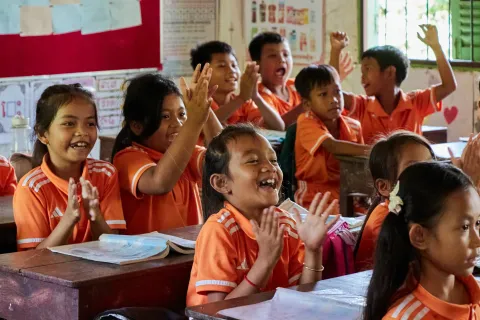
31 May 2023, Stung Treng – Seven-year-olds Sovandara Lima and Prey Haraty are excited to begin their maths lesson. Today they are working on their addition, but instead of just copying down exercises from the whiteboard like they would have been doing last year, they’re choosing the sums themselves. The game involves picking facedown flashcards at random to create two two-digit numbers that they must then add together, no matter how difficult.
Sovandara is clearly up for the challenge. “If we have a lot of friends and we play together it makes us feel better,” he says about being able to play games in class.
Sovandara and Haraty are the only two students in the classroom today at Kom Phon Primary School, but that’s because the lesson is not part of their regular classes. The kids, who live in Sesan district in Stung Treng province, are taking part in a demonstration for a new early grade learning (EGL) methodology that is transforming how literacy and mathematics are being taught across the country. Today’s training covers Grade 2 mathematics, which is supported by the Capacity Development Partnership Fund (CDPF), a partnership between the EU, USAID, Global Partnership for Education (GPE), the Swedish International Development Cooperation Agency (Sida), UNICEF, and the Ministry of Education, Youth and Sport (MoEYS).
Rolled out by the MoEYS with support from the CDPF and other development partners, the new methodology aims to move children away from rote learning to activities that keep them engaged, excited and able to learn – it promotes learning through interactive games, encourages more teacher-student and student-student contact, and introduces new classroom management techniques that positively engage students who may misbehave and help teachers separate students according to ability level. Kids are given a range of materials to support their learning, including textbooks, storybooks, and take-home workbooks. Teachers are also provided with a teaching guidebook that contains step-by-step lesson plans for each part of the curriculum as well as interactive teaching aids like flashcards.
“I like it. It’s beautiful and colourful and I can read it,” says Sovandara of the new workbooks. Compared with the at-home learning implemented during COVID-19, when teachers delivered print-outs of worksheets to students at their homes, the new materials are more comprehensive, follow a student-centred approach, and are full of engaging illustrations that help demonstrate and consolidate learning. The hope is that the resources can support students both in the classroom and at home, help build back the foundational learning that very young students missed out on during the pandemic and ultimately improve learning outcomes over the long run.
Both Sovandara and Haraty are two of the many indigenous Laos students at the school. As they speak Laos at home, their mothers say that they found it challenging to support their children’s learning during the pandemic.
“I could not help my daughter because I cannot read and write,” says Haraty’s mother, Am Nang. “She is the only daughter in the family. She has no older sibling to help her. I am happy she is back in school.”


The materials and trainings have come at a critical time, as now teachers can differentiate between different ability levels in the classroom and help students catch up on their learning.
“The old method could only help those who are already outstanding,” says Grade 2 mathematics teacher Nheu Yicheka, explaining that before they only used one textbook and students would have to copy down small exercises from the board into their notebook.
“That was not so fun. Those who are not good performance students tend to be isolated, do not improve much and might drop out. With this method, I can differentiate between them. When the outstanding students are busy with their classwork, I can support the low performance students with other exercises and educational games.”
Since implementing the new method, first in literacy in 2021 and this year in mathematics, the school has already seen an encouraging decrease in the number of students dropping out – a positive start towards transforming the improvement in foundational learning into improved learning outcomes in later years and increased opportunities in life.

As a recent Grade 6 National Learning Assessment indicates, most Cambodian children continue to face challenges in mastering basic literacy and numeracy skills, with 45 per cent of Grade 6 students failing to attain minimum proficiency in Khmer and nearly three-quarters of them failing in mathematics. These numbers reveal the severe decline in performance caused by the pandemic. To respond to this learning loss and help ensure that all students in the lowest grades of primary education gain basic competencies in numeracy and literacy before they advance to higher grades, the MoEYS Primary Education Department has developed a comprehensive EGL strategy. The CDPF and other key partners are coordinating their support to MoEYS, ensuring a harmonised roll-out of EGR and EGM across the country using the same package of materials and training. To date, 19 provinces have been reached with Grade 1 literacy interventions, with a goal of reaching all provinces by 2025.
For the 2022/23 school year, the CDPF supported MoEYS to expand early grade reading to more than 1,500 primary schools in eight provinces, with a focus on Grade 1, and early grade mathematics to almost 900 primary schools in four provinces, with a focus on Grade 2. More than 113,000 students are benefitting. Grade 1 and 2 teachers as well as primary school directors, school-based mentors, master mentors, Provincial Offices of Education (PoEs) and District Offices of Education (DoEs) in target provinces are being trained on teaching and learning methodologies for early grade reading and mathematics in addition to facilitation skills, classroom management and gender responsive pedagogy.

The lesson plans and teaching guidance provided to teachers aim to make it easier for them to ensure they are covering each part of the curriculum, says trainer Lay Chinda. While most teachers are eager to incorporate certain parts of the new method, especially the interactive games, others have been more unwilling to change their teaching style after decades in the classroom as it requires them to organise their lessons and manage their classrooms by following steps that may be unfamiliar to them. “It’s hard to change their mind-set sometimes,” she says.
To support the integration of new methods, the MoEYS has also set up a comprehensive mentoring system to ensure teachers have all necessary support to understand and implement EGL in their classrooms.
Though Nheu Yicheka disagrees that it’s too challenging.“I feel like this teaching methodology is more natural,” she says.
“I feel confident using the step-by-step guide because the lesson goes smoothly. Both teachers and students are more proactive and motivated in classroom activities. With the new materials, it’s easier to teach them. I enjoy teaching more and I am happy to see the students doing better.”