Up against online predators, young people stay safe
Over 160,000 children in Cambodia have experienced online sexual abuse and exploitation. Supported by UNICEF, youth are learning how to protect themselves from the very real risks of the internet

- English
- Khmer
29 May 2025, Battambang – Best friends Kolap and Romdoul* love social media. They’re just like so many other young people in Cambodia – they take selfies to post on their stories, they watch and share funny reels, they film and post a day in my life videos for fun, even if they only ever get a couple of hundred views.
They both have around 5,000 friends on Facebook, and they’re no stranger to receiving messages online from people they don’t know.
“I reply if I think that person looks trustworthy,” says 16-year-old Romdoul. “But if I reply and they seem weird, I block them.”
Most of the messages come from men. “After chatting for a bit, they start flirting. They ask for photos,” says 15-year-old Kolap. “They are perverts.”
They know never to agree to such a request, the girls say, and they quickly block any profiles that make them feel uncomfortable.
In other cases, if they don’t spot any immediate red flags, the conversation continues, and the connection slowly builds. Romdoul and Kolap have both started online relationships with boys they’ve never met. They even shared with their boyfriends the log in details, including the password, for their social media accounts, a common gesture of trust among Cambodian adolescents.

Romdoul says she would share selfies with her then-boyfriend, but he never asked for more than that. They never met in person, and when they eventually broke up, she blocked him and changed all of her passwords to make sure she was safe.
“I was afraid of getting scammed, or that he’d hack into my account and use it with bad intentions,” she says. “Now I’ve stopped chatting with random strangers. Girls need to be more careful when trusting people online.”
Young people in Cambodia are spending more time online than ever before. Almost three quarters of the population were active social media users in January 2025, while more than 80 per cent of children aged 12–17 are internet users.1
But alongside the limitless opportunities offered by the internet are very real dangers that threaten to cause long lasting damage to the country’s youth. In Cambodia, 11 per cent of internet-using adolescents aged 12–17 have experienced online sexual exploitation and abuse (OCSEA).2 This equates to 160,000 children manipulated to share images or videos of their private parts or threatened and blackmailed to engage in sexual activities online.
The same report found that 16 per cent of children have received unwanted sexual comments, primarily through social media, 16 per cent of children have been sent unwanted sexual images, and 9 per cent of children have faced requests to share sexual images of themselves. Many cases likely go unreported.
Until recently, Kolap and Romdoul have followed their instincts to keep themselves safe online, but a few months ago the girls started learning more about the very real dangers of the internet. A new UNICEF-supported course on online safety at their school has been teaching them what they unknowingly risk when they connect with strangers online and when they share personal information, photos and passwords. Together with their classmates, they’ve been learning how to protect themselves from becoming victims of online scams, cyberbullies, cybercriminals and hackers, and – worst of all – online sexual predators.

Nowadays, the two girls insist that they don’t accept friend requests from strangers, always checking the profile first to see who they are. They’re more careful about who they speak to on the internet, and Kolap has made her social media accounts private.
“The course taught us about online risks like sextortion, and that if I encounter any problems, I can contact APLE,” she says, referring to a UNICEF partner that provides a free hotline for victims to anonymously report online abuse and seek support. “After learning this, I set the privacy to only friends, because I think that setting it to public is not safe.”
The course has been integrated into the Local Life Skills Education curriculum for Grades 7, 8 and 9 in more than 100 schools across four provinces. It’s based on the Child Online Protection Teachers Training Manual, which was developed by the Ministry of Education, Youth and Sport, with support from UNICEF and partners including Action Pour Les Enfants (APLE), and with funding from Safe Online and the Government of Australia.
The manual aims to empower educators with essential tools to help children and adolescents navigate the digital world safely, speak up if they encounter any problems, and seek assistance or support services if they ever need to. So far, more than 300 teachers have been trained on topics such as digital literacy, children’s rights in the digital environment, online risks for children, the five forms of OCSEA, online safety tips and how to report abuse. As a result, 34,000 students have benefited from the programme.
More than 6 million people have also been reached online through UNICEF campaigns aimed at preventing and protecting children from online sexual predators and exploitation and helping them and their families navigate the digital world safely.
“Before, the students were not very aware of the content they shared online,” says Local Life Skills Education teacher, Hanh Rathana. The students liked chatting with foreigners so they could improve their English, but many accounts turned out to be fake.
“After teaching the online safety tips, they were more aware. When they receive a friend request from a stranger, they don’t accept it immediately. They will go through the account to see if it’s a real person or not.”
While the course only targets Grades 7, 8 and 9, the school knows how relevant the content is to protect the whole community.
“We encourage the students to share what they know with other friends and family as well,” says Rathana. He’s happy to see the younger students passing on what they learn with the older students who missed out on the course, while the school has also hosted sessions for parents to help them understand how they can better protect themselves and their children.
“And it’s not just their child that’s important. Every child is important. So we encourage the parents to spread awareness to other family members as much as possible.”
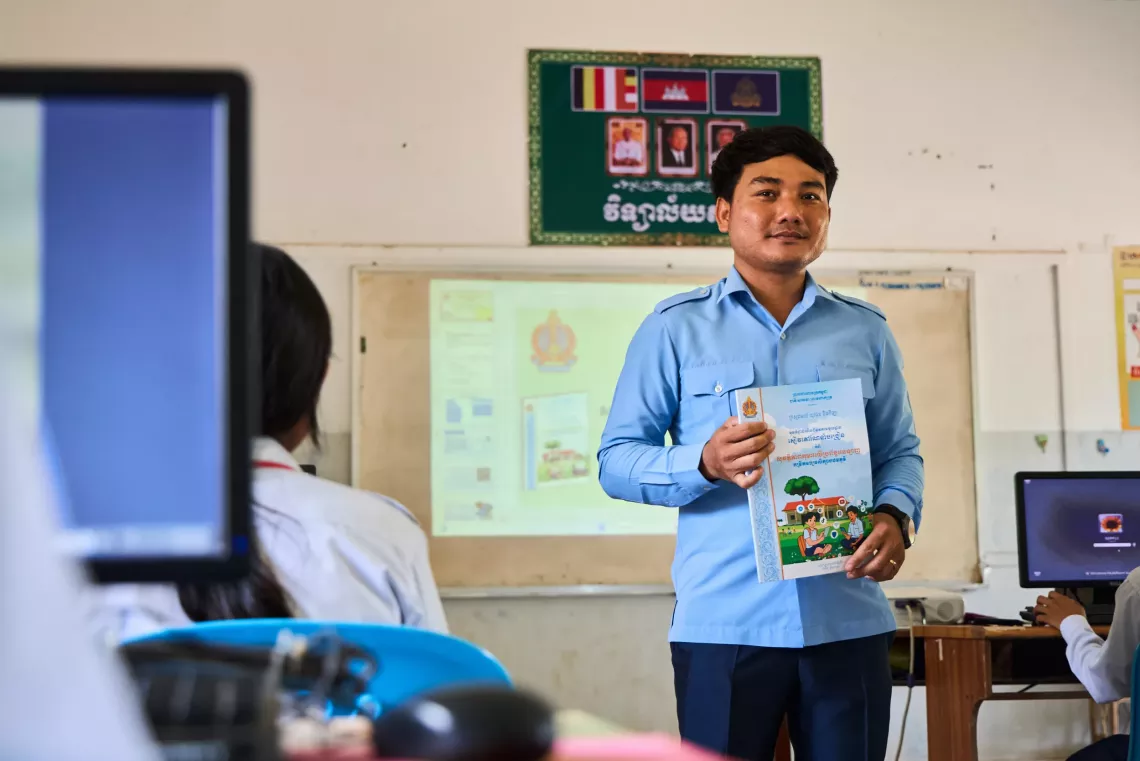
School director Soeung Sonay says teaching students from an early age, when they are just beginning to explore the digital world, will help protect them from falling victim to the most traumatising kinds of online abuse. So far, the school hasn’t heard of any serious harm coming to one of their students as a result of their experiences online. He hopes it will stay that way.
“The school is trying to teach the students in advance, so we can prevent this from happening,” says Sonay.
Romdoul and Kolap also haven’t heard of such cases happening to any of their peers, but they know the potential consequences if it does.
“We’ve seen young people on the internet getting nude photos leaked,” says Kolap. “This could lead to mental health issues, even suicide.”
She says her father is also active on social media and likes to post photos of her and her siblings. He used to tag their location each time until she told him it’s better to be safe.
“I told my father that it’s not good to show where we are,” she says. “It might be dangerous.”
And when she posts her own day in the life videos, she’s careful not to give away too much information.
“I want young people like me to be more careful online.”
*Names have been changed to protect the young people involved
1 Disrupting Harm, 2022
2 Disrupting Harm, 2022