

Cambodia accelerates cervical cancer prevention through HPV Multi-Age-Cohort Vaccination Campaign for adolescent girls
- English
- Khmer
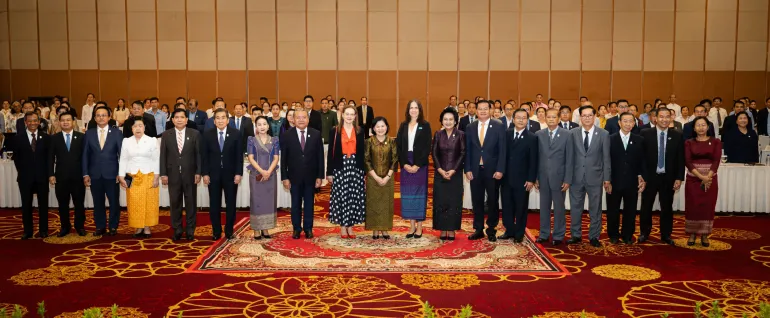
Phnom Penh, 10 November 2026 – The Royal Government of Cambodia, through the Ministry of Health and the National Immunization Programme (NIP), today launched a nationwide Human Papillomavirus (HPV) Multi-Age Cohort (MAC) vaccination campaign, which vaccinates multiple age groups of adolescent girls at the same time, and catch-up vaccination, expanding protection against cervical cancer for adolescent girls across the country.
Cervical cancer remains a major public health challenge in Cambodia and is the second leading cancer among women of all agesi. Nearly all cervical cancer cases are linked to persistent infection with high-risk human papillomavirus, making HPV vaccination one of the most effective preventive measuresii. Together with cervical cancer screening and early treatment of precancerous lesions, HPV vaccination forms the cornerstone of global efforts to eliminate cervical cancer as a public health problem.
Building on the successful introduction of HPV vaccine into Cambodia’s National Immunization Programme in 2023, the campaign will be implemented alongside routine HPV vaccination for 9-year-old girls. It will provide free HPV vaccination to all girls aged 13–14 years, while offering catch-up vaccination for girls aged 10–12 years who may have missed vaccination through the routine programme in 2023–2025. This catch-up approach is intended to close remaining immunity gaps and ensure protection for girls who were not vaccinated when eligible. In line with WHO recommendations, a single dose of HPV vaccine provides strong and durable protection against HPV infection and cervical cancer. To maximize coverage, the nationwide campaign will be implemented in two phases from November to December 2026. The campaign reflects Cambodia's continued commitment to preventing cervical cancer and ensuring healthier futures for women and girls.
Implementation is being coordinated in collaboration with the Ministry of Education, Youth and Sport (MoEYS), national and subnational government authorities, and community partners, with support from Gavi, the Vaccine Alliance (Gavi), the World Health Organization (WHO), the United Nations Children’s Fund (UNICEF), and the Clinton Health Access Initiative (CHAI).
Launching the campaign, H.E. Professor Chheang Ra, Minister of Health, reaffirmed Cambodia's commitment to protecting future generations from cervical cancer.
"Every girl deserves protection from cervical cancer. By expanding HPV vaccination opportunities across the country, we are ensuring that girls who missed previous opportunities can still benefit from this safe, effective and life-saving vaccine. We appeal to parents, caregivers, teachers, health workers and local authorities to work together so that every eligible girl can be reached and protected."
The campaign will be delivered through coordinated school-based, community-based, and health facility-based vaccination approaches. Vaccination teams will work closely with teachers, Village Health Support Groups, local authorities and community leaders to identify and reach all eligible girls, with particular focus on those who are absent from school or living in hard-to-reach communities.
“HPV vaccination is one of the most effective tools for preventing cervical cancer,” emphasized Dr Marianna Trias, WHO Representative to Cambodia. “WHO recommends vaccinating girls aged 9–14 years, before they are exposed to HPV. By expanding vaccination opportunities for girls up to age 14, Cambodia is accelerating progress towards eliminating cervical cancer while safeguarding the health and well-being of future generations.”
The central objective of the campaign is to ensure that no eligible girl is left behind, especially girls who are out of school and living in remote and hard-to-reach communities. Community engagement, social mobilization, school participation and local leadership will play central roles in helping families understand the benefits and safety of HPV vaccination and know when and where vaccination services are available.
"Every eligible girl should have access to HPV vaccination, regardless of where she lives or whether she attends school," said Ms. Maha Damaj, UNICEF Representative to Cambodia. “Reaching those most at risk of being left behind is essential to ensuring that protection against cervical cancer is available to all,” she added.
The campaign also draws on lessons learned from previous HPV vaccination activities in Cambodia, particularly in identifying eligible girls, strengthening microplanning, improving community engagement and ensuring accurate monitoring throughout implementation.
"Cambodia has already demonstrated strong leadership in introducing HPV vaccination," said Mr. Lan Mao, acting Director of CHAI Cambodia. "This campaign builds on that success by strengthening the systems needed to identify, reach and vaccinate all eligible girls, particularly those who may otherwise be missed."
National HPV vaccination programmes are now established in more than 162 countries worldwide, protecting millions of lives. In low- and middle-income countries, Gavi-supported efforts have protected 95 million girls, preventing an estimated 1.9 million future deaths from cervical cancer. HPV vaccination is among the most impactful interventions Gavi supports, averting an estimated 13 deaths for every 1,000 children vaccinated.
“We commend the Government for its outstanding partnership and its efforts to control cervical cancer through investments in screening, treatment, and prevention programmes. This campaign demonstrates what is possible when national leadership is matched by sustained investment,” said Priya Gajraj, Director, Core Countries at Gavi. “HPV vaccination is among the most impactful interventions Gavi supports. With more than USD 3 million in funding for this campaign, which aims to protect more than 700,000 girls in schools and communities, Gavi reaffirms our commitment to support Cambodia in its efforts to build stronger links between adolescent girls and essential health services.”
The multi-age cohort campaign and catch-up vaccination, together with routine HPV vaccination, will help close immunity gaps, increase protection against HPV infection, and contribute to Cambodia's long-term goal of eliminating cervical cancer as a public health problem throughout the country.
Notes to editors:
Gavi supports lower-income countries to introduce and sustain national HPV vaccination programmes by financing vaccines, delivery and campaigns, strengthening immunization systems and technical assistance, and helping shape a more secure and affordable global vaccine market. By the end of 2025, Gavi had supported 53 countries to launch national HPV programmes, fully immunizing more than 95 million girls and helping avert an estimated 1.9 million future cervical cancer deaths. Through its wider HPV programme, Gavi is working with countries and partners to expand equitable coverage, reach girls missed by school-based services and integrate vaccination into broader adolescent health efforts. More here.
Media contacts
For further information please contact:
National Immunization Program, Ministry of Health
Mr. Ork Vichit
Tel: + 855 12 830 548
Email: [email protected]
Gavi
Eunice Kilonzo-Muraya, Gavi
Tel: +41 76 424 85 03
Email: [email protected]
Cirũ Kariũki
Tel: +41 79 913 94 41
Email: [email protected]
About Gavi
Gavi, the Vaccine Alliance is a public-private partnership that helps vaccinate more than half the world’s children against some of the world’s deadliest diseases. The Vaccine Alliance brings together developing country and donor governments, the World Health Organization, UNICEF, the World Bank, the vaccine industry, technical agencies, civil society, the Gates Foundation and other private sector partners. View the full list of donor governments and other leading organizations that fund Gavi’s work here.
Since its inception in 2000, Gavi has helped to immunize a whole generation – over 1.3 billion children – and prevented more than 23 million future deaths, helping to halve child mortality in 78 lower‑income countries. Gavi also plays a key role in improving global health security by supporting health systems as well as funding global stockpiles for Ebola, cholera, meningococcal, mpox and yellow fever vaccines. After more than two decades of progress, Gavi is now focused on protecting the next generation, above all the zero-dose children who have not received even a single vaccine shot. The Vaccine Alliance employs innovative finance and the latest technology – from drones to biometrics – to save lives, prevent outbreaks before they can spread and help countries on the road to self-sufficiency. Learn more at www.gavi.org and connect with us on Bluesky, Facebook, Instagram, LinkedIn, TikTok, X and YouTube.
About WHO
The World Health Organization (WHO) works in close collaboration with the Royal Government of Cambodia, particularly the Ministry of Health, as well as other relevant ministries, international development partners, and nongovernmental organizations to improve the health and well-being of the Cambodian population.
WHO provides technical expertise, strategic guidance, and public health support to strengthen the country’s healthcare system and public health programmes. These efforts aim to improve access to quality healthcare, promote health equity, and ensure better health outcomes for all Cambodians, with particular attention to poor, vulnerable, and underserved communities.
About UNICEF
UNICEF works in some of the world’s toughest places, to reach the world’s most disadvantaged children. Across more than 190 countries and territories, we work for every child, everywhere, to build a better world for everyone.
For more information about UNICEF and its work in Cambodia, visit: www.unicef.org.kh
Follow UNICEF in Cambodia on Facebook | X | YouTube | Instagram | LinkedIn | Threads | TikTok
About CHAI
The Clinton Health Access Initiative, Inc. (CHAI) is a global health organization committed to saving lives and improving health outcomes in low- and middle-income countries by enabling the government and private sector to strengthen and sustain quality health systems. For more information, please visit: www.clintonhealthaccess.org


