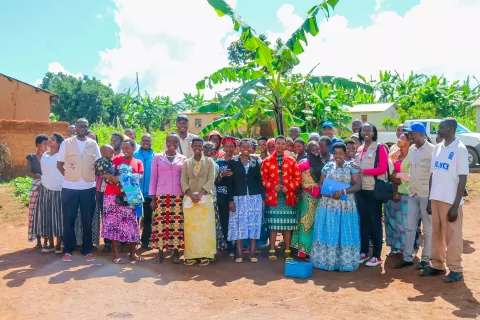
Child trafficking: Xavier and Lenka share their stories
Burundi is a trafficking hotspot, where victims are exploited domestically and externally. External trafficking often affects natives of border provinces such as Muyinga, Makamba and Ngozi

- English
- Français
We will dive into the story of Xavier and Lenka[1]. They are from the same village, a commune called Ruhohoro, within the Ngozi province.
Xavier, 17 years old, abandoned school because his parents could not afford his fees. He recalled that sometimes, his family would go to bed hungry because of their dire financial situation. Tired of this life, he sought a way out. Mr. Jean Claude, a man in his neighborhood had told him that he could afford a better life, and greener pastures in Tanzania. With this information, and with no notice to his friends or family, Xavier took off with this man.
Upon getting to Tanzania, he worked as a domestic aid for three months without salary; his employer directly gave payment to Mr. Jean Claude. Whenever Xavier asked for his remuneration, he was met with violent words and curses, and he tried reaching out to Jean Claude regarding this issue but was informed that the man had left for Congo.
I remember one day, after working for my employer for 2 months, I asked for my salary again. He went straight to insulting me, calling me a thief. He said ‘that is how Burundians are, they will ask for their salaries knowing that the money was given to their guardians’
I tried to reach out to Mr. Jean Claude to no avail, I asked my employer for his number, but I was met with more insults and frustrations, I had no way out. At the recollection of these memories, tears begin to flow.
Frustrated, Xavier made the wise decision to return to Burundi. Upon getting to his home country, he was approached by the local administration of the commune of Ruhororo who, with the community-based Child Protection Committee, reached out to Fondation Stamm, UNICEF’s partner organization, for their support.
During conversation with the Fondation Stamm focal point, Xavier was asked what he wanted to engage in now that he was back in the country: would he want to go back to school or to learn a trade? He agreed to the trade. The organization prepared a hairdressing training session for young people, many of whom like Xavier were child trafficking victims.
He, additionally, joined a solidarity group with his peers. These solidarity groups are savings and loan associations whose members contribute an agreed sum on a weekly basis which is pooled together to invest in an income generating activity and to provide micro credit to members. This solidarity group got together with other solidarity groups to form a cooperative.
“I am very thankful to Fondation Stamm for all the support they brought to me. Today, I am able to work and save up for my future, and especially help my family. I do not want my siblings to endure the same tragedy I endured, so I am working to help send them to school,” says Xavier, works at a hairdressing saloon financed by the cooperative, where he earns a living and currently rears pigs thanks to an additional skill he learned and implemented with the support of the Fondation Stamm.
From external to domestic trafficking, the other side of the same tragedy

Lenka dropped out of school at age 14 and therefore decided to start working. A neighbor shared with her a “work opportunity” in Gitega and recruited her when she was only 16. The young girl travelled to the capital city and embarked on this “work opportunity”, without any safety net and expecting to earn enough money to help her family back home.
Lenka worked for six months without payment, awaiting to receive the due earnings. After six long months without pay, she was beaten up by her employers and dismissed from her work only because she demanded to be paid.
Lenka, by then 17 years old, fled Gitega and decided to return to her family again, hoping they would welcome her back, without any of the earnings she had hoped to bring back.
Upon her return to the Ruhororo commune, UNICEF’s partner organization Fondation Stamm learnt about her story. After receiving psychosocial assistance, Lenka wished to join a cooperative with other young members and was encouraged by a youth supervisor to choose a profession among several options available. Lenka set her sights on the hairdressing profession and joined other young people working at a hairdressing salon established with the support of Fondation Stamm, within a building powered by solar panels. Thanks to the solar panels, the young people manage to have an income not only from the hairdressing salon, but also from a mobile charging point and a food shop established within the building.
Her integration into the cooperative and social reintegration in the community helped her, her family but also many members of her community. Thanks to Lenka's testimony, as well as other young members of the cooperative who were victims of trafficking and who support each other, awareness was raised about the signs, risks and consequences of trafficking.
Xavier, Lenka and many other children like them were assisted through the UNICEF-Fondation Stamm project “Solidarité Communautaire pour la Protection des Enfants et Reintegration Socio-économique des Filles Socialement Marginalisées” funded by USAID. The project was launched in 2018 in the provinces of Bujumbura, Ngozi, and Rumonge.
[1] Both names are fictional in order to protect the persons involved.