A new Dawn in Puerto San Lorenzo
The Journey of Solar-Powered Hope

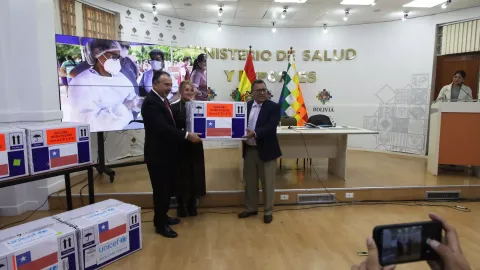
Thanks to UNICEF and the Government of Canada there is now a working solar-powered refrigerator in the community of Puerto San Lorenzo, south of the Indigenous Territory Isiboro Secure National Park (TIPNIS). Such refrigerators provide vital support for the COVID-19 vaccination system in remote localities that do not have access to the electric grid. The support provided through the CanVAX grant made it possible to purchase these refrigerators and transport them to remote communities in the Bolivian Amazon.
For years, maintaining vaccine quality was a gamble against time and elements, hinging on the unreliable supply of propane gas canisters. But that was about to change.
Was it a miracle? Frequently this is the name we give to extraordinary human actions. That is what Dr. Iván Gutiérrez Mamani must have thought on October 12, 2023 when, after a six-day trip on a slider boat, the new, solar-powered refrigerator arrived. He had been in charge of Puerto San Lorenzo's healthcare centre for 2 years, and that day looked like the beginning of a new life.
Nestled south of the Indigenous Territory Isiboro Sécure National Park (TIPNIS), this village’s remote location poses daunting challenges. Accessible only via the Sécure River, with no public transportation available, the journey to this secluded community is fraught with difficulty. Phone and internet services are scarce, leaving locals, including 75 children under the age of 11 and 30 adolescents attending the local school, largely isolated from the outside world. Moreover, the area is not connected to the public electric grid, relying instead on local wells and the river for its water supply. Within this backdrop, the health centre’s services, powered by unreliable propane gas canisters, were constantly under threat.
Dr. Mamani, alongside two dedicated nurses, faced the constant threat of vaccines spoiling, jeopardising the health of the 60 Mojeño Trinitario families calling this place home. "We had to get some cork boxes and buy blocks of ice to fill them, and that would keep the vaccines at their ideal temperature for about three days" shared the head of the health centre, his voice reflecting the weight of past struggles. At least four propane canisters were needed every month to keep the vaccines at the right temperature but in the summer months when temperatures can hover at or above 100°F (34° Celsius), up to seven of them were often necessary to maintain the cold chain.


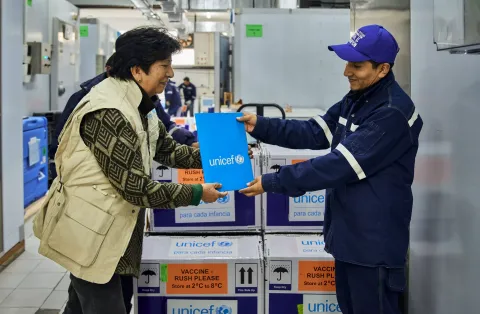
Once in Bolivia, the solar-powered refrigerator left the storage space in El Alto, high up in the Andean region of the country, and made its way to the Amazon.
Despite these hurdles, health coverage is now on the upswing, marking a new chapter for Puerto San Lorenzo. Dr. Gutiérrez Mamani, witnessing the transformation wrought by the new refrigerator, is beyond thrilled and barely can contain tears. Knowing that safe vaccines, including the COVID19 one, will now be readily available fills him with an indescribable joy.
The journey to a new life for this health centre began in Copenhagen, Denmark,in the UNICEF Supply Division warehouses. Thanks to the support of the Canadian Government through the CanVAX grant, which financed equipment, transportation, and logistics, the solar-powered refrigerators began their journey across the ocean on a cargo ship that travelled from Denmark to Chile. From there they crossed the border into Bolivia, until they eventually began their final river journey into the TIPNIS.
On October 6, 2023, four young indigenous community members embarked on a historic mission, navigating the Mamoré, Isiboro, and Sécure rivers. Their voyage, fraught with challenges from sandy winds to unpredictable swells, was a testament to their resilience. With a steady gaze, the young captain Lorgio Moye Mutimo began the voyage without fear, relying on his vast experience. His skill and prowess kept everyone calm during the six-day voyage. At just 26 years old, he had already mastered the different sections of each river and also knew many survival techniques.
The refrigerator reached Puerto San Lorenzo by riverboat, thanks to the expert sailing of Lorgio Moye Mutimo, a member of the Mojeño Trinitario indigenous community.

“Luckily, all our effort wasn’t in vain, and today with this new refrigerator, our community has a guaranteed cold chain storage space, and we won’t have to worry about finding propane canisters anymore,” said Lorgio. “This is a gift to my community, and I am happy to be a part of this story.” His boat carried not just a refrigerator but the promise of a healthier future for the people of Puerto San Lorenzo.
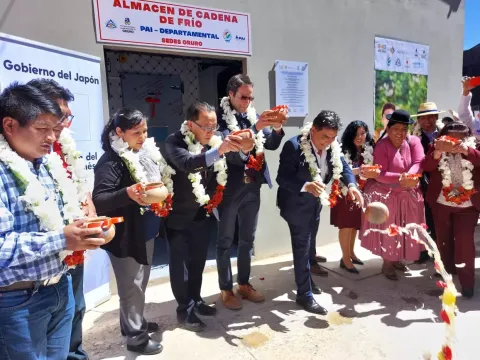
The support provided by CanVAX made it possible to purchase these refrigerators and transport them to remote communities in the Bolivian Amazon. These refrigerators provide vital support for a wide range of vaccinations including the COVID-19 one and are part of the Ministry of Health and Sports' National Expanded Immunization Programme. One of the goals of this programme is to reach more remote indigenous communities with solar-powered refrigerators.