

FROM SOCIAL ASSISTANCE TO SOCIAL ENTREPRENEURSHIP
Social entrepreneurship in Jajce; Homecare assistance for the elderly and infirm, employment and support for able-bodied beneficiaries of social protection

- Bosanski/Hrvatski/Srpski
- English
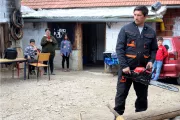
Zahir Talić from the Skela settlement in Kuprešani near Jajce signed up to receive a work overall, work shoes, two chainsaws and a trimmer and is ready, at the invitation of the most vulnerable citizens of Jajce Municipality, to go to the field every day and help them with the work in and around the house that they are not able to do themselves.
"I work and help, I have the equipment and when our beneficiaries need me – here I come. I cut and chop wood, bring it inside, do the painting job. The beneficiaries respond very well, they got used to it, I do whatever they say," Zahir tells us while preparing to leave for one of his field works.
Together with four other participants, Zahir is involved in the provision of the social service - homecare assistance through the Jajce CSW project "Improving the work and activities of the PI CSW in crisis situations and the development of social entrepreneurship and integrated case management in the area of the municipality of Jajce". Homecare assistance is intended for people who, due to age, disability or chronic illness, cannot take care of themselves, nor can family members provide them with the necessary support. Zahir says that he was previously engaged in various jobs and collecting secondary raw materials, but that through this kind of engagement he feels security for himself and his family:
"We live better, now I'm 100 percent secure, I know where I'm going. I don't have to worry like I used to when I worked with iron, every day I worried about whether there would be any work, whether I would be paid for what I do. Now I have a secure place where I go to work, I don't worry about whether I will make money or not, I know that I am going to be safe. I want to work and I'm happy for this opportunity," Zahir tells us, who with his wife Hasnija has three of their five children in school:
"I send my children to school, I buy them school supplies and everything they need, and this has helped me in everything. I would like this project to be expanded, when I could earn a pension for myself, for the children to finish school and to get a better opportunity with their education than I had".
Anelin boasted to us that he is in the third grade, Emanuel is in the fourth, and Hajrija is in the fifth grade of elementary school and says that she likes going to school, and how nice time and fun she had at the workshops organized at the Children's Centre through the project. During the project, Mahmut went to kindergarten, and mom Hasnija would like the youngest Jasko to get a similar opportunity.


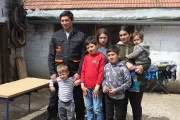

"It was useful for me, Mahmut got the opportunity to go to kindergarten, these schoolchildren went to workshops, socialized, and I got some time for myself, so that I could do what I didn't normally get to, but also to have some rest. It is important to me that now we can equip the children for school, that they have all the accessories, a pencil, a notebook, that they can have a school snack. Since Zahir started working, we live better," Hasnija tells us.
Senita Melić, the manager of the social entrepreneurship project component, says that the project was recognized in a very short time, and that apart from the people who got the opportunity to work, it has a great benefit in the community as well:
"When we first started the social service Homecare assistance, the users were distrustful, even in situations where we knew that there was a need for a certain service in the field. However, as we started to activate people and provide this service, people quickly gained trust and started contacting us themselves, calling, asking how and in what way they or one of their close relatives or neighbours can get the service," explains Senita Melić, adding that everyone from the area of the Jajce Municipality who needs this service can apply on the CSW telephone number, and as part of the project activities, a website has also been created where all the necessary information can be found.
Mirnes Dreco, who is in charge of crisis interventions at the Centre and is constantly on the ground with Senita, points out that it is significant that in CSW Jajce, three components have been united through the project: the Centre’s action in crisis situations, social entrepreneurship and integrated case management:
"I think that in this way we can best cover all areas, work together and complement each other. The COVID crisis has shown us how important it is in such situations to have accurate information about each beneficiary, where they are and how best to help them at a given moment," Mirnes Dreco points out.
Director of the Centre for Social Work Jajce Indira Mejić-Čejvan emphasizes that the model of social entrepreneurship in the territory of this municipality enabled the introduction of new social services, and provided the opportunity to employ able-bodied beneficiaries of social protection from vulnerable groups: single mothers, unemployed persons with disabilities and Roma.
"Through this project, and with the support of the Jajce Municipality and other partners, through training and advisory work, we empowered a total of 26 beneficiaries, and for five of them work engagement was ensured through the provision of the social service homecare assistance, which very quickly took root in the community. The importance of this approach is widely recognized, so we managed to get an incentive from the Federation of BiH Employment Agency for Zahir and another beneficiary to continue their engagement for the next six months," says Indira Mejić-Čejvan.
"It is the energy that was seen during the implementation of the project that is particularly important, and how much this type of employment meant to the engaged people that they feel valuable and useful members of the community to which they contribute in this way. While they were engaged in work, their children were in kindergarten and in workshops, which was another motive. Through all of this, the community recognized and accepted them, as well as the new service, which now benefits everyone," she added.
Mayor of Jajce Municipality Edin Hozan, along with the protocol on integrated case management and support to social entrepreneurship resulting from the Project, highlights the importance of long-term cooperation with UNICEF through other projects to strengthen social protection and inclusion, the Protocol on cooperation and treatment in working with children with developmental disabilities, the imminent establishment of a Day Care Centre as well as an Early Childhood Growth and Development Centre which already works.
"Any support to the local community is important, especially support to the social sector, and that is why we are glad to have UNICEF as one of our partners in order to create the best possible environment for all our citizens, especially for children who are the most vulnerable. Most of the citizens' problems are solved through the institutions of the local community, and support for each one and their connection contribute to a better overall picture", he said.

The project "Strengthening social and health protection in response to the COVID-19 pandemic in BiH" made it possible to strengthen sustainable institutional support for the most vulnerable groups of social protection beneficiaries. The project is implemented by UNICEF BiH through a partnership with the Union of Social Workers of the Federation of BiH and the Union of Associations of Professional Social Workers from the RS with the financial support of USAID.


