Proper response can save a child's life
Educators in Doboj learn about food safety and first aid for severe allergic reactions in children

- Bosanski/Hrvatski/Srpski
- English
At the “Sveti Sava” Elementary School in Doboj, a lecture titled “Food Safety in Schools with a Focus on Food-Induced Anaphylaxis” was held, organized by the Doboj Health Center and supported by UNICEF. The lecture, aimed at teachers and school staff, was delivered by Dr. Dragana Stojisavljević from the Institute for Public Health of Republika Srpska and Dr. Slaven Krajina from the Doboj Health Center, who also demonstrated the proper use of an adrenaline auto-injector.
“We must raise public awareness about food allergies and educate not only school staff but also parents and students. In the event of a severe allergic reaction, when a child is exposed to a food they must avoid, there are clear procedures on how to administer first aid. Workshop participants learned how to act during a severe reaction and how to promptly administer adrenaline in crisis situations—without hesitation or fear,” says Dr. Slaven Krajina, who initiated the professional event.
He explains that the most common symptoms of a severe allergic reaction include skin rashes, difficulty breathing, nausea and vomiting, collapse, and even loss of consciousness—which, if not treated in time, can result in death. Among the most common allergens, he says, are usually some of the "big eight": milk, eggs, peanuts, tree nuts, soy, wheat, fish, and shellfish, with sesame added to the list under new guidelines.
“Fortunately, many children outgrow these allergies by the time they start school, but a smaller number remain allergic, which can pose serious challenges in the school environment, especially when it comes to severe reactions. Parents must inform teachers if their child has allergies and be cautious about the food their child consumes. Other parents should show empathy and avoid packing problematic foods in lunches, as there’s always concern about children sharing food during recess,” Dr. Krajina adds.
He emphasizes that in the case of a severe allergic reaction, there should be no hesitation—adrenaline should be administered immediately, and emergency medical services should be called without delay to ensure proper care for the child:
“In kindergartens and schools, awareness of food allergies must be raised to a higher level, because the current state is below what is needed. Speaking not only professionally but from personal experience, our daughter—now in elementary school—did not attend preschool due to a food allergy. There are no clearly defined legal provisions. In European countries, for example, if a child with a food allergy (like a peanut allergy) is in a group, other parents are informed, the food is excluded from the group, and staff are trained to act in emergency situations.”
The activity was supported within the “Preschool Institutions/Schools – Friends of Proper Nutrition” (PUPPI)Program, implemented by the Ministry of Education and Culture of RS, the Ministry of Health and Social Welfare of RS, and the Institute for Public Health of RS, with support from UNICEF BiH.
Dr. Dragana Stojisavljević, PUPPI program coordinator at the RS Institute for Public Health, gave a presentation on standardizing children's nutrition in schools, with a focus on improving nutritional literacy:
“Workshops like this are extremely important, especially since more and more parents are turning to kindergartens and schools with concerns about food allergens. That’s why part of my presentation focused on raising nutritional literacy—because allergens often hide in certain foods, and it’s crucial to understand food labeling and ingredient knowledge. We need to work toward creating a nutritionally aware environment.”
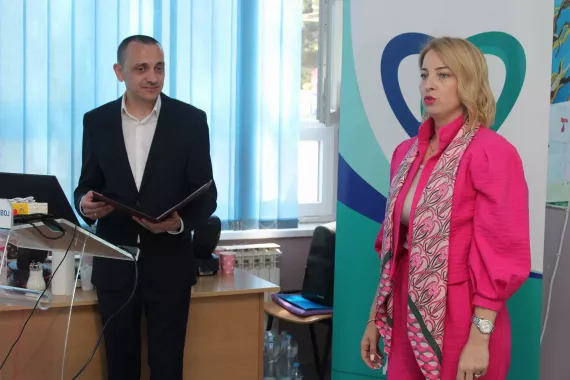


Branka Kondić, principal of “Sveti Sava” Elementary School in Doboj, stressed how important it is for school staff to know how to react if a child experiences a severe allergic reaction, which is why organizing workshops like this one is essential:
“After home, school is where children spend the most time. If we want to help children grow into healthy individuals, we all need to be aware of what is specific to each child. To work with children who have allergies, we must know how to do so properly and what to pay special attention to.”
Jela Aćimović, head of the health section at UNICEF BiH, said that UNICEF supports such initiatives because their goal is to protect children's health:
“This workshop is one example of such support, backed by the PUPPI program, because healthy eating isn’t just about nutritious food—it’s also about food safety. Food allergies, especially severe ones, pose major challenges not only for children and their parents but also for schools, which need to know how to react appropriately, as the correct response can save a child's life.”
Jelena Medar Petrović, pharmaceutical advisor at the Ministry of Health and Social Welfare of RS, also emphasized the importance of the workshop:
“It’s a fact that more and more people—not just children but also adults—are sensitive to allergies and experience these health issues. The Ministry fully supports such activities to educate the public, parents, and children to ensure a safe environment and healthy development for children.”
Dr. Tanja Ješić Petrović, Deputy Director of the Doboj Health Center, said the large number of educators who attended the workshop speaks volumes about their dedication and willingness to learn in order to provide a safe environment for children:
“We are aware that the number of children with food allergies is increasing and that school and preschool settings should be safe spaces for their play, development, and well-being. Unfortunately, for some children, these can also be places of great danger. The goal of this training is not to instill fear but to teach everyone how to respond in situations when a severe allergic reaction occurs.”
Nataša Cvijanović, Assistant Minister for Preschool and Primary Education at the Ministry of Education and Culture, thanked the school for recognizing the importance and relevance of the topic and treating it within the PUPPI program:
“It all began as a project, continued as an initiative, and has now evolved into a full-fledged program. We started with preschools, and it became clear that educators need more information and knowledge about what our children eat, the kinds of food they use, and the quality of meals served in collective settings. This year, many schools will be included, and we plan to expand the initiative to cover nutrition in after-school programs. Together with the Institute, we’ll work on defining nutrition standards for student dormitories as well,” announced Nataša Cvijanović, outlining the next steps in the PUPPI Program.