Online violence = Real violence
At a peer workshop held as part of “16 Days of Activism Against Gender-Based Violence,” children learned about online violence
- Bosanski/Hrvatski/Srpski
- English
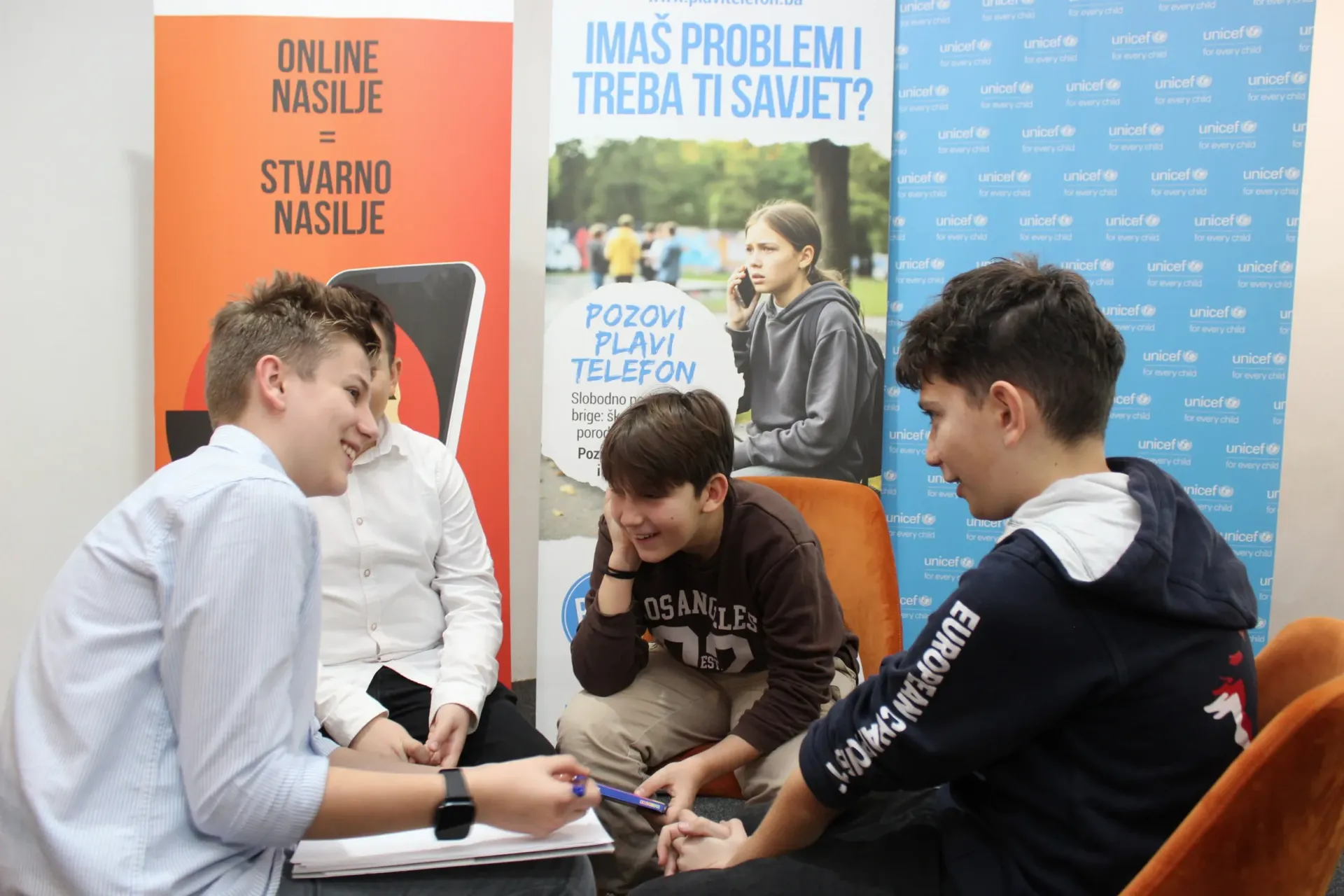
As part of the global “16 Days of Activism Against Gender-Based Violence” campaign, primary school students from Novi Grad Sarajevo took part in a peer workshop focused on online violence, with special attention to recognizing and preventing technology-facilitated gender-based violence.
At the workshop, Ali, a seventh-grade student at “Umihana Čuvidina” Primary School, told us:
“Today was the first time I learned exactly what gender-based violence is — I didn’t know before that it means mistreating someone just because they’re a girl or a boy. We also learned what online violence looks like and what forms it takes — for example, when someone shares another person’s photos without permission. It means a lot to know that in situations like that we can reach out to the Blue Phone, and that UNICEF is here to protect children’s rights. I learned that help always exists, and that we should never stay silent if we have a problem.”
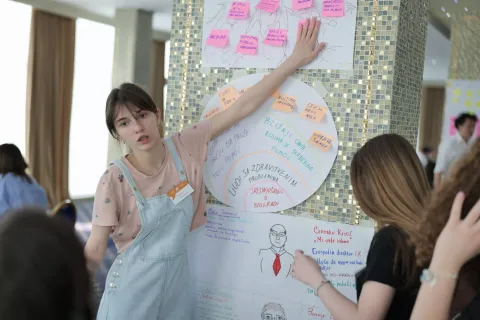
Farah, an eighth-grade student at “Meša Selimović” Primary School, also found the workshop useful — especially the group activity in “Online Detectives,” where children were given different scenarios and asked to identify the problem and create a map of solutions:
“My group worked on the topic of fake profiles, and I realized how common that problem is. I learned what gender-based violence is and how we can recognize it when someone insults girls or boys just because of their gender. What I can tell my peers is that if they experience online violence — if someone insults them or threatens them online — they need to react right away: report it, talk to parents, and call the Blue Phone.”
Denin, a ninth-grade student from “Skender Kulenović” Primary School, says peer workshops are essential for young people:
“I think a lot of young people don’t recognize violence because they think it’s just a joke, but workshops like this help us understand the problem and share what we learn with others — in person and in class communities — and that way we can make a positive impact. I already knew online violence exists, but only today I learned its concrete forms — from cyberbullying to gender-based violence, when someone is insulted because of gender, religion or skin color. We also met the UNICEF and Nova Generacija team and learned how the Blue Phone was created, and how we can reach out to them if we ever need help.”
The workshop was led by Najda Hajdarević, a member of the Children’s Parliament of the Municipality of Novi Grad Sarajevo and the Blue Phone Youth Advisory Board, with support from Ilma Brezac, activist from “Naša djeca” Sarajevo.


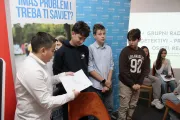
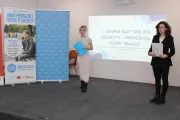
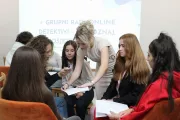


“I’m glad I was able to share what I know, and I hope they’ll pass it on. I’m very happy with their reactions — one group even created and presented a ‘support chain’ for cases of violence. It showed me how mature they are, and I hope this awareness will keep spreading from generation to generation. It always hits me hard to hear how much digital violence girls face and how much more exposed they are than boys — that gives me even more motivation to continue raising awareness,” Najda said, adding:
“It hurts because we live in a time when people stay silent about this — when young people watch from the sidelines and repeat things like ‘she asked for it’. I’ve been trying for six years to bring these topics closer to my peers, and I designed this entire event myself as part of the 16 Days campaign. Every new activity with UNICEF is a new lesson for me and a chance to grow.”
Participants also had the opportunity to speak with Marc Lucet, UNICEF Representative in BiH, and Saša Risojević, Director of the organization Nova generacija, which runs the Blue Phone helpline for children and youth.
“Workshops like this are extremely important because direct contact can’t be replaced by online communication. When children meet in person, they can hear others’ experiences, understand emotions, connect, and clearly see how their online behavior affects others. That’s why keeping these workshops accessible is essential,” said Saša Risojević, stressing that the rise in online violence is the reason this year’s 16 Days campaign is particularly focused on protecting girls and women in digital spaces:
“Online violence makes up about a quarter of all reports we receive. Just this year, more than 60 children reported digital violence, which shows how serious the problem is — especially because children often use the internet unsupervised and have access to content and groups that negatively affect them.”
He added that the Blue Phone has received nearly 6,000 calls from children across BiH this year — a clear sign that broader support is needed to ensure the service is available at all times:
“What worries me most is the large number of missed calls — about 200 per month — that happen on weekends, when the Blue Phone isn’t available. These are calls from children who need help the most at that moment. We have good practices, but we lack a harmonized approach at the state level. With systemic institutional support, the Blue Phone could operate 24/7 and prevent many missed calls.”
Marc Lucet, UNICEF Representative in BiH, emphasized that UNICEF is deeply involved in addressing online violence — a major and growing problem both globally and in BiH:
“Through the U-Report platform, we found that more than half of young people who participated in the survey have witnessed online violence, and a third of them experience it almost daily — usually through insulting messages. The prevalence is high and serious. That’s why it’s crucial to work with adolescents and young people — not only raising awareness, but listening to them, involving them, and acting with them, because they are part of the solution. That’s the first priority.”
The second priority, he noted, is strengthening online support systems:
“The Blue Phone is proof that digital tools can be a safe resource for children and young people. What’s essential is that services like this are treated as a public good and receive stable state support. The Blue Phone is still struggling to secure sustainability, and that’s something we must address. At the same time, we need strong multisectoral child-protection systems — schools, social workers, health services, mental-health care, police, justice, and parents must work together.”
The third priority, he said, concerns developing and reinforcing policies, laws and procedures that allow these services to adapt to new challenges:
“Children today grow up in a world where parents often struggle to keep up with the pace of digital change. Parents need to clearly explain to children that talking to someone they don’t know online and sharing personal information is just like letting a complete stranger into their bedroom. These messages must be clear — to parents, institutions, professionals, and society as a whole. And above all, everything we do must keep the child at the center. Children are not passive recipients — they are partners and part of the solution.”
This year, the “16 Days of Activism” campaign highlighted the message “Online violence = real violence”, aiming to raise awareness of the harmful consequences of online abuse and to empower children and young people to recognize, prevent and report digital violence.
The workshop with the Children’s Parliament and the Municipality of Novi Grad was held as part of the “16 Days of Activism Against Gender-Based Violence” campaign, within the broader Gender Equality Accelerator initiative funded by the EU, Denmark and Sweden, and implemented by UN Women, UNFPA, UNDP and UNICEF.