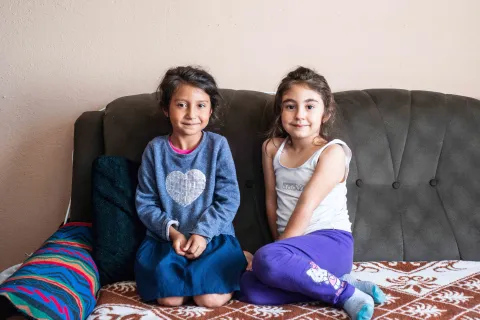
Increasing immunization uptake in Roma communities
It is estimated that the vaccination rate with mandatory vaccines for children in Roma communities is only between 5 and 6 percent

- Bosanski/Hrvatski/Srpski
- English
Immunization represents the most effective and safest measure for preventing and suppressing infectious diseases that can have serious consequences for health, and yet, it is estimated that the vaccination rate with mandatory vaccines for children in Roma communities is only between 5 and 6 percent. There are many reasons for such low coverage - from difficult access to health facilities to parents' uncertainty about the safety of vaccines.
In Bosnia and Herzegovina, the problem is also the lack of mandatory health insurance for children aged 6-15 who do not attend school and whose parents are not health insured, as well as the lack of a developed network of social support and security, which can lead to families bearing the entire financial burden of immunization, warns Mujo Fafulić, President of the Roma Support Center Romalen Kakanj.
"In short, the causes of poor immunization coverage in our country are multiple and interrelated. Addressing these challenges requires a comprehensive, multidisciplinary approach that includes strengthening health infrastructure, improving access, raising awareness, and addressing socio-economic and cultural challenges.”
UNICEF, in cooperation with Romalen, and with the financial support of the European Union, is implementing a project aimed at increasing vaccination coverage in Roma communities, which includes the cooperation of Roma Community Mediators and patronage nurses from local healthcare centers. In this way, better and longer-lasting contact is established between Roma communities and local health institutions.
"I think my results would have been zero if I hadn't worked with Jadranka (Roma Community Mediator). They know her, they trust her. There are questions, but now they are already opening up to us and have more trust. There are families that we managed to include, after education, after talking, we directly agreed when they should come. Vaccination is here done only three times a week, we have one pediatrician, and vaccination can only be done by a pediatrician," says sister Šemsa from Vitez Healthcare Center.
In the settlement of Sofa near Vitez, we met Jasmina, a mother of four children - a 12-year-old girl, 8- and 4-year-old boys, and a one-year-old girl.


"To tell you the truth, I was a little afraid of vaccines, since I had heard many things being said. Still, I went to vaccinate the baby, while the three older children did not get all the vaccines. The arrival of the patronage nurse made everything easier. I took courage and agreed, because I want my children to have normal health insurance."
In the settlement, we also met Monika, who has five children aged 8, 7, 5, and 2, as well as a four-month-old baby. She says that the children have not yet received all the vaccines, but that she is now aware of their importance.
"If the children are sick, I take them to the doctor. Vaccines are important to keep children healthy, vaccines protect them from getting sick. My son once had a bruise after a vaccine, I didn't know when he should be taken, I kept coming, but the doctor explained everything to me and I understood."
Jadranka is a Roma Community Mediator and has been working in the Sofa settlement for 18 years.
"People are afraid to vaccinate their children, especially after the emergence of COVID-19. Even before, they distrusted vaccines, due to lack of knowledge, they didn't have enough information, they didn't know what the word immunization meant, when a child should be vaccinated, against which diseases. Their first question is whether vaccines are safe, whether something will happen to their children, who guarantees the safety of vaccines, what if a child receives a vaccine and something happens, who will stand behind it," says Jadranka.
In order to achieve greater results, sister Šemsa points out that a greater presence in Roma communities is needed.
"I don't have enough time to go back to families where children have received some vaccines, to remind them that they need to come for the next vaccine. I would like to have time to go back to the same families, to talk to them, to ask why they didn't come, if they didn't."
Better results are achieved with the involvement of Roma mediators in the community and visiting nurses in the field, Mujo Fafulić points out.
"We have good people working in the field, who know how to respond to the needs of families, including improving knowledge about immunization and strengthening confidence in vaccines, until finally guiding the child to receive one of the regular vaccines. This cycle of regular immunization must be followed, because even if we manage to get one child to receive one of the incoming vaccines, we have not finished the job if it is not done continuously, if it is not monitored, we have not finished the job."
Through the implementation of the project in 2023, 280 Roma families were visited and 175 children were vaccinated. In total, over 3,000 adults were included in education and 518 children were vaccinated through the cooperation program with the Romalen organization in the past two years, with the support of the European Union and USAID.
Low immunization coverage increases the risk of outbreaks of vaccine-preventable diseases, and children who contract these diseases are at risk of severe complications, long-term disability and even death.
Investing in health infrastructure, education of health workers, but also parents and communities, especially in rural and remote areas, significantly contributes to increasing immunization coverage.