Communication bridges
For Ahmed* from Ušivak, the Akelius digital language learning platform facilitates communication, learning and inclusion in classes

- Bosanski/Hrvatski/Srpski
- English
Girls and boys from the Ušivak Temporary Reception Center near Sarajevo gather in the non-formal education corner where they eagerly await the start of a new class of the Akelius digital language course, which is being implemented by World Vision with the support of UNICEF. After getting ready, they carefully unpack the devices, prepare their headphones and wait for further instructions from their English teacher, Elma Šabanović, who introduces them to the topic they will cover, and today the topic is the correct time.
"Given the circumstances in which we work and that children come from different socio-economic, linguistic and educational backgrounds, using the Akelius platform helps us to bridge all these differences in a subtle way that is acceptable to children. I am happy that I can use Akelius in my classes because it is important for us that children feel safe and relaxed in class, and that they know that it is okay to make mistakes", says Elma, adding that the Akelius platform combined with traditional teaching creates a friendly and relaxed atmosphere for children. She adds that when she previously worked in a public school, she did not have the opportunity to use the Akelius platform, which would have been very useful for her:
"I am glad that curriculum reform is being worked on, especially for the English language, and that Akelius is being introduced into our public schools because digital literacy is important to us for learning outcomes."
Muris, a cultural mediator for Arabic and Persian, assists teachers and says that Akelius is useful not only for language learning but also for initial communication with children.
"The children generally don't stay here long, they speak different languages and at the beginning, I help them a lot in communicating with the teachers, but after a few visits, they become less dependent on my help and start communicating independently using the application.
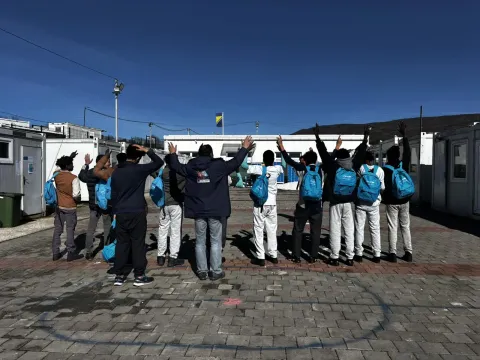
In addition to the Akelius course, children also have various workshops, they come to prepare for school, get help with their homework or with the English and Bosnian language they need at school. Among the most active in the class is Ahmed*, who came to the course before leaving for the First Elementary School in Ilidža, where he attends preparatory classes for children on the move. He is 12 years old and recently came to Bosnia and Herzegovina with his parents, from where they plan to move on. The course in Ušivak is over, Ahmed packs his things in a blue "UNICEF" backpack and goes to school by organized transport.
"I'm having a good time at the course and school. I have already learned a lot, I like working with tablets and it's fun", says Ahmed, adding that he would like to live in Canada, and when he grows up, he would like to be an engineer or a football player. Along with the story about football, there is also the inevitable story about the favourite football player, which, Ahmed says, is Ronaldo in any case. We ask him if he knows any of the Bosnian football players:
- I don't know any!
- What about Džeko?
- Edin Džeko! Fenerbahce! realizing that he does know the UNICEF Ambassador in Bosnia and Herzegovina.


The class at the First Elementary School, which is attended by a group of boys of different ages, is lively, and Ahmed is among the most active.
"Ahmed is my main assistant!" says Nermina Memić, a teacher in preparatory classes for children on the move, who also uses the Akelius program in her work:
"In addition to being an excellent teaching tool, Akelius is also a bridge of communication for us, given that the children who come speak different languages and at the beginning, we mostly don't understand each other. Their level of knowledge is different, Ahmed, for example, went to school until the eighth grade, but here we currently have two boys, aged 13 and 15, for whom this is the first time they have attended any kind of education at all".
The Akelius program is currently implemented in two temporary reception centres - Ušivak and Borići and in several schools in Una-sana and Sarajevo cantons, among which is the Ilidža Elementary School.
"I am very happy that we got the opportunity to use Akelius and we enjoy working on this platform. Last year I used Akelius in my work with fourth-grade students as an extracurricular activity, and this year I am working with ninth graders, and you can see how happy and satisfied they are, they enjoy such work and easily learn new things," says Bogdanka Dubak, English teacher at First Elementary School in Ilidža.
The theme of the class is the "Roaring Twenties, children through photos, associations and quizzes using the Akelius application on tablets, answer questions and talk about music, culture and famous people who marked that period, and at the end, they all danced the Charleston together.
"I like this way of working with the use of digital technologies. It is much more modern; we learn faster and easier. I think that this way of working should be used more often in some other subjects, it would certainly be much more interesting", Džan, a ninth-grade student, tells us after class.
English teacher Elma Drpljanin also uses the Akelius program in her work in the English language section for fourth grade. She says that the children look forward to every Wednesday, and even though the section is not mandatory, there are almost no absences - they are always at the section in full!
"They are happy to come, they can't wait to take out the tablets and get to work. The teaching process is much easier, we are currently using Akelius in several classes, but we are trying to slowly expand it to the rest of the school because it has proven to be excellent and something that helps children learn in a fun and adequate way", says Emina while children in groups do various tasks through three corners: "Teacher-led Station", "Offline Station" and "Online Station" where they work with tablets on the Akelius application.
"We like working with Akelius, it's fun! We wish there were more games to learn with. It would be good if we could do math and other subjects with tablets!", Ferhad, Asja, Almedin, Tarik, Džan and Emina, who have just finished part of the class at the "Online Station", are impressed.


The mentioned classes and workshops were also attended by UNICEF Sweden's deputy director for partnerships and philanthropy Annika Bränning and project manager for Akelius in UNICEF Sweden Laetitia Antonowicz during a recent visit to the Ušivak Temporary Reception Center and First Elementary School in Ilidža.
"Everything I saw during the visit was impressive, and what is very clear is that a good school is much more than just education. It's about children needing a safe place where they can laugh and build confidence. I am pleased to see that the Akelius platform is used in the school and the temporary reception centre, and that it is very well implemented", says Annika Bränning, while Laetitia Antonowicz says that she found it interesting how the Akelius program is implemented in different ways, but equally successfully in school and reception centre:
"In the reception centre, the use of Akelius allows children to have the same opportunity for education as all children and allows children to be children. They stay in a stimulating educational environment and go to school, which is especially important for some of them who did not have that opportunity before. On the other hand, at the school, it allows teachers to enrich the teaching material they use in class, and it allows students to get involved in various activities. I was particularly impressed by the children's fluent English pronunciation, even among the younger ones from the fourth grade, which is on the one hand the result of quality teaching, but on the other hand also the result of using the Akelius platform where children can hear the correct pronunciation and then repeat it".
UNICEF started conducting the Akelius Digital Language course in July 2020 in five temporary reception centres. About 4,500 refugee and migrant children and almost 4,000 children from eight local schools, to which the program was expanded in 2021, have gone through the course so far. It is based on digital technology and includes children in user-friendly, interactive lessons via computers and tablets.
So far, more than 250 teachers, assistants and cultural mediators have been trained to work on the program, and it is planned that a total of 350 of them will be trained by 2025. Since the beginning of the implementation of the program, around 300 tablets with headphones have been procured, which has greatly facilitated the learning process with increased interest in language learning not only among children but also among their parents.
At the beginning of 2023, UNICEF joined the Akelius Quality Acceleration Initiative to improve the digital environment and connectivity, as well as teacher training, which will be one of the priorities for 2024. The goal is for all English and German language teachers in the Sarajevo Canton to be trained to use the Akelius program, which will continue to be implemented in eight schools in two cantons, which will share best practices with other schools and become a model for integrating the Akelius digital language course into the curriculum.
* Names have been changed to protect the identity of the actors