A parent’s lesson, a nation’s resolve
Bhutan turns evidence into action to protect every child from lead exposure

Thimphu: When Kinley Zam from Gidakom first heard about lead poisoning, it was through television broadcasts. The mother of two never imagined the issue would touch her own family. That changed when she took her four‑year‑old daughter to the Mother and Child Hospital for what she thought would be a routine check‑up. There, she learned about a blood test for lead that was underway for children who were visiting for check-up.
The result revealed high levels of lead in her child’s blood. Soon, health workers visited her home with lead testing equipment, testing her family members and sources of lead in cooking pots, kitchen items and tots. They confirmed the presence of contamination in a few household items.
The discovery was unsettling, but it opened her eyes. “The testing helped us understand what lead poisoning is and how to prevent it,” she says. “Every parent wants their child to have a bright future and do better in life.”

Her family’s experience reflects a wider reality. A national survey showed that 76 per cent of young children in Bhutan have unsafe levels of lead in their blood. Lead contamination was traced to some everyday items such as cookware and kitchen items, toys, spices and some religious items.
In response, Bhutan acted quickly. The government launched investigations, strengthened regulations and market surveillance, resulting in the Bhutan Food and Drug Authority issuing a regulatory notice and suspending operation of a local traditional medicine manufacturer that contained high levels of lead in their products. The government has also began drafting the country’s first National Environmental Lead Regulations and a comprehensive Lead Poisoning Prevention Strategy. Awareness campaigns reached parents, teachers, and communities, while healthcare workers were trained on screening blood lead level including prevention of CEH issues with focus on lead poisoning.
The Ministry of Health recently completed screening of select individuals in hospitals to determine if blood lead levels are higher among ill patients or pregnant mothers. Information from this recent initiative will guide the development of clinical management guidelines for managing lead exposure.
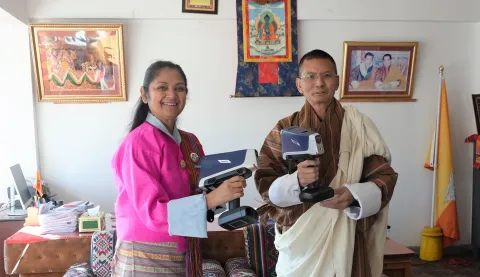
Families received counselling and information materials, and those with the highest blood lead levels were visited at home with specialised equipment to trace the source of contamination. With UNICEF’s support, these efforts have already reached more than 18,000 children through early childhood centres and primary health care services.

The message has spread far beyond hospitals. National television and radio have carried awareness programmes, panel discussions, and documentaries on lead poisoning and clean air. Social media campaigns have amplified the message, reaching more than half a million people. Communities have been engaged when their household products were tested for lead, parents sensitised on hygiene, and local leaders engaged in prevention.
Globally, lead poisoning affects one in three children. At the 2025 United Nations General Assembly, Bhutan’s Prime Minister Tshering Tobgay joined UNICEF in reminding world leaders that small nations can lead on big problems when evidence is combined with action. “If Bhutan can move from discovery to action in months, then together we can move the world towards a lead‑free future. We can prove that no nation is too small, and no child’s future too unimportant to protect.”
For Kinley Zam, that commitment is personal. She now insists on regular handwashing and careful choices about utensils. “That is why testing matters,” she says. “Of everything, I’ve come to understand that the most important preventive measure is to maintain cleanliness and wash hands regularly.”
Her words echo Bhutan’s national resolve. Evidence, action, and care can protect children, proving that even the smallest steps can lead to a lead‑free future.