UNICEF and Prime Minister of Bhutan call for urgent global action to end childhood lead poisoning at the 80th UN General Assembly
At a UNICEF high-level side event, Bhutan showcases its rapid national response to childhood lead exposure

Joint Press Release
NEW YORK – Recognising Bhutan as a model for evidence-based policy response, Prime Minister Tshering Tobgay of Bhutan today addressed global leaders at a high-level event during the 80th UN General Assembly, calling for urgent international action to eliminate childhood lead poisoning.
Speaking at "Toward a Lead-Free Future: Mobilizing to End Childhood Lead Exposure," hosted by UNICEF, the Prime Minister highlighted Bhutan's swift and comprehensive response to the country's first-ever National Blood Lead Level Survey, which revealed that 76 per cent of young children have unsafe levels of lead in their blood.
Globally, lead poisoning affects one in three children, causing an estimated 3.45 million deaths annually, making it the eighth leading cause of death worldwide. The health implications are particularly severe for children, causing irreversible brain damage, developmental delays, and learning problems that affect entire generations. Each year, lead poisoning leads to average global IQ losses of six per cent and productivity losses costing the global economy at least $1.4 trillion.
As the Secretariat for the Partnership for a Lead-Free Future (PLF), UNICEF brings together governments, business, and civil society, while providing tools, guidance and technical assistance to support countries to take effective action to tackle lead exposure.
"UNICEF has completed a cost analysis showing that for just US$2 per child, we can collectively cut childhood lead poisoning in half by 2033 and end it entirely by 2040,” said UNICEF Executive Director Catherine Russell. “This is an extraordinarily high-return investment in children's health, learning, and a better future."
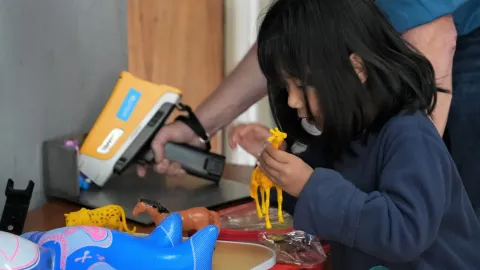
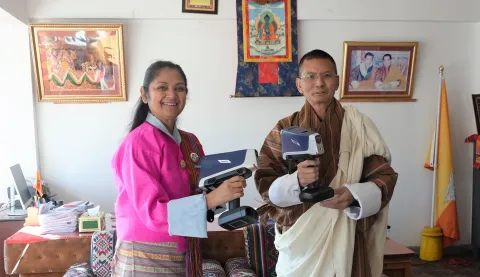
In Bhutan, the national survey findings revealed lead contamination in everyday items close to home, including spices, cookware, toys and cosmetics. In response to the findings, the Royal Government of Bhutan took immediate actions, including:
- Evidence building: Conducting investigations to identify all sources of lead contamination in the market.
- Regulatory strengthening: Reviewing existing lead regulations and enhancing market surveillance systems.
- Whole-of-government coordination: Developing Bhutan's first-ever National Environmental Lead Regulations and comprehensive National Lead Poisoning Prevention Strategy.
- Community engagement: Deploying national awareness campaigns to educate parents, teachers, healthcare workers and communities.
- Capacity building: Training healthcare workers and integrating children's environmental health modules for health professionals.
Looking ahead, Bhutan has committed to establishing a National Task Force to set and enforce lead standards, creating surveillance systems for blood lead testing, and continuing mass awareness campaigns alongside nutrition education to reduce lead absorption.
“What we've proven is this: small nations can lead on big problems when we combine evidence with action,” said Prime Minister Tobgay. "If Bhutan can move from discovery to action in months, then together we can move the world towards a lead-free future… We can prove that no nation is too small, and no child's future too unimportant to protect.”
The event, livestreamed globally, brought together ministers, philanthropists, and advocates committed to eliminating childhood lead exposure. Additional high-level speakers included UNICEF Executive Director Catherine Russell, UNEP Executive Director Inger Andersen, and a keynote message from Amina Mohamed, Deputy Secretary General of the United Nations.
The Partnership for a Lead-Free Future has mobilized over US$150 million, and counts more than 30 governments, 29 civil society organizations, 6 multilateral organizations and 12 private foundations among its partners.
#####
Download photos here
Media contacts
About UNICEF
UNICEF promotes the rights and wellbeing of every child, in everything we do. Together with our partners, we work in 190 countries and territories to translate that commitment into practical action, focusing special effort on reaching the most vulnerable and excluded children, to the benefit of all children, everywhere.
For more information about UNICEF and its work for children, visit www.unicef.org.