EU's Digitalisation Initiative Transforming Bhutan's Classrooms
The European Union funded initiative is empowering 6,000 students and 400 teachers in 10 schools across Bhutan

The European Union (EU) Delegation led by Ms. Paola Pampaloni, Deputy Managing Director, European External Action Service AsiaPac, visited the Changangkha Middle Secondary School, one of the flagship schools selected under the Digitalisation in Education initiative. The EU Delegation was in Thimphu for a three-day official visit. Mr. Franck Viault, Head of Cooperation, and Ms. Olaya Alvarez Fernandez, Political Officer, Delegation of the European Union to India and Bhutan and Mr. Roshan Lyman, Policy Officer, EEAS AsiaPac were part of the delegation. Ms. Rushnan Murtaza, the Representative, UNICEF Bhutan, was also present.
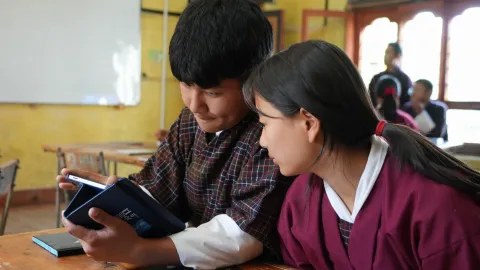
Funded by the EU with €1 million, the Digitalisation in Education initiative is implemented by UNICEF Bhutan in partnership with the Royal Government of Bhutan’s Ministry of Education and Skills Development (MoESD). It aims to enhance children’s learning experiences and skills development by providing reliable school connectivity, digital content and capacity-building programs while promoting cybersecurity awareness. The work is underway to provide campus-wide connectivity in 10 target schools already, which will help empower 6,000 students and 400 teachers.
Expressing satisfaction on the work done under the Digitalisation in Education initiative, Ms. Paola Pampaloni said, “It was truly heartwarming to see the efforts deployed to include the children with special needs to the regular curricula as well as to provide them non-academic vocational skills, with thought to enabling them to lead financially independent lives. The EU is extremely pleased and proud to be supporting the digitalisation programme of Changangkha school, which includes such children with special needs, which perfectly aligns with EU’s values of inclusion.”
Following the launch of the EU funded initiative, MoESD and UNICEF have completed a comprehensive gap analysis of school connectivity, identifying critical gaps in internet access across Bhutan’s schools.
This analysis has helped to develop three connectivity models that meet the unique needs of Bhutanese schools, while creating an engaging, effective and inclusive educational environment. In addition, digital content for Grade 9 Science and Mathematics has been developed to enhance online learning, aligning it with national curricula and making it more interactive. 24 teachers from 18 schools across 10 districts were trained and equipped with skills for creation of digital content and design of high-quality digital learning materials aligned with the national school curricula.
As part of the programme, a comprehensive digital skills training package was developed for UPSHIFT, a skills-building social innovation accelerator programme. So far, 64 teachers and 605 students from 11 schools across 10 districts have been trained, gaining essential digital competencies, problem-solving, and entrepreneurial thinking. Further training will focus on integrating ICT into teaching and digital literacy.
Ms. Rushan Murtaza thanked the EU for supporting the learning of children, including for children with special needs. “The digitalisation initiative in education is catalytical in supporting the learning and growth of children and teachers in Bhutan,” Ms. Murtaza said.
The initiative also supports the preparation of the Education Technology Framework (ETF), a policy document designed primarily for policymakers, administrators, and educators that sets the vision and provides guidelines and standards for digitalisation in education aligned with iSherig – ICT in education masterplan.
Through this initiative, the EU remains committed to support an inclusive, safe, and enabling digital education environment for school education in Bhutan.
###
About the European Union (EU):
The EU, which consists of 27 countries, has the world's second-largest economy and its third-largest population, after China and India. Though richly diverse, the countries that make up the EU (its 'Member States') are all committed to the same basic values: peace, democracy, the rule of law, and respect for human rights. By creating a frontier-free single market and a single currency (the euro), which has been adopted by 20 Member States, the EU has given a significant boost to trade and employment.
EU-Bhutan relations: The European Union-Bhutan cooperation started with a development project in 1982, focusing on renewable natural resources. In 1985, diplomatic relations between the Royal Government of Bhutan and EU were established. The EU's current support for Bhutan under the 2021-2027 Multiannual Indicative Programme, focuses on three priority areas i.e. Climate Change and Green Growth, Good Governance for inclusive development; and Digital Transition in the education and public service delivery sectors. These areas have been allocated an amount of €48 million for the period 2021-2027.
Download photos here
Media contacts
About UNICEF
UNICEF promotes the rights and wellbeing of every child, in everything we do. Together with our partners, we work in 190 countries and territories to translate that commitment into practical action, focusing special effort on reaching the most vulnerable and excluded children, to the benefit of all children, everywhere.
For more information about UNICEF and its work for children, visit www.unicef.org.