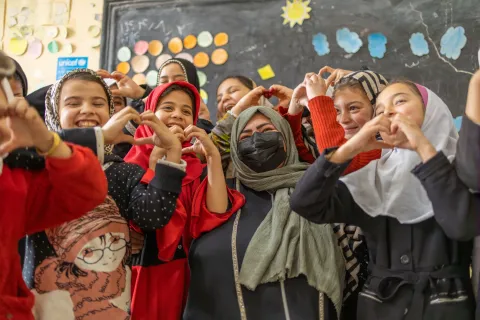
Teaching with Heart: Bahara’s Journey to Inspire, Grow, and Transform
With support from UNICEF, a passionate female teacher turns learning into a journey of hope

32-year-old Bahara begins each day with determination as she gets ready to leave for the school in Kabul where she teaches. A mother of three, Emran (6), Erfan (5), and baby Omra (5 months), Bahara has dedicated the past 15 years of her life to teaching. With a monthly salary of 9,000 AFN (USD130), she continues to balance the demands of motherhood and her passion for education, every day.
“I loved studying biology since I was a teenager, and wanted to become a biology teacher,” says Bahara. “Teaching really inspires me.”
Despite her experience, Bahara often felt something was missing. “I always knew I needed to learn more to teach better, but I did not know how and where to start from,” she adds.
This feeling changed when Bahara received her nomination to participate in UNICEF-supported ‘Teacher Development Support’ training. Through this World Bank funded training, Bahara discovered a new way to teach, one that goes beyond textbooks and tests. The training gave her practical, hands-on strategies to make learning more meaningful for her students. It was not just about improving lessons but also creating a classroom where children feel supported, curious, and confident.
The Teacher Development and Support programme focuses on helping teachers like Bahara grow professionally, with tools that are easy to use and rooted in real classroom needs. It also strengthens the entire school environment, ensuring teachers are well-prepared and have the appropriate learning materials aligned with their lessons. Most importantly, it builds a foundation for lasting change by empowering educators to keep learning and supporting each other.
The opportunity came at a challenging time for Bahara. Her daughter Omra was just five months old.

“There was no one to care for her,” Bahara says. “But after many discussions with the training management and the mentor, I was allowed to bring her with me to the training. That meant everything.”
The training introduced Bahara to modern, student-centered based teaching methods that replaced the traditional approaches she had been relying on for years. She learned SMART planning - Specific, Measurable, Achievable, Relevant, and Time-bound - which helps her structure lessons with clear goals.
One of the biggest challenges Bahara faces in her classroom is the lack of resources.
“Many of my students cannot afford basic supplies like books and notebooks, and our classroom lacks enough chairs for all students.” It affects their learning and my teaching,” she adds.
“I would get nervous every time someone from the Ministry of Education or school management checked my lesson plans. But now, I know how to write accurate lesson plans. I am fearless,” shares Bahara.

Managing a classroom of 50 to 60 students was another hurdle. “Earlier, it was overwhelming. But now I have learned to divide them into groups, making learning more effective and engaging. This training has changed the way I teach, and it will change the way my students learn. They will remember my lessons not just from the books, but from the experiences we create together,” says Bahara with a sense of pride in her voice.

Through the Teacher Development support (TDS) training, Bahara discovered innovative techniques like Gallery Walks, where students work in teams led by peers. She also learned to use visual aids and real-life examples to make biology come alive for her students.
In 2025, with funding by the World Bank, Asian Development Bank, Global Partnership for Education, the Government of Japan and the German UNICEF National Committee, UNICEF aims to reach more than 50,000 Teachers, School Management Shura (SMS) and headteachers across 34 provinces in Afghanistan with the Teacher Development Support programme with sustained school-based follow-up through coaching and learning circles.