Prevention is better than cure
In Afghanistan’s north and east, a holistic nutrition and health project aims to stop malnutrition before it starts – in the womb.

In Bochi village, the last of the night’s chill dissipates under the midday sun. The village is a cluster of mud and stone buildings, stepped up the side of an almost-vertical river valley in Faizabad district of Badakhshan, the northeastern-most province of Afghanistan.
At the top of the village, a group of women sit under a shady terrace. At one end, a kettle of rice bubbles on a gas stove. Hamida chops vegetables, while her niece Farzia, the local community health worker, gives a running commentary. High school-educated Farzia embellishes her narration with additional details, which are appreciated by her audience.
“Yoghurt is important, especially for children,” she explains. “It contains calcium, which helps build healthy bones and teeth.”
Malnutrition is at the centre of a Venn diagram of deprivations. Its root cause is poverty, exacerbated by multiple intersecting environmental factors. Badakhshan exemplifies a perfect storm of geography, climate and poverty, culminating in one of the highest malnutrition rates countrywide. This year, 165,000 young children and 93,000 pregnant and lactating women in the province are expected to suffer acute malnutrition. An estimated fifth of the children will need life-saving treatment.

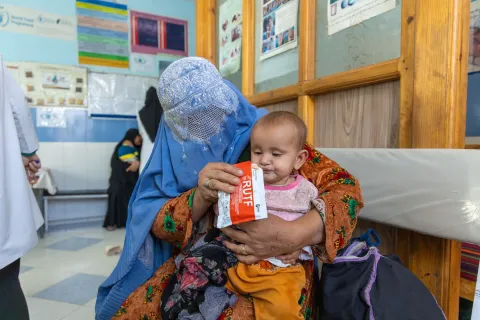
In 13 provinces of North and East Afghanistan, a UNICEF-run project takes a holistic approach to preventing malnutrition by addressing the factors that drive it. This project brings together improved water and hygiene services in health facilities, community health services for women, adequate nutrition for women, adolescent girls and young children, and nutrition sensitive cash transfers for households with pregnant and lactating women. The project, which began in 2022, aims to improve the nutritional status of over 1.5 million children under 5 years old by the end of 2026.
Treating a child for acute malnutrition will save its life, but the damage already done to its cognitive and physical development will last for the rest of its life. The roots of malnutrition often lie before birth: if a woman is malnourished when she becomes pregnant, the chances are the child will be born under-nourished. In Afghanistan, over a fifth of women display the signs of acute malnutrition, while an estimated third are anaemic.
Ultimately, healthy women are more likely to have healthy babies. To stop malnutrition before it starts, the project targets 1.1 million adolescent girls and over 500,000 pregnant women and new mothers.
Farzia and the women of Bochi village are not alone in knowing how to keep themselves and their children healthy. Still, Badakhshan has one of the highest rates of malnutrition countrywide – which brings us back to poverty and geography. Outside the provincial capital, Faizabad, people live in villages clinging to the mountainsides - most of them below the poverty line. Cut off by stormy weather and bad roads, some are isolated for up to nine months of the year.
Countrywide, nine in ten Afghan children are not getting the variety or quantity of foods they need to grow up healthy. Some foods are simply not available: for remote communities, markets are geographically unreachable. Other foods, especially meat and out-of-season produce, are financially unaffordable for many families.
Nahiye Se basic health centre is in a suburb of Faizabad city, home to professional households that used to bring in a dual income. Since the ban on women working, the earning power of many local families has halved. Some have had to tighten their belts, quite literally.

Naseema, the resident midwife, sums up the situation faced by her patients. “Health, hygiene, good nutrition – people know about these things. It’s affording them that’s the problem.”
Naseema estimates that one fifth of her patients are anaemic. Without supplements containing iron, their health, and their babies’ health, suffers.
Wazhma, a former teacher and mother of three, has come to see Naseema for a routine antenatal checkup. She has made monthly appointments since being diagnosed as anaemic early in her pregnancy.
“I was dizzy all the time. The nutritionist told me to eat more red meat and green leafy vegetables. We tried - my husband took on extra work - but meat is expensive, and we can’t afford it every day anymore. The supplements make a big difference, to my health and our grocery bills.”
Wazhma’s iron levels are back to normal, and she feels more like her old self. While she and her unborn baby are doing well, the prognosis for Afghanistan is sobering: this year, 3.5 million children and 1 million pregnant and lactating women are expected to need treatment for acute malnutrition. More needs to be done to stop the next generation of Afghans starting life one step behind.