Picking up the pieces
After three catastrophic earthquakes in a week, 96,000 children and their families in western Afghanistan face a long road to recovery

11-year-old Milat was just a few metres away from the wall of his neighbour’s house, when it fell on his little brother Serajuddin. A pile of rubble remained where his brother walked only seconds before.
Everything around Milat happened so fast. People ran and screamed for help. In an instant, his entire village had crumbled from the impact of a 6.3-magnitude earthquake.
“I ran home to get help and found my mother buried up to her neck,” recalls Milat.
His father and two neighbours dug through the rubble to save Serajuddin and their mother, but Serajuddin did not make it.

Milat’s injured friends and neighbours were taken to the hospital as rescue workers continued to search for survivors. Milat and his family traveled to Herat city, where his mother is still being treated for a broken back.
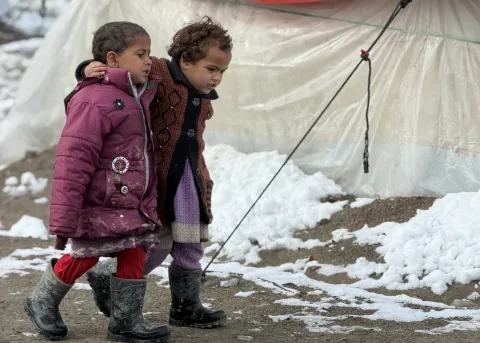
“We came back to the village the next day, but we have no house, so now I sleep in a tent,” explains Milat. His school, the health clinic, the village mosque, and some water distribution lines were also destroyed in the earthquake.
When a second 6.3-magnitude earthquake hit early morning on 11 October, Milat was asleep. He was awakened by the ground shaking beneath him. There were no houses to fall this time, so there were no deaths, but the fear lingers.

Picking up the pieces, for every child
With over 1,300 lives lost, and thousands more injured and displaced, it is a tough road ahead for children like Milat. He doesn’t know if there will be a new school for him to go to.
“When I grow up and become an engineer, I will rebuild our house and the whole village,” he says.
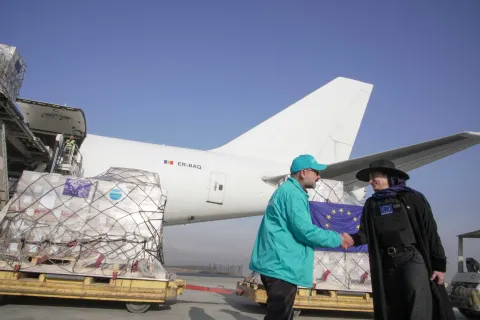
Since the earthquake struck, UNICEF has been on the ground providing medicines and mobile health teams to treat the injured, trucking safe water to affected families, delivering buckets, jerry cans, soap, household utensils, blankets and winter clothes.
With funding from the European Civil Protection and Humanitarian Aid Operations (ECHO), UNICEF is establishing 100 temporary learning centres, so children like Milat can return to school.


Coping with loss of livelihoods
The tale of loss is echoed across villages. Chahak village, some 30 kilometres from Herat city, is outside the epicentre of the first earthquake, but the aftershock stirred enough fear to force people from their homes. Many now sleep in makeshift shelters.
When another earthquake struck the village, many lives were spared, as structures were already destroyed. Still, 500 more families lost their homes, and one school was flattened.


Bibi Jan, her husband, and their three young children lost their house, their property and their sheep – their entire livelihood. Looking over the spread of dry, flat land and into the distance, she wonders how they will recover what they have lost.
“We can’t grow anything here. Water is a problem. Sometimes my husband goes to Iran to work on construction sites, but it’s not easy to find work,” explains Bibi Jan.
With support from ECHO, UNICEF will provide cash assistance to over 2,500 families. This will give families like Bibi Jan’s flexibility and dignity to purchase the things they need, like food or medicine.
A third 6.4-magnitude earthquake struck Herat on 15 October. More houses, health centres, schools, water sources and other infrastructure on which children and families depend have been damaged.
Bibi Jan and her family will need this cash assistance now more than ever. And with winter fast approaching, the needs are even more urgent for the thousands of children like hers.