One year on, three brighter smiles
After Afghanistan’s destructive earthquake a year ago, UNICEF is helping communities rebuild with new classrooms and child-friendly spaces

PAKTIKA & KHOST PROVINCES – You might remember Naghma, Gulaba and Kefayat. They are just three faces of hundreds who lost family members, homes, and possessions in Afghanistan’s devastating earthquake last year.
But a lot can change in a year.
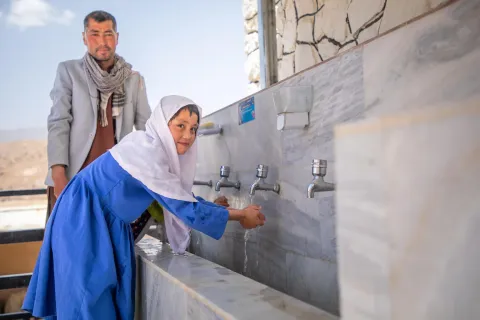
Hours spent fetching water gave way to time with family. Feelings of isolation were abandoned for happy new friendships. Days spent languishing at home became joyful, filled with curiosity and discovery.

Naghma
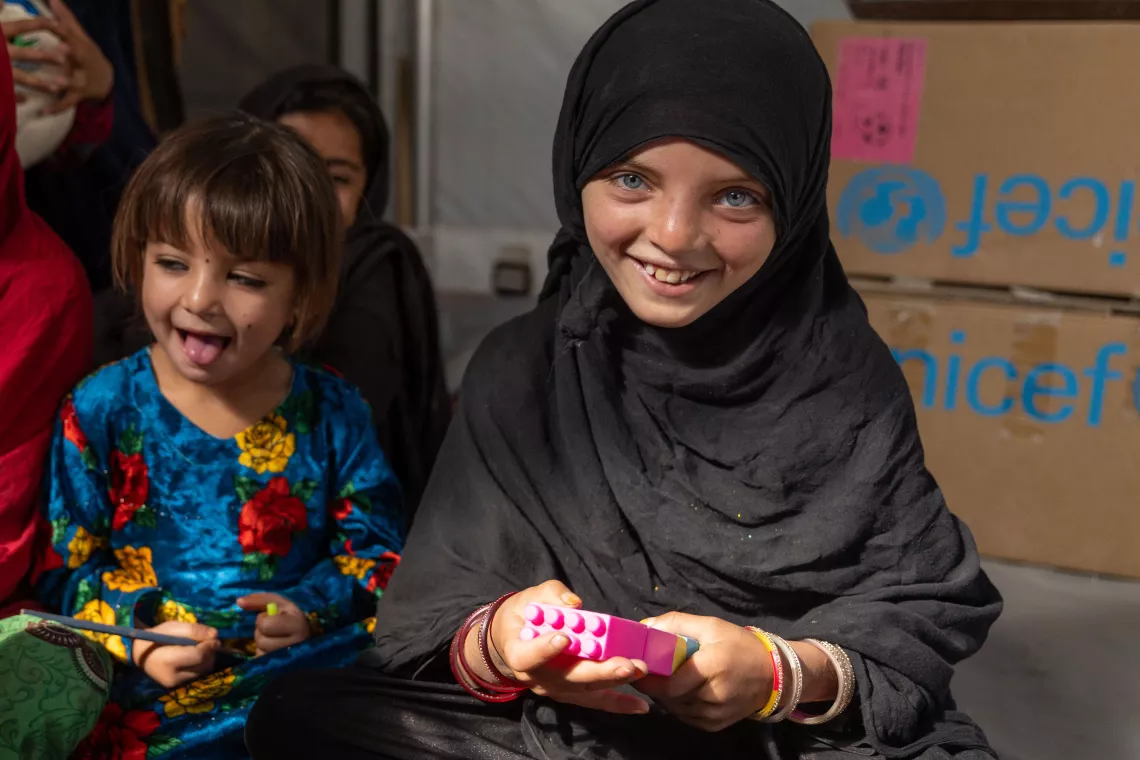
With a bright smile and even brighter blue eyes, surrounded by toys and friends, Naghma radiates with delight. The room around her is alive with giggles and games.
Seven-year-old Naghma lost her father in the earthquake last year. Since then, she has found comfort in this child-friendly space, one of 24 which UNICEF established in Paktika and Khost immediately following the earthquake.
"I have learned so many things here. I come every day with my brother, and we are happy."
The child-friendly space is facilitated by a social worker, one of 30 UNICEF deployed last year to help children and families cope with trauma from the earthquake.
Naghma runs to the centre every morning. In the year since the earthquake, she has found not only fun and friendships, but a safe space where she can express her emotions as she continues processing her loss.
“It makes me sad that we lost our house, and sometimes we still cry about my father,” she admits.
But Naghma has also become more confident, maybe even a little precocious.
“I received coloured pencils and a notebook, but I would really like one of those bags,” pointing boldly to a UNICEF blue backpack. With a self-assured smile, she turns back to her toys.


Gulaba
“Before this classroom was here, I knew nothing.”
Last year, Gulaba and her family lost everything: their home, their livestock, and even Gulaba’s 10-year-old sister, Mah Gul. Gulaba was despondent, with nothing to occupy her mind as she grieved.
But this year, Gulaba stands resolute at the front of her new classroom.
In Gayan and four other communities affected by last year’s earthquake, UNICEF established 140 new community-based education classes.
For more than 3,500 girls like Gulaba, this is the first time they have ever known a formal education. For the first time, 9-year-old Gulaba can hold a textbook, practice lessons with her own pens and exercise books, and learn to read.
“I am now learning the books,” she smiles, shyly, but betraying her joy.
“I am very happy that I am studying the books of second grade.”

Kefayat
9-year-old Kefayat used to spend his days in the mountains, sometimes wandering aimlessly, sometimes herding goats and picking up sticks for firewood.
Nestled between hills, hours away from paved roads, Mir Sapar village is one of the most remote in Khost Province. Last year, after the earthquake shook those hills, UNICEF established new community-based classes for 6,500 children who had never been to school before.
In earnest, Kefayat has waited for his chance to learn. Now, he blossoms in his second-grade class, never shy to raise his hand.
“I was given bags and books,” he shares. “I have learned to read and write.”
Kefayat sits perpetually in the front row, his love of learning palpable. He needs no prompting from his teacher, Hazrat Ali, to open his exercise book. His pen hovers expectantly above an empty page, his eyes cast upwards, his ears hungry for the day’s lesson.
“One year ago, I couldn’t read or write. Then UNICEF started this class, and in the last year I have made good progress.”

UNICEF is grateful to the Government of Denmark and the Central Emergency Response Fund (CERF) for supporting the 140 new community-based classes in Paktika and Khost Provinces following the earthquake, as well as the World Bank and Asian Development Bank (ADB) for providing learning supplies like schoolbags, notebooks, pens and more.
UNICEF also appreciates partners like the German Committee for UNICEF and the United Kingdom Foreign, Commonwealth and Development Office (FCDO) for supporting child-friendly spaces in Paktika and Khost, as well as the social workers who keep them running.