First Foods for a healthy life
UNICEF First Foods Initiative in Afghanistan reaches young children with healthy diets to combat child food poverty

Up in the mountains of Foladi valley, through the steep and narrow pathways, are several small cottages built with mud and wood. One of these is where Nikbakht, a 25-year-old woman lives with her three children – a seven-year-old daughter Sahar, three-year-old boy Binyamin, and two-year-old girl Azar.
“I cannot afford to go to a market or buy meat and a variety of foods for my children, maybe once in a few months,” says Nikbakht as she cuts the vegetables to prepare lunch for her children. “We have a good produce of potatoes every year, and then together with my neighbours we grow some vegetables locally, including the spinach, which helps with some food variety,” she adds.
Bamyan is known for its potatoes production – the excellent both in quality and quantity. However, due to its remoteness, with much of the population settled high in the surrounding mountains, access to basic commodities, including to a variety of food is always a challenge.
“My husband is a teacher and works in another town. He visits us once every month and then stays during the winter break, when schools are closed. We face heavy snowfall, therefore, in the winter season, our only source of food is potatoes, rice and wheat stored during the summer season. Sometimes, the winter lasts more than six months,” says Nikbakht.

The lack of access to and consumption of complementary foods, such as meat and vegetables, as well as safe drinking water not only puts their health at risk but pushes children closer to child food poverty. With support from the UK Foreign Commonwealth and Development Office (FCDO), UNICEF conducted the first-ever Child Food Poverty Analysis in Afghanistan. The findings were alarming—but clear. Children are not eating enough of the right foods. Data shows that the current agriculture investments overlook the dietary needs of young children, and greater focus is needed on making nutrient-rich foods—like eggs, vegetables, meat, fish, and dairy—accessible and affordable.
The estimated population of Bamyan according to the UN data collected in 2024 is 531,344. While 19 per cent of the total population are children under five years of age – more than half (54 per cent) are estimated to be at risk of child food poverty.
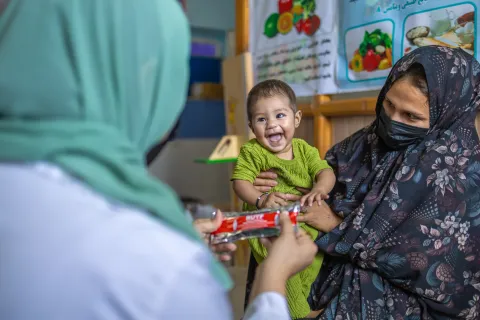
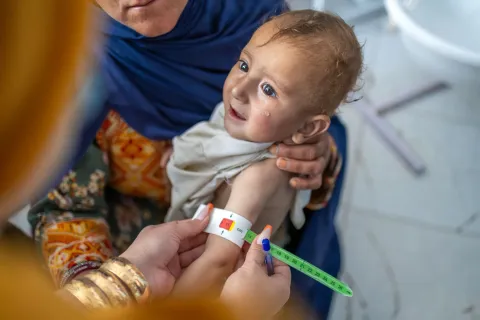
UNICEF through its First Foods Initiative is reaching hard-to-reach families– families that are vulnerable and have children on the verge of child food poverty – and providing them the tools and information they need to improve the diets of young children, as well as with supplies of Micronutrient Powder (MNP). The MNP has 15 essential vitamins and minerals, that play a crucial role in preventing micronutrient deficiencies that can lead to wasting and stunting in children under two years of age.
“I am the only caretaker of my children. While I cannot do much, I stay connected with our community health worker to keep learning about my children’s growth and health. She gave me a micronutrient powder that I add to my younger children’s meals. It helps add nutrients that are usually missing in our everyday diet. Seeing my children healthy and active brings me a lot of peace,” says Nikbakht.

Nikbakht and her family earn around USD 400 from selling their potatoes each year. Living on around 30 USD every month, she must arrange for meals, clothing and household items and other necessities. Climate crisis in the region is now adding to the already challenging lives of the people of Bamyan. “We have been facing drought for the last few years. It affects our potato produce, and endangers our only source of income and living,” says Nikbakht. “This year, it has not rained since March, and the water in the stream is also decreasing,” she adds, visibly worried about the challenges that the coming months may bring to her and her children.
UNICEF provided MNP to over 62,000 families in 2024 and is reaching more in 2025. While Nikbakht’s two-year-old daughter Azar gets a chance to grow healthy, many children stay at the verge of losing their potential for growth and a healthy start to the life. The First Foods Initiative is our collective answer to this crisis. It repositions children’s diets—not just services—at the heart of the response. For too long, nutrition investments in Afghanistan have focused mainly on the provision of services through health systems or the production of staple foods through food systems, while overlooking the food and dietary needs of very young children, especially during their first two years of life. This is the critical window for prevention—because over 80% of malnourished children are under the age of two are the same age group most affected by child food poverty. If we can get their diets right during this formative period, we have a real chance to break the cycle of malnutrition for good. A bold shift is needed from simply growing food to growing nutrition.