A father’s regret, a sister’s determination
A week after an attack at a high school, the streets are eerily quiet

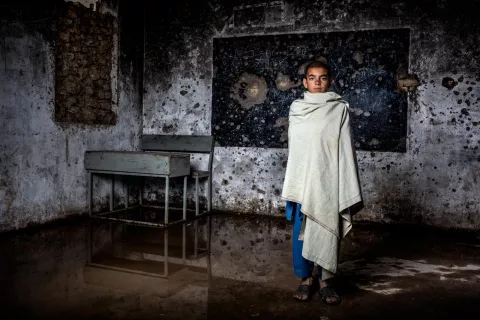
Kabul – Afghanistan. The streets are eerily quiet; there is an air of heavy grief all around. The alleys, doors and walls are covered in black. The silence is broken only by the footsteps and low murmuring of the mourners shuffling up and down the street, and the periodic and excruciating screams of grief from relatives and friends who have come to pay their respects to the more than 85 families who lost their children and loved ones in the barbaric attack on the Sayed ul Shuhada high school last week in the Dasht-e-Barchi district of Kabul.
Located in an impoverished neighbourhood, the Sayed ul Shuhada high school operates in three shifts due to the high demand from students and their families. Daily, the second shift is dedicated to girls.
A father’s regret
Twenty minutes before the first explosion, Mohammad Hussain Nazari, 56, left his home. His four daughters attended the Sayed-ul-Shuhada high school. He stopped at the school to see his daughters and ask them what gifts they wanted for the upcoming Eid holiday. He also cautioned them to go straight home as soon as school finished. His conversation with them was cut short by a call from work. As he walked away talking, he had barely made it 100 meters when the first blast shook the ground.
Nazari ran back to the school terrified for the fate of his daughters. All he could think was, “Are they alive?” As he ran, panicked, scared and confused, the second explosion happened. Then a third.
Fifteen minutes after the first blast, Nazari received a phone call saying two of his daughters had made it home. A short while later, there was another call: his third daughter had also made it home. But there was no word on the whereabouts of Rihana, his fourth daughter.
Nazari searched for Rihana for more than five hours. Asking everyone he met, running to different hospitals and clinics, he eventually came to the Sehat-e-Watan Hospital. Guided into a ward where some of the dead students had been laid out on the ground, he saw her lifeless body.
Numbed, he whispered over the body of his youngest child, one of a set of triplets, “Forgive me that I couldn’t see you one last time, my dear child.”

All I could think of was, she’s only 15 years old. My Rihana, gone forever. All her dreams of becoming a doctor to serve the underprivileged people of our community, done, gone, over. I was going crazy thinking about my children,
A sister’s determination
The top student of grade 10, Amena Rezaye, 18, lost many friends and classmates in the horrific attack. A chance request by the headteacher may well have saved her life. Before leaving school that day, the principal asked Amena to reorganize the chairs and desks.
As Amena pulled and pushed the chairs and tables into lines, the first blast, a car explosion, shattered the silence. Shards of glass littered the classroom. Instinctively, while in shock, she walked to the empty window-frame to survey what had just happened. She remembers that her body began to shake uncontrollably.
“I could only say, oh God, please no, please…” I don’t think I said anything else,” Amena remembers.
“It was terrible scene. Some girls were running, screaming, to the school gate as teachers tried to stop them. But that's when the second explosion happened. I could see so many bodies; we lost so many students. Then the third explosion claimed even more lives.”

“My eyes are wide open at night. If I fall asleep, I see the faces of my dear friends. I see the images of that day and countless students lying in their own blood. I want to return to school to see my teachers and my friends. I feel better when I see them and talk to them and I hope to get better again, mentally and physically,” says Amena.
As well as healing her own wounds, Amena has to look after the well-being of her little sister, 13-year-old, Fatima Rezaye, a grade 7 student at the same school. She was also injured in the blasts.
Fatima talks over and over about seeing girls lying on the ground, unconscious, with blood running from their heads, hands and legs. She recounts schoolbooks scattered, and her classmates’ bags stained with their own blood and riddled by shrapnel.
“At moments,” says Fatima, “I felt like I was not going to make it out of there.”
Although the family is still scared, for Fatima’s and Ameena’s sakes, they are encouraging Fatima to study at home while she heals and return to school with her sister as soon as she is able.

A student’s dream
Habiba is 12 years old; she is in grade 7 of the Sayed ul Shuhada high school. Habiba loves to solve maths problems and she wants to be fluent in English.
With a family of seven burdened by poverty, and with a mentally ill father who works as a cobbler, going to school and changing her future and that of her family is a top priority for Habiba.
On the day of the explosion, Habiba left school earlier than usual. She and her friends were talking excitedly of buying clothes for the coming festivity of Eid ul Fitr. She had just reached the canal, close to her school, when the first explosion occurred. The force of the blast propelled her into the ditch.
“I was in shock; I couldn’t feel any part of my body. I could only hear the painful screams of my friends and classmates; then, I think, I fainted.”

It wasn’t until later that evening a man noticed a child lying in a ditch. Picking Habiba up, he took her to a nearby clinic where she was given medical help.
Habiba’s mother is hesitant to send her to back to school. But Habiba is determined to return and achieve her, now, many dreams of becoming a pilot, a police officer and a nurse.
“Those were the dreams of my classmates. Now, they are gone, and I am here, I will live for them and do my best to realize their dreams by serving my people right.
A principal’s iron will
Aaqela Tawakulli 42 has been the principal of the Sayed ul Shuhada high school for nine years. Minutes before the triple blasts that killed and injured many of her beloved students, the principal, as was her routine, was standing in the schoolyard with some students and teachers when the first explosion happened. Aaqela rushed to the main gate to stop the students from leaving.

Before she could help her students, the second explosion rocked the school.
Reeling from that shock, she paused, wondering, “Will there be a third, or is it safe to run to the students?”
“I looked two of the brave and selfless teachers in the eye and said, “We have to go get them; now!”
We only took a few steps and the third explosion shattered the neighbourhood. I could see body parts and students strewn on the ground bleeding, Aaqela says quietly.
There are more than 7,500 students in Sayed ul Shuhada high school, and too few teachers. On the day of the attack 4,500 students were in attendance in different shifts.
“If only we had more teachers, we could have helped more students,” she says regretfully.
UNICEF’s response
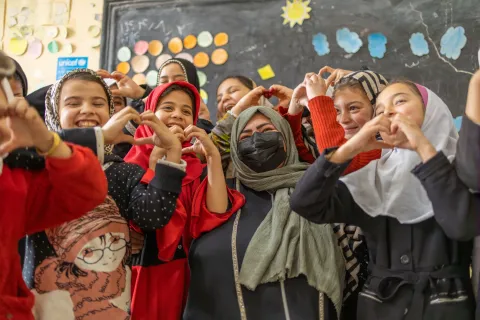
In response to the atrocity, UNICEF conducted a Rapid Needs Assessment with the children and families affected by the school attack in cooperation with child protection organizations and the Ministry of Labour and Social Affairs, Martyrs and Disabled. As a priority, UNICEF is providing psychosocial support, feminine hygiene kits and case management support to affected children.
UNICEF is also working closely with the Ministry of Education to provide teaching and learning materials as well as psycho-social support for the students and teachers so that they can resume classes. This will include recreational kits with equipment for sport activities, blackboards and chalk, teaching aid materials, and notebook and pens.