Phone project helps young and old to connect in Ukraine
A telephone befriending service is helping people to come together at a time when COVID-19 and ongoing conflict is forcing many apart.

- Українська
- English
At first, the March 2020 quarantine did not seem so unusual to Ukrainians. For some, it seemed like a two-week holiday, a chance to relax and spend time with their families. But nobody was prepared for a national lockdown, an economic crisis and thousands of deaths.
Over the ensuing weeks, the public rallied and began to help those in need by delivering food packages, walking pets for the elderly or purchasing oxygen concentrators for hospitals.
UNICEF Ukraine, too, was determined to help. One of its most successful projects, delivered in partnership with the Ukrainian Volunteer Service, was the My Phone Friend project.

The check-in and chat initiative worked to support people who found themselves alone — the elderly, people living with disabilities, single parents and families with young children. By uniting volunteers and people in need by telephone, hundreds overcame loneliness, stress and uncertainty through warm and friendly conversations. Volunteers also shared breaking news, verified pandemic and vaccination information, celebrated birthdays and even learned foreign languages.
Making a connection
Telephone befriending is a simple and effective tool for building invisible bridges between young people and the elderly. It also helps to build trust, understanding, respect and awareness between regions, cities, cultures, communities and generations.
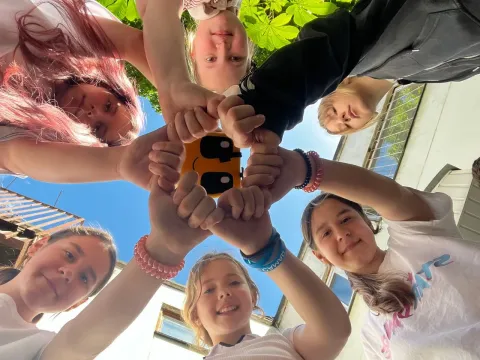
Today, almost 40 per cent of the My Phone Friend volunteers are teenagers between the age of 13 and 18. More than 600 single people from all over Ukraine participate in the project and around 10 per cent are people with disabilities.

“Telephone volunteering performs two tasks: individual and public,” explains Anna Bondarenko, the head of Ukrainian Volunteer Service. “On the one hand, My Phone Friend improves the lives of specific people who, through communication, feel cared for, receive verified information on important topics, and experience crisis times more easily. At the same time, telephone volunteering is a tool to increase social trust as well as break down stereotypes. For example, the fact that strangers are not ready to help unselfishly, and young people live solely for themselves.”
Friends from afar
Margarita, 22, from the city of Uzhhorod in western Ukraine, has been talking with a 37-year-old woman who cares for her parents and has no friends.
At first, Margarita says it was extremely difficult to build her trust. But now the pair call each other twice a week to share the latest news from their own lives.

No less touching is the story of 16-year-old Maria from Zhmerynka. The youngster joined the project in December 2020 and was partnered with 61-year-old Olga from Poltava. The pair immediately struck up a firm friendship that lasts to this day.
"I do not communicate with my phone friend out of pity or because it is necessary,” says Maria. “I really want to call her and share what happened to me in a week. I also listen to her stories with the same pleasure. I feel real emotions during the conversation and it's valuable.”

Fifteen-year-old Yulia Karkusha from the Lviv region even teaches her telephone friend English. Eugenia, 73, lives alone and loves to learn new skills. Yulia prepares various topics for their telephone conversations, such as art, the lives of famous people or major historical events.
Keeping in touch
Since its launch in June 2021, My Phone Friend has mobilized around 7,000 youth volunteers from all over Ukraine and continues to help people who may need telephone support. At any given point in time, at least 1,500 pairs of friends maintain regular communication.
For so many, the weekly calls have become an opportunity to connect, share life experiences and learn more about different generations. Volunteers have also become a vital source of reliable information about health, COVID-19, vaccination and other important issues for elderly people. UNICEF helps to train the volunteers via webinars and mail-outs.

"It's like a breath of fresh air for lonely people who needed to communicate before the pandemic,” says Ms. Halyna, a user from the Donetsk region. “My phone friend Sasha helps me understand what is happening outside, because I can't leave the house.”
Lotta Sylwander, UNICEF Representative in Ukraine, hopes more volunteers will come forward: "Overcoming loneliness and bringing people closer in times that require distance is undoubtedly an unprecedented challenge that no organization can address alone,” she says. “This is why we are calling upon Ukrainian youth to help. We hope that this project will be an effective response to the secondary impacts of COVID-19 and will start a successful tradition of telephone volunteering in Ukraine.”