

UNICEF’s Cash Transfer Programme brings hope to vulnerable families with young children in Sri Lanka
.

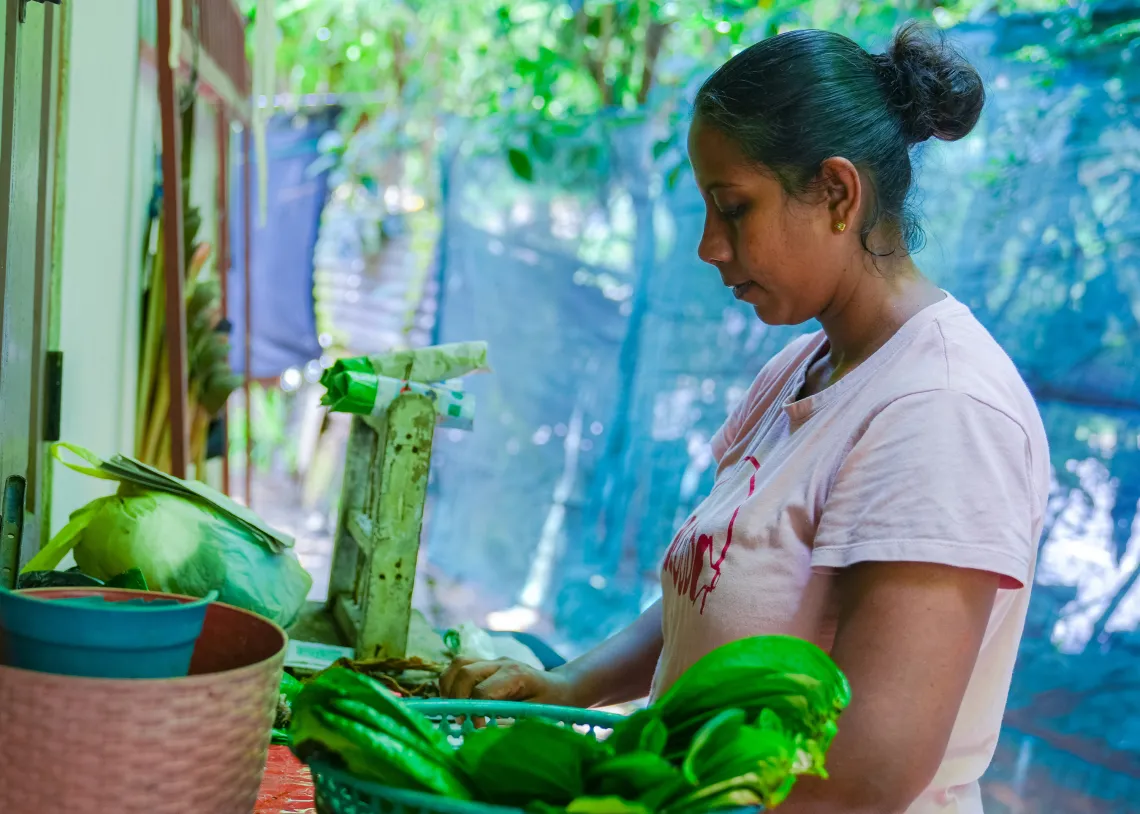
Ms Damayanthi Dissanayake (36), a mother of five children from Ratnapura, in Sri Lanka’s Sabaragamuwa Province, is one of many recipients of the UNICEF nutrition-sensitive short-term cash transfer programme – a lifeline transforming the lives of many vulnerable families with young children across Sri Lanka.
Damayanthi's story is one of strength and determination. The mother of five only studied upto level 8 in a local school and has had no gainful employment. Ms. Damayanthi strives to make ends meet by selling betel quid (paan) - a small home-based business she runs whilst taking care of her children; the three older girls are 15, 11 and 7 years of age and attend a nearby school; the one-year-old twins, a girl, and a boy, are the latest addition to the family.
“In the mornings when the older children are at school, I am busy looking after the younger two,” she says. The twins are a handful, but she finds the time to prepare the betel quid – a traditional mixture of betel leaf, areca nut, slaked lime, and tobacco. “The afternoons are a little easy for me as my older children help me take care of the younger ones. I use this time to start selling the quid to workers returning home from the nearby tea estate,” she explains.
“The past four years have been tough for us. My husband is a day-wage earner. The onset of the COVID-19 pandemic and the economic crisis reduced his employment opportunities,” she adds. To add to their struggles, her husband, Janaka, faced extended hospitalization two years ago, further crippling the family’s income. The mere 500 odd rupees she earns by selling betel quid, barely covers any essential daily expenses.
When the twins were born prematurely last October, one severely underweight, Damayanthi struggled to provide the necessary nourishing food for the children’s growth and development.
Fortunately, in April, UNICEF’s nutrition-sensitive short-term cash transfer programme commenced registration in Ratnapura. This was a turning point for Damayanthi. “I got to know about the programme from the midwife. I registered at the nearby clinic,” she explains. “So far, I have received two tranches of cash transfers. It has made a big difference in our lives”
UNICEF’s nutrition-sensitive short-term cash transfer programme is a response to the increasing vulnerabilities of families in the face of the country’s economic crisis and the alarming rate of child undernutrition. Aimed at providing critical support to mothers and caregivers with young children, UNICEF collaborated with the Department of National Planning (NPD), the Ministry of Women, Child Affairs, and Social Empowerment, and the district authorities of nine districts identified as most vulnerable, to implement the programme.
Targeting families with young children born between 1 May 2021 and 31 December 2022, that is, roughly aged five months to two years, the programme is aligned with existing government initiatives and commitments to support young mothers. The support provided to these families encompasses four monthly disbursements of Rs. 6,750 (USD 20.86) per eligible child and is funded by the United States Agency for International Development (USAID) and the Department of Foreign Affairs and Trade, Australia (DFAT).
The cash transfers have provided significant relief to Damayanthi’s financial struggles, enabling her to provide for her children. “I spent most of the money ensuring my 4-year-old daughter improved her weight as the midwife told me she was undernourished. The rest of the money was spent on food items for the twins,” she explains. "I purchased essential items like eggs, chicken, lentils, chickpeas, vegetables, and even cheese for my children."
Ms Dhammika Munasinghe (50), Assistant Director of Planning, Ratnapura Divisional Secretariat Office, emphasizes the meticulous planning and implementation that went into ensuring the success of the programme.
“Eligible mothers and caregivers were provided with all the support, including in opening bank accounts and the convenience of registering for the programme at their local divisions. Additionally, the option for working mothers to register during the weekend, for those who missed registration at the local division, the convenience of registering at any nearby division, and the option of registering directly at the Divisional Secretariat, was also provided.”
In the Ratnapura District itself, over 21,000 mothers and caretakers are part of the programme. With 21 tea and rubber estate communities, the district is considered one of the most vulnerable districts.
Ms W. N. A. Menike (55), a midwife in Ratnapura, played a vital role in connecting families like Damayanthi's with the programme. "This programme has offered a crucial lifeline by providing the means to guarantee that children receive nutritious meals, thereby relieving the burdens on these mothers and enhancing the well-being of the children.”
Mr W. M. N. Wijekoon (43), the Development Officer for Malwala, Ratnapura adds, "This programme provides families in the area with valuable financial assistance to help meet their children's nutritional needs. The programme has proven to be immensely successful.”
Currently nearly 115,0000 families like Damayanthi’s, in nine most vulnerable districts, have been reached through this programme, fostering hope and resilience in communities across Sri Lanka. The programme aligns with existing government initiatives and demonstrates UNICEF's commitment to bolstering essential support systems for vulnerable families during challenging times.


