Supporting rural families in Sri Lanka to adopt sustainable healthy lifestyles
A story from Kilinochchi

The Sivakumar family in Kilinochchi, in the Northern Province of Sri Lanka, is preparing their backyard to grow manioc yams. In their little home garden, they have already attempted growing chillies, brinjals, tomatoes and a few leafy greens. “Manioc grows well in the Kilinochchi soil and can substitute rice as the staple food if need be – and it’s very healthy too,” explains Mr Sivakumar (50), a fisherman turned bank clerk.
Maintaining the garden takes a lot of effort – Mr Sivakumar used to do it alone, but now his 13-year-old daughter Thadchayini, with her newfound interest in healthy eating, helps him out by regularly watering the plants.
A typical teenager, Thadchayini had not always shown interest in eating healthy, or even gardening. In fact, being the only child, she would rule the roost at home and con her parents into allowing her to consume sodas and junk food, instead of the food prepared at home.
“My wife and I dote on her at home and try to provide her with the best of everything. The best education and good healthy food. But unfortunately, children are not necessarily fond of nutritious food or spending time doing schoolwork. My daughter lacked discipline and I didn’t know how to enforce it. Trying to sweet talk her into it, she would sweet talk right back and get her way out. When her mother insistently serves her leafy greens and other nutritious vegetables, as soon as the mother leaves, she would swiftly scoop it onto my plate. I would obligingly eat it before her mother spotted it. She knew how to play us.”
It was through a community awareness activity in late 2021 that the way of life for Thadchayini and her family changed.
Thadchayini explains how the awareness activity changed her attitude towards life.
“A few months ago, the community mobilizing officers started coming to my home to talk with us. Initially I used to be quite shy and refused to interact with them. With time they made friends with me and drew me out. They gained my interest in good habits such as reading and nutrition and convinced me to implement them in my life.”
“I am now aware of the nutritious values of vegetables and green leaves. Even though I still haven’t acquired a taste for it, I no longer pass the green leaf curry to my father. I like it when my mother makes juices. She likes to experiment with different types of green leaves. I prefer the juice to curries and salads.”
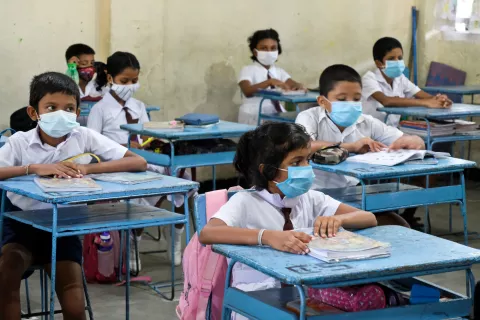
The community awareness activity is one of many under the Educational Environment Improvement Project being implemented in the Kilinochchi District. The project, which commenced in 2018, aims to enhance children’s education by improving various aspects of their learning conditions, including school facilities, teaching and learning methods, and community awareness and strengthening. The project is implemented by UNICEF, together with civil society organization (CSO) partner Organisation for Eelam Refugees Rehabilitation (OfERR), with the financial assistance from the Korea International Cooperation Agency (KOICA).
Much to the relief of her parents Thadchayini is no longer a fussy eater. She is conscientiously taking responsibility for eating healthily. Though previously she would pick the meat and dhal curry off her plate, now she eats everything she is served – a meal carefully curated by her parents to be the most nutritious possible, within their meagre budget.
Mr Sivakumar’s primary concern is the health and well-being of his family, especially that of his daughter. He is happy with the holistic approach of the programme that looks into providing the healthy lifestyle for his daughter.
The project’s community awareness efforts have engaged with 5000 families in Kilinochchi and provided essential support to children and parents to develop healthy lifestyles to make the most of the improved quality of learning provided.
“The programme has also made my daughter more confident and friendly. I was overprotective of her and didn’t let her go out to play with other children. She thus had no social skills outside the home”, explains her father. “The project officers identified this as a barrier to her holistic development. They took the trouble to draw her out so that she becomes friendly with them over time – then advised me that it was in her best interests to let her socialise with her peers.”
“I acceded to the project officers’ advice and allowed her go out to play with the neighbourhood children on her own. I am happy that she has visibly blossomed since then into a more confident and engaging child. She has also become conscientious and responsible. I now realise that we were smothering her from achieving her potential.”
By fostering her social development into a more responsible and confident young teenager, he feels they are better able to navigate the challenging times ahead with their more dependable, health-conscious daughter.
The holistic development approach has also left the family well prepared for imminent food shortages and increased cost of living in the country.
“Buying food, even those that we considered cheap, and freely available, is becoming unmanageable,” he said. “We also face a lot of challenges getting our home garden together; drought and regular wild animal attacks have hindered this process several times.”
Despite the myriad of challenges, he is hopeful of having a thriving home garden and continue to provide his child with the kind of healthy nutrition she needs, from their own home garden, if need be.