Stitching hope
Celebrating importance of empowering girls and women this International Women’s Day

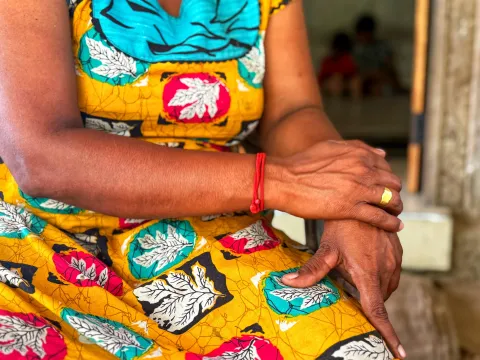
As a little girl, Chathuri would press her face against the glass panes of clothing store windows, mesmerized by the colorful, intricate embroidery of the dresses on display. She imagined what it would be like to wear them; something created with love and care. But for most of her childhood, surviving each day was the only thing on her mind.
Chathuri’s story is one of resilience, and ultimately, empowerment. Born into a family struggling with poverty, she lived with her grandmother and mother after her father abandoned them. Her mother - a daily wage laborer, fought hard to keep the family afloat, sending Chathuri to school for as long as she could. But by the time she was in the third grade, the financial strain became too much, and Chathuri was forced to drop out.
Life took another turn when Chathuri’s mother remarried. Home soon became a battleground. Fights broke out frequently, and one day, when Chathuri was just 13, her mother had left without a word.
What followed was a nightmare. Left alone with her grandmother and stepfather, Chathuri became a victim of repeated rape. Terrified and alone, she endured in silence, not knowing where to turn.
Why am I taken away?
It was the neighbors who eventually noticed her distress and alerted the area medical office. Midwives visited the house and confirmed her pregnancy. Chathuri was removed from her home, placed under the care of the state and thereafter transferred to a children’s home.
The pain of separation from her only close relative, the loss of freedom - it all felt like another cruel twist in her fate. Chathuri says back then, she remembers thinking, “I didn’t do anything wrong. Why was I the one being taken away?”.
"I was told by the probation officers overseeing my case, to think about what I wanted for my future, what I wanted to do. . .At first, I resisted. With all that happened I thought to myself, what future could I possibly have?”
But slowly, a childhood memory surfaced - the shop windows, the dresses, the beautiful fabrics. And so, when asked by the Probation Officer what she would like to learn, she decided it would be sewing.
Child protection and child-friendly justice
The probation officers made arrangements for her to take sewing lessons, and for the first time in a while, Chathuri felt a spark of hope. With every stitch, she found a way to rebuild herself. She immersed herself in her training, her fingers weaving together not just fabric, but the scattered pieces of her own life.
The officers focused on ensuring Chathuri’s continuous safety, while facilitating means to improve her skills and confidence so that she is able to leave the care home and lead an independent life. By the time she turned 18, Chathuri had developed a marketable skill.
Later, they connected her with a bridal designer, securing her an apprenticeship. It was more than just a job; it was a lifeline, a way to stand on her own feet. She worked tirelessly, learning new techniques, perfecting her craft, and earning an income that allowed her to dream again.
Appropriate child-friendly justice and child protection for child survivors of violence requires immediate intervention to ensure safety. But it also goes beyond, to provide sustained support and social reintegration as soon as possible. Making decisions that prioritize children’s safety and continuous development, ensuring family strengthening and family reunification, are some areas that probation officers and judges are reflecting on, through the European Union-funded Support to Justice Sector Reforms project (JURE), jointly implemented by UNICEF and UNDP.
Today, Chathuri is no longer the frightened girl who once felt powerless. She earns her own money, supports herself, and has plans to go even further. Through support from the JURE project, she is even set to receive a sewing machine - one that will allow her to train other girls like herself.
“Someday, I will start my own business, and I will employ girls like me,” she says, determination shining in her eyes. “It is my only hope.”
“Many girls who experience violence are unfortunately placed in care homes in Sri Lanka. This is due to many reasons, including lack of adequate supportive services in the community. Chathuri’s story demonstrates that the home is and can be the best place for girls to recover from their experiences of abuse, closer to family members and friends they trust. For girls whose placement in care has been unavoidable, the priority is to support their education and empowerment and facilitate their return to society as soon as possible,” says Bismarck Swangin, UNICEF Chief of Communication in Sri Lanka.
“When girls like Chathuri are given the right opportunities, they don’t just lift themselves, they create ripples of change that uplift entire generations,” he added.

Children recover better in family settings
Chathuri’s story is not an isolated case. Child victims of abuse, especially girls, are frequently placed in children’s homes as per years of practice, which saw institutionalization of children as the best way of ensuring ensure the child’s safety and welfare.
However, the UN Guidelines for Alternative Care for Children suggest that family is the best place for the child to grow up and note that placement of children in care facilities should only be considered when absolutely necessary.
Sri Lanka’s Alternative Care Policy amplifies these principles and aims to offer children better opportunities for developing in a safe environment, in family settings. The Department of Probation and Childcare services in cooperation with UNICEF and through support of JURE, succeeded in reintegration and family reunification of over 1,600 children while thousands more have been prevented from leaving their families.
UNICEF and partners are also working to ensure that child victims of abuse receive supportive services while they remain in the safety of their homes, continue learning and leading their normal lives.
International Women’s Day is a reminder that the empowerment of girls and women is not just about offering them immediate safety, but also about giving them the tools and opportunities to reclaim their lives, enabling to continue learning in schools and living in supportive communities, close to their families.
This involves reshaping power dynamics by guaranteeing inclusive access to education, employment, and decision-making spaces, particularly to girls and women in vulnerable situations. Chathuri’s journey is proof that resilience, when nurtured with support and opportunity, can transform a survivor into a leader and a mentor.
As the world celebrates women’s strength, courage, and potential, Chathuri’s story stands as a testament to why investing in girls and women is not just necessary, it is life changing. With every stitch, she is not just creating a work of art; she is crafting a future filled with hope, dignity, and empowerment.
The Support to Justice Sector Project (JURE), funded by the European Union and jointly implemented by UNICEF and UNDP in collaboration with the Ministry of Justice, aims to strengthen the justice system to be more accessible, efficient, and inclusive. UNICEF leads efforts to enhance child-friendly justice and child protection processes, ensuring better protection and support for children within the legal system.