A safe space to heal after Cyclone Ditwah
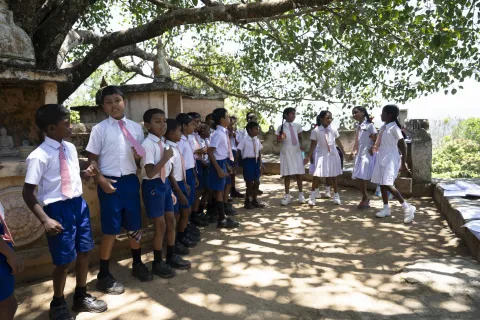
Child-friendly spaces established with the support of Japan in Cyclone Ditwah affected communities help children reconnect, play and support their mental health and psychosocial well-being.

Lately, 10-year-old Thyadi is happiest when she is around other children. Three days a week, despite her mobility limitations, she makes her way to the community hall in Sangili Kanadaraawa, a small village in north-central Sri Lanka, where she joins other children in play.
This was not always the case. Just a few months earlier, it would have been difficult to imagine.
When Cyclone Ditwah struck, Thyadi could no longer go to school. She was separated from her teacher and the familiar routine she loved, leaving her to spend much of her time at home. Like many children affected by the cyclone, she lost the everyday connections and activities that gave her a sense of normalcy.
With support from the Government of Japan through UNICEF, a child-friendly space was established in Sangili Kanadaraawa in January 2026 to support the mental health and psychosocial wellbeing of children impacted by the disaster. Equipped with toys and activities, the space gave children an opportunity to play, spend time with their peers and reconnect after the disruption caused by Ditwah.
For Thyadi, it also opened a door to something she had found difficult before - interacting with children outside the small circle she knew.
A challenging childhood
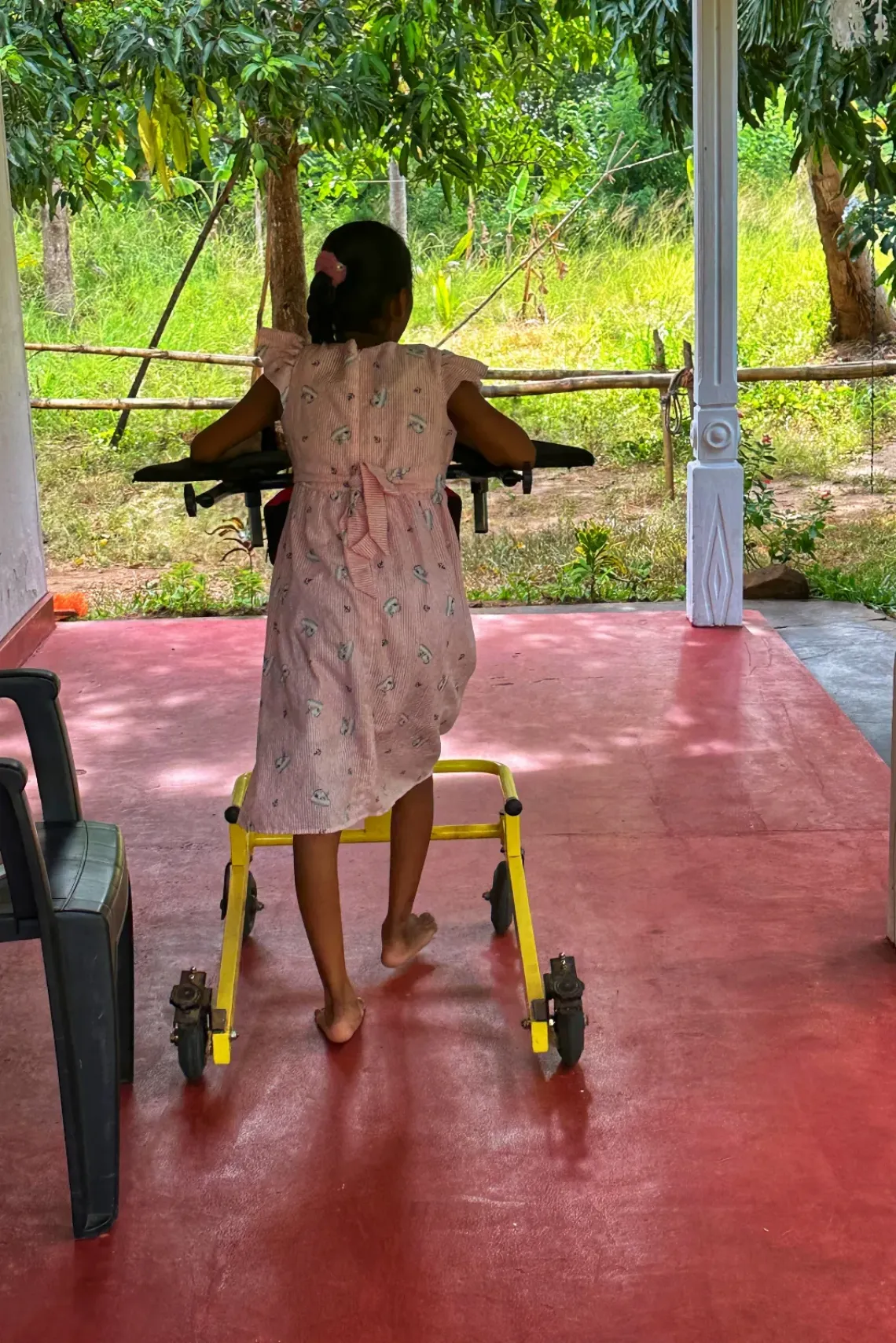
Thyadi was diagnosed with cerebral palsy at six months old. She is non-verbal and has limited mobility. She relies on her family for support with many aspects of daily life. She communicates through her own unique sounds, walks with the help of a walker, and does not let anything restrict her from expressing herself and what she loves.
Her mother, Kavini Wathsala, remembers that even as a baby, Thyadi found it difficult to adjust to unfamiliar surroundings but recalls how her strength and resilience kept her going.
“She would cry her lungs out as a baby,” Kavini recalls. “Sometimes she would turn blue from crying, and we would immediately have to take her to a nearby medical facility to give her oxygen.”
The family learnt to take extra precautions when travelling with her due to her health and medical needs. As a result, much of her early childhood was spent between home and the hospital.
As she grew older, school became one of the places where she felt most comfortable. She attends a special education class and loves interacting with her teacher. But her opportunities to interact with other children were limited.
“Other children would look at her and point at her because they were curious,” Kavini says. “But there was never really any interaction beyond that.”
Cyclone Ditwah disrupted the routine she had come to rely on.
“She became very moody,” Kavini says. “Not being able to go to school and having to stay indoors because of the rain and floods frustrated her.”
The experience was shared by many children in the community. Even before the cyclone, there had been no dedicated place for children to play in the village. The cyclone exacerbated the need to establish a dedicated space for children in the village. Kavini says some children had never even held a bat. Instead, they made their own games and toys from whatever was available, including dried coconut branches.
With funding from the Government of Japan and support from UNICEF, the Rural Development Foundation (RDF), together with Grama Niladharis and Child Rights Protection Officers, conducted a rapid assessment of children in the worst-affected communities following the cyclone. The assessment identified children affected by the disaster, including children with disabilities who might require additional support.
Based on the findings, 55 child-friendly spaces were established across the Northern, Eastern, North Central and Northwestern provinces, including the space in Sangili Kanadaraawa.
To make the spaces more inclusive, UNICEF also organized a two-day training led by an international expert on inclusive child-friendly spaces. The training equipped implementing partners and community volunteers with practical guidance on creating spaces where children with disabilities could participate alongside their peers.

To play and interact
Three days a week, children between six and 10 years old gather at the space for two hours. With the support of a community volunteer and parents in the village, they take part in indoor and outdoor activities and have time to play together.
For the children, the space offered something simple, but important for their well-being: an opportunity to spend time with their peers.
“The children were able to come together, play and get to know each other,” says Sampath Madusanka, Field Coordinator at the Rural Development Forum.
For Thyadi, becoming part of the group took time.
She was not accustomed to being around unfamiliar children and would become overwhelmed in new social situations. But as she returned regularly, she gradually became more comfortable. The other children became familiar faces, and she began taking part in activities alongside them.
Kavini has noticed a change in her daughter since she began visiting the space.
“She has started to become more comfortable around the other children,” she says. “Before this, she would get frightened when she saw children she didn't know. Now she enjoys being around them.”
Thyadi also enjoys mathematics. During a recent activity, she demonstrated her skills using an abacus, carefully moving the beads despite the difficulty caused by limited movement in her hands. It took time and effort, but she persisted, determined to complete the activity herself.
“Even when it is difficult for her to move her hands, she tries to do it herself,” Kavini says.
For children recovering from the effects of a disaster, these opportunities to play and interact with their peers can be an important part of their mental health and psychosocial well-being. The child-friendly space provides a safe environment where children can reconnect, express themselves through play and rebuild social connections.
But recovery for Thyadi's family is also about rebuilding their livelihood.
The family's paddy crop was completely destroyed by the cyclone, taking away their supply of rice for the year. Thyadi's father, the family's breadwinner, works at a hotel. To help the family strengthen its income, Kavini has also received livelihood and entrepreneurship support.
“We lost the paddy we had cultivated for the year,” Kavini says. “It was very difficult for us because that was the rice we depended on for the whole year.”
For families affected by Cyclone Ditwah, recovery takes time. It means rebuilding livelihoods, restoring access to education and helping children regain the routines, relationships and sense of security disrupted by the disaster.
In Sangili Kanadaraawa, the child-friendly space has become one part of that recovery.
For few hours each week, children can gather with their friends, try new games and simply play. For Thyadi, it has also become a place where she can communicate in her own way, participate at her own pace and feel part of a group.
With support from Japan through UNICEF, as part of the UN Sri Lanka Humanitarian Priorities Plan, over 40,000 children affected by Cyclone Ditwah were given the space and support they need to reconnect with their peers and begin rebuilding a sense of normalcy after the disaster.