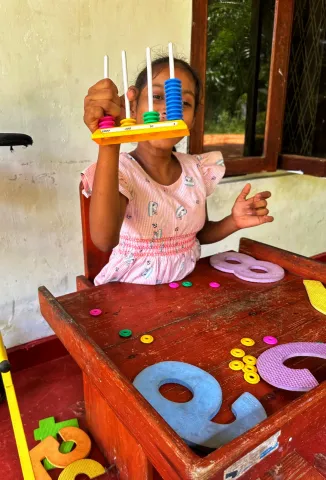
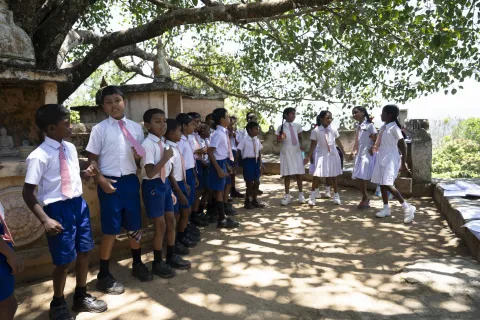
Remedial classes help primary graders in Sri Lanka catch up after multiple school closures.
Learning opportunities to make up for lost time

Nepul (10) and his grade-5 friends from Christ Church School in Hanguranketha, in Sri Lanka’s Central Province, stay after school for extra lessons in mathematics and their native language, Sinhala. With action rhymes and writing activities, the specially curated remedial learning class is designed to help them overcome the lost learning due to school closures during the COVID-19 and the 2022 economic crisis in the country.
“Schools were closed multiple times from 2020 – 2022, and young children lost crucial learning years – especially those who commenced lower primary education in 2020. Children are introduced to numbers, letters and the construction of simple words in grades 1 and 2 - proper knowledge of which is vital to progress to higher grades,” explains Ms Nirupa DeSilva (59), a grade five teacher at Christ Church School.
“The effect of school closure on these children’s learning is now visible as we prepare them to transition to secondary school. These students joined my grade 5 class at the beginning of the year. Soon, I realized that some of them took time to grasp Mathematics and Sinhala. This was because they could not recognize and write numbers and letters as fast as they should. Therefore, they could not write long words or understand small, uncomplicated mathematics.”

The education of 1.6 million primary school children in Sri Lanka has been impacted by multiple school closures since 2020; initially, due to the COVID-19 pandemic. The interruptions continued in 2022 due to the country's economic crises. As a result, children across the country have suffered significant losses in their education, especially the literacy and numeracy foundations essential in their transition to secondary school and beyond, both in life and work. This learning gap has also worsened the pre-existing inequalities among vulnerable children.
To ensure these children gain the required proficiency and minimise the learning gap, UNICEF, together with the Ministry of Education, launched the learning recovery programme in 2023.
The programme is designed to bridge the learning gap between the learner’s capacity and the grade requirement and support the student’s transition to higher grades. The programme includes training of education professionals and teachers, hands-on learning and interactive student activities, and regular assessment of learning levels.
“We conducted an assessment in class to identify these gaps and the students requiring special attention. Depending on the areas where they need remedial learning, they receive lessons from the grade two teachers as this is where the learning gap commenced when the schools were disrupted due to the COVID-19 pandemic,” explains Ms Nirupa.
“The students really enjoy the classes as they are practical and interactive. Since the students started the extra classes, I have seen progress in the class. However, there are still some gaps when it comes to the grade requirement.”
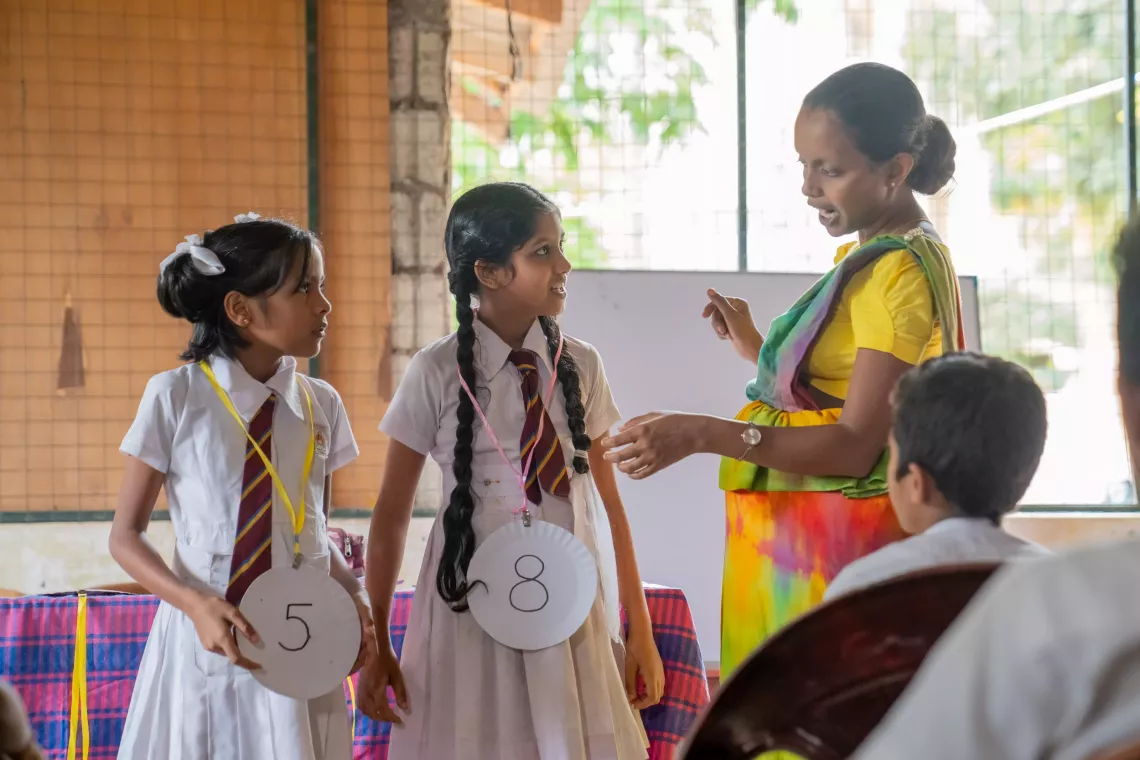
“I hope the classes continue until these students are ready to transition to the higher grade.”
“Nepul will enter Grade six next January,” explains his father, Nandana (38). “He is a keen learner and it is invaluable for him to catch up on maths and local language with his peers to succeed in his education.”
“He enjoys the activity-based learning provided by his grade two teacher and the extra classes have helped greatly with his progress. Earlier, his reading was slow, and he took a long time to do even simple sums. But now this has improved, and he is also getting better results in classroom activities,” he affirms.
The learning recovery programme spans from 2023 – 2025 and has so far benefitted over 150,000 students in over 8,000 schools across all nine provinces. As part of the programme 20,000 education officials and teachers have received special training on conducting remedial classes.