

Raised by Strength
.
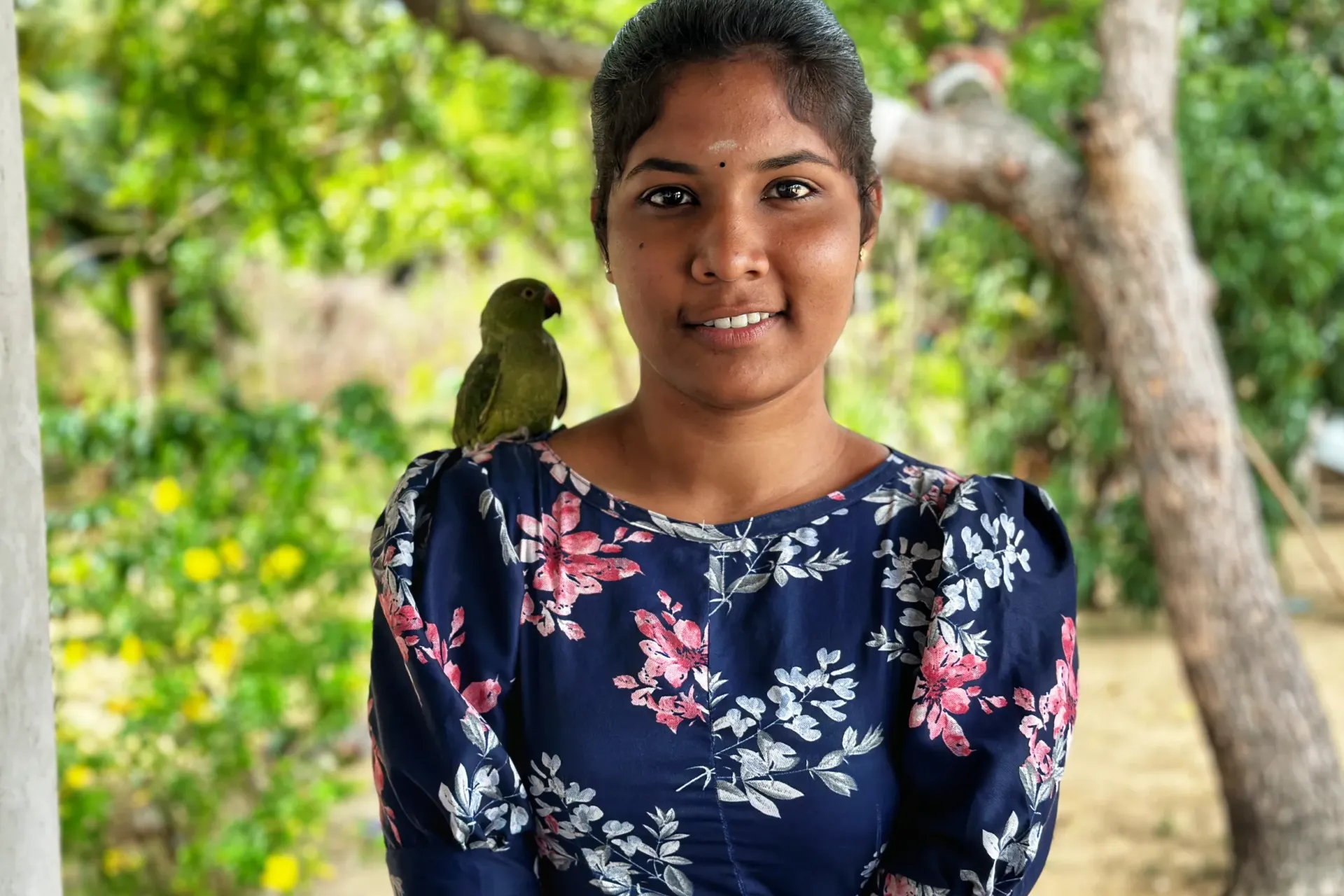
In the quiet northern Sri Lankan village of Muhamaalai, 17-year-old Kavinila Suresh Kumar stands as living proof of what can happen when girls are given the confidence to lead. Her story shines as a reminder of the power of opening up opportunities for young girls.
Only a few years ago, Kavinila barely spoke up in class. Today, she is the Chairperson of the District-Level Children’s Council, leading dozens of children to voice and solve concerns within their communities. When UNICEF’s Adolescent Girls Empowerment Programmeme reached her small village, it paved the way for girls like her to speak up, learn, and empower themselves to see themselves as leaders.
The voice that grew louder
“When I first joined the programme, I didn’t even know how to say sorry,” she laughs. “We used to have small fights among children and didn’t know how to solve them. Now, I know how to handle problems, how to talk to people, and how to lead.”
The Adolescent Girls Empowerment Programme is designed to support girls develop essential life skills, from communication and decision-making to problem-solving and self-confidence. It combines practical lessons with mentorship and safe spaces for open discussion, which in turn pushes girls to think critically and make informed choices.
In rural communities like Muhamaalai, the programme has made a lasting impact on young girls, helping them recognize their potential, build agency, and shape their own paths.
Through leadership skills-building workshops supported by UNICEF programme, and close mentoring by Child Rights Promotion Officers (CRPOs) from the Department of Probation and Child Care Services, Kavinila began to find her voice. “When we had elections for the Children’s Council, I decided to contest. Ordinarily this was not a step I’d have taken,” she says. “Speaking in front of everyone gave me courage. I realized I could lead too.”
She went on to win with the highest number of votes.
Learning to lead, one issue at a time
Since then, Kavinila has been putting her skills to work. When her village faced a shortage of school writing books, she didn’t stay silent. “I reached out to the CRPO and explained the problem,” she recalls. “She gave us ideas on how we could rally for support and she also supported us by arranging funds for books and managed to resolve our issue.”
Her leadership also extended to more sensitive issues. One of her peers once came to her, crying about problems at home; a father struggling with addiction and constant family conflict. “We couldn’t solve it alone, so I once again spoke to community elders and the CRPO, who guided my friend on necessary steps to take. She is now more hopeful about her future.”
She says it was a moment that shaped how Kavinila saw leadership, not as power, but as compassion in action.
The woman behind her strength

Behind this determined girl is her mother, Kala Nandhini, a 44-year-old single mother whose resilience has shaped her daughter’s strength.
Having served previously as an officer of the LTTE police force, Kala now earns a living cooking at weddings and selling food. Her hands, weakened by nerve pain caused by years of stress, still move swiftly over the pots. “People used to say, ‘How can she educate her daughter to pursue higher studies? She’s alone, how will she do it?’” Kala recalls. “But I never stopped believing in my child.”
When Kavinila was seven months old, her father passed away. Since then, Kala’s life has been a series of sacrifices, long hours, and little rest.
Kala is also a beneficiary of UNICEF’s programmes. Having participated in a UNICEF-supported session on positive parenting sessions, Kala learned new ways to guide her daughter, moving away from harsh discipline to open conversation. “She’s very stubborn,” Kala smiles. “But now, I talk to her like a friend. We understand each other better.”
Despite pain in her arm and legs, Kala continues to cook and work, motivated by her daughter’s determination. “When I see her reading late at night, I feel proud,” she says softly. “I know everything I have endured was worth it.”
A dream that keeps her going

Now in her Advanced Level studies, Kavinila has chosen the Arts stream, as a foundation for her biggest dream; to become a lawyer.
“Some people said a middle-class girl like me will never be able to do it,” she says. “But I want to prove them wrong. I want people to say, ‘She’s a lawyer and she came to that position because of how she was raised by her mother, alone.’”
For her, law isn’t just a profession; it’s a mission. “Sometimes innocent people are judged unfairly because lawyers don’t represent them well,” she says. “I want to change that.”
The girl who once hid behind her shyness now speaks boldly at meetings and raises her hand to talk about issues, even those that were once considered taboo. “Before, I thought leadership was only for others,” she says. “Now, I know it’s for me too.”
A story of many girls
Across Sri Lanka, hundreds of girls like Kavinila are rewriting their stories through UNICEF’s Adolescent Girls Empowerment Programme, learning to speak up, take initiative, and see themselves as changemakers.
Each girl’s journey is different, but their message is the same: when a girl is empowered, her whole community grows stronger.
As dusk falls over Muhamaalai, Kavinila sits beside her mother, textbooks spread across the table, the sound of crickets rising around them. Her eyes are bright with hope.
“My dream is big,” she says with a smile. “But I’ll get there, step by step.”


