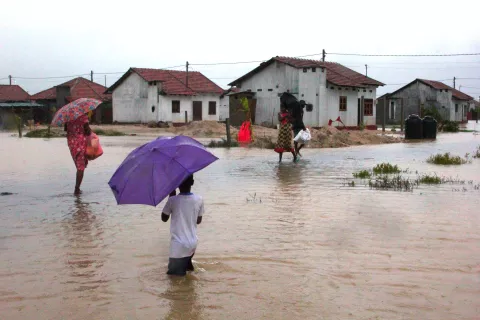
Children take centre stage in efforts to fight Climate Change disasters in their communities
in Sri Lanka

“When we were invited to take part in a disaster management training, we were very excited even though we didn’t know what disaster management meant. And today we are confident of our community’s capacity to respond to the needs of children during a disaster”
Mss Nirasha and Naveesha Colambage are 20-year-old twins from the Bulathsinghala Divisional Secretariat (DS) of Kalutara District – an area prone to natural disasters in Sri Lanka. They both belong to a children’s club in their area.
“It was in 2018 that our children’s club was invited to take part in a training programme in disaster management. We were very excited but apprehensive as we were not familiar with the concept of preparing for and reducing disaster risks,” recollects Naveesha. “But today, four years later, we are confident of our capacity to reduce the risk of disaster in our community, respond to the needs of children during a disaster, and support the local authorities in disaster management.”
“The first training inspired both of us - when we realized the kind of work it involved and how we can impact our community, especially in voicing the needs of the children in the event of a disaster, we were both very enthusiastic,” continues Naveesha. “The training gave us the opportunity to learn from experts, and to work beside them in developing strategies. We were proud to be part of the effort, and to be representatives of children’s needs,” she adds.
“Just the year before, in 2017, we had experienced floods and landslides in our area – Bulathsinghala being located in the Kalu River valley, on the western coast of Sri Lanka, is usually one of the most affected areas during the monsoon season. We lost many lives that year,” they said.
Identified as a climate change hotspot, 96% of Sri Lanka's disasters are related to climate; recurrent extreme weather events and irregular climate trends cause frequent damages in physical, social and economic sectors in the country.
In an effort to improve the country's capacity in emergency preparedness and response, a national and district level contingency and relief plan was implemented in 2018 to reduce the risk of disasters and its impact on communities that are vulnerable to weather related disaster events. The programme focusses on the districts that are most exposed to recurrent disasters caused by the Southwest and Northeast monsoons, including Ratnapura, Kalutara, Galle, Matara, Kurunegala, Puttalam, Anuradhapura, Mullaitivu and Batticaloa.
To reinforce this effort and to ensure the specific vulnerabilities and needs of children are taken into consideration during disaster preparedness planning, UNICEF, in collaboration with the Government of Sri Lanka initiated the Child Centred-Disaster Risk Reduction (CC-DRR) programme, a concept which underscores the importance of child participation in disaster management, and risk assessment.
Accordingly, the Bulathsinghala children’s club was one of the first among 50 clubs to receive training under this programme ensuring that children and adolescents have the skills and knowledge to contribute to DRR and Climate Change Adaptation (CCA) initiatives at sub-national levels.
“The training we received helped us become aware and confidently identify risks, implement risk reduction, and also take leadership at community level.”
“It was especially interesting to study the area topography to identify risks; to be able to observe a mountain and note risks, or what the next monsoon would bring, understand the early signs of landslides and recommend what action can be taken,” Nirasha contributes.
“How unprepared communities are impacted more by disaster situations is one of the important things we learned. We could relate to it from our own experience – our community did not have the knowledge or the capacity to identify the risks in 2017,” continues Naveesha. “Being well aware of the consequences of natural disasters has made us and our community wiling to adapt. It also made our learning, as well as disaster preparedness planning, implementation and engaging with our communities easier.”
Today, we are well equipped to make our community resilient to climate disaster situations,” Nirasha affirms. “We were confident to share our knowledge with other children who in turn explain these to their siblings, parents and even grandparents. This way the entire community is knowledgeable and is prepared to reduce risk in the event of a disaster.”
At youth and children’s club level other children and youth are trained by Nirasha and Naveesha. From there the network of knowledge develops. “The entire programme is underpinned by the discourse we continue to develop around it, plus the village level work we do in planning for reducing risk raises awareness about disasters and engages other children ensuring this knowledge does not stop from here,” they emphasise.
Mr Nishantha Silva, Child Rights Promotion Officer, Bulathsinghala, reflects upon the impact of this initiative and shares useful insights into involving children and youth in DRR planning and implementation. "The concept of CC-DRR and the training programme taught me how important a child’s perspective is; they have the capacity to see things from different points of view, their understanding of situations is far simpler and with accurate training and knowledge, more advanced."
He explains, “during the field training ‘transect walk’ I realised their capacity and potential; they demonstrated the ability to identify risks most adults overlooked. Further, their straightforward approach to a problem leads to practical and simple solutions; having their inputs in risk assessment and preparedness meant that the planning approach was comprehensive.”
“In terms of working at village level, the children's network is an asset that we didn’t realise we had.” Mr Silva elaborates, “the exceptional relationship between the village elders and children is an advantage; they interact well and learn from each other; there’s also the wisdom of the older generation, the folklore, the simple ways of reading nature for indications of rain or storms.” “I feel there’s knowledge passed each way. Which is beneficial for the community overall and specifically in disaster readiness,” he affirms.
“Lastly, I am really proud that the children's network functions so smoothly and supports our work; from planning and implementation to communication, these kids have a good grasp of what needs to be done to reduce the risk of disaster, especially its impact on children and youth.”
Since 2017, Sri Lanka has not experienced severe rain fall. The communities in the Bulathsinghala area have been safe from floods and landslides. However, the reality is that the severity of the monsoon seasons cannot be predicted due to climate change. Out of the 54 Grama Niladari Divisions (an administrative sub-unit comprising several villages) of Bulathsinghala, 21 usually experience extreme flooding and landslides during the monsoon season. This means communities like Naveesha’s and Nirasha’s are especially vulnerable to these severe weather events.
Thanks to the CC-DRR initiative, many vulnerable communities around the country are now equipped with the disaster risk knowledge and preparedness. The scope of the children and youth have increased. Not just in contributing towards building resilient communities, but also in ensuring the needs of the children are taken into consideration in preparation for and in responding to disaster events.