UNICEF and partners distribute clean water to children and families in dire need of this resource
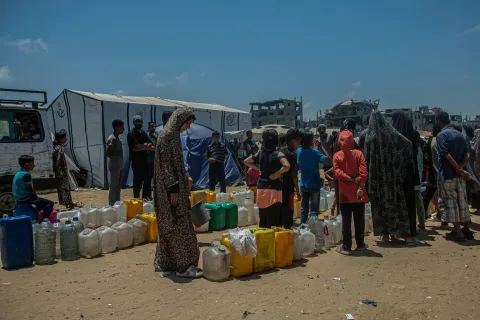
In the Gaza Strip, hundreds of children are seen every day trying to gather water, a resource that has become extremely scarce for many families.
- English
- العربية
In July, humanitarian actors reported that Gaza’s estimated 2.3 million people are surviving with only one-fourth the quantity of water that was available before the start of the current war—an amount that was already far below recommended guidelines for good health. The scarcity of clean water is one component in a dangerously unhealthy environment, with extremely poor hygiene and sanitation conditions, spurred on by the high temperatures of summer and a breakdown of sewage disposal systems.

Worsening Situation
"The situation gets worse day by day,” says Manar, carrying her one-year-old daughter and a bottle of water that she filled at a tanker provided by UNICEF.
“The water crisis hinders our lives, especially in this hot weather. I bathe once every three weeks because of the lack of water,” she says. “I wish to have my basic rights—to bathe daily or drink clean water.”
Small children are especially vulnerable to water-borne diseases and outbreaks, and health workers are witnessing a terrible increase in rashes, diarrhoea and other illnesses brought on by lack of clean water and sanitation.
Older children, sometimes fetching water far from their family’s tent or shelter, are exposed to terrifying bombardment and other hazards and can be easily separated from their families in an unfamiliar landscape, where 9 out of 10 families are displaced. UNICEF estimates that at least 19,000 children have been separated from their families, forced to fend for themselves.

Easing a Dire Water Shortage
Gaza’s current water crisis is precipitated by electricity outages that stall pumps, damage to water infrastructure and lack of safety to make repairs, and shortages of fuel, spare parts, and chlorine. To address the critical lack of clean water, UNICEF with the support of the governments of Australia and Sweden—is providing 15 litres of water per person per day for nearly 900,000 people, ensuring their water needs are met for a duration of three months.
Since 7 October, UNICEF has provided water for over 1.7 million people in Khan Younis, Rafah and the centre of the Gaza Strip by procuring and distributing 4.75 million litres of lifesaving bottled water and supporting local authorities with more than 3.4 million litres of fuel and over 40 cubic metres of water treatment chemicals that partially restored water production and distribution from the sea water desalination plants. UNICEF has also installed four mobile water treatment plants in Khan Younis and Rafah, each able to produce five cubic metres of water per hour.
Tankers then distribute the clean water to areas where displaced Palestinians are living, as fuel for vehicles is difficult to obtain and children are often tasked with walking long distances to collect water for family needs.

Easing the Burden on Children
“I fetch water every day and it is exhausting,” says 12-year-old Hiyam. “My hands hurt from carrying the jerry cans for long distances.”
She is wistful for life before the war and longs for the conflict to end; adolescents like her have lost nearly an entire school year, their days now spent searching for water and other basic needs. “I miss waking up in the morning, brushing my hair, and getting ready to go to school. I wish those days would come back."
___________________
Sources:
- ¼ of water then before the war – Humanitarian Update # 194: https://ochaopt.us5.list-manage.com/track/click?u=5a6b19e1cb44562e4e7a92167&id=3a314b5972&e=fca735e8e8