Helping vulnerable families in the Gaza Strip
meet their children’s needs

“I wish I could get a bicycle to help collect plastic for the recycling shop; it would make my tough life a little easier,” Yousef says. Until his home is rebuilt by international organizations, he is living in a one-room cement-block structure generously offered by a family friend.
Imagine having next to nothing, eking out a living by selling plastic garbage that you collect on the street, only to have your home and nearly all its contents destroyed suddenly by war.
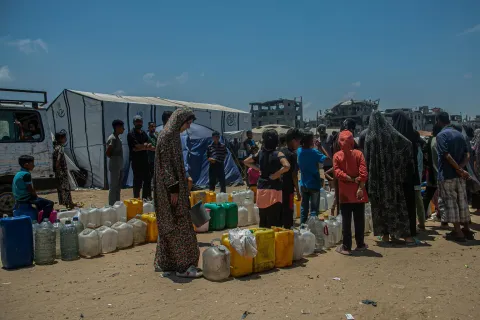
Yousef al-Saee, 62, and his wife and five children are one of the many families struggling to make ends meet in the Gaza Strip, which has been cut off by the closure since 2007, and experiences repeated escalation of the conflict. Poverty in the Gaza Strip was estimated at 59 per cent in 2021[1], counting those living on less than $5.50 a day – a marked rise over the last five years.
UNICEF, EU and partners are providing relief through multipurpose cash assistance to 1,168 households including 9,182 children, living on the margins for a period of five months.
Families with homes damaged by conflict or living in poverty are being provided with five cash payments of NIS 370 - 1,230 (about $100 - $360), depending on the number of children at home. Cash payments provide families with dignity and choice. They are preferred over food baskets or other non-cash assistance.
[1] https://openknowledge.worldbank.org/server/api/core/bitstreams/d6bbf177-c0da-5337-ba38-77046b34db32/content

“The cash voucher supported me in buying winter clothes for my children, food, and household supplies for the family,” says Mohammed Daya, 34. As the unemployed head of the family, Mohammad has 12 mouths to feed – his youngest child is only one week old.
The Daya family lives in a flood-prone home in the Tufah neighborhood in eastern Gaza. “My house was affected by the last war in the Gaza Strip because of the heavy bombing,” he explains. “The walls of my house have cracks, and the place is hazardous for kids to live in, especially in the winter.”

Mohammed, who used to work in agriculture, has chronic back pain that prevents him from holding down a job. “I used to cry every day because I was incapable of giving my children their daily pocket money and providing for their basic needs. Thanks to this programme, I can give my children pocket money to go to school and provide needed supplies for the home.” He also hopes to reduce about $1,000 in debt that he has accumulated.
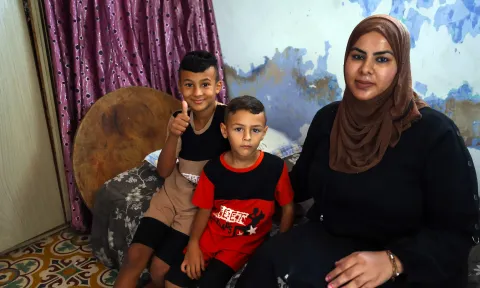
Taghreed Nahal is also grateful for the cash support. Her family fled their home in Shati refugee camp before its roof collapsed in the May 2021 shelling. Five adults and five children still live in the family’s cramped quarters, which remains unrepaired.

“This programme is good since the transfers are monthly compared to a quarterly transfer,” says Taghreed. “Unfortunately, we don't have other income sources, and my husband is unemployed.” She purchased pain relief and other medication for one of her children, who has a bone disease, and whose condition has greatly improved as a result. She also bought winter clothes and food.
Still, the cash installments are not enough to meet the family’s needs. Taghreed yearns for a small income-generating project to help them get by.
Ahmad Tayeh, 31, and his wife make a little bit of money buying and selling used clothes, earning about NIS 30 (about $8) each week. They also learned how to make homemade detergent from the internet and sell it to neighbors for less than a dollar a day.

Even such hard work and enterprise is barely enough to meet the needs of their family of five. The cash support provided by UNICEF, in coordination with the Ministry of Social Development and with funding from the European Union, allowed Ahmad to take his son to the pediatrician when he was sick with a fever.
“I can buy food, milk, clothes, and all the critical supplies for my children and the house,” says Ahmad. “I even managed to take my family to have a little fun, to pay their kindergarten fees, and buy some toys for the children.”

The family’s living room was damaged in the 2021 conflict, and the roof leaks. Still, Ahmad tries to make his home a place of hope, painting the walls with birds and other drawings. Ahmad’s smiling daughter embodies that hope wearing her crisp school uniform.