With a ceasefire in Gaza, UNICEF begins assessing the damage to water and wastewater infrastructure
Despite steadily increasing water production, families’ basic needs for water, sanitation, and hygiene are not being met.

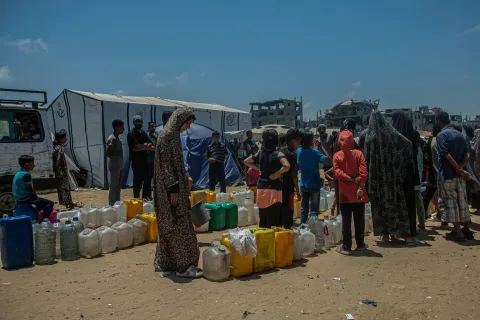
In the Gaza Strip, the Water, Sanitation and Hygiene (WASH) situation is critically desperate. Despite steadily increasing water production, families’ basic needs for water, sanitation, and hygiene are not being met. Half of all families in Gaza have less than the bare humanitarian minimum of six liters of water per person/day for drinking and cooking. And a fourth of the population has less than nine liters of domestic water per person/day for laundry, maintaining personal hygiene, cleaning their shelter, and other domestic needs. Before the conflict everyone in Gaza had sustainable access to basic water and sanitation services, making the current situation even more precarious, perpetuating a serious public health risk, especially for the most vulnerable.
The ceasefire declared in October 2025 is a critical opportunity to address the situation.
This is the reason why UNICEF, with support from the European Union, under the Gaza Water Supply Project, and in close cooperation with the Palestinian Water Authority (PWA) and the Costal Management Water Utility (CMWU) of Gaza, has started a comprehensive needs and damage assessment of the water and wastewater facilities across the Gaza strip.

Three of the main consulting engineering firms in Gaza have been contracted by UNICEF and site visits have already started. The first detailed assessments of critical high priority water and wastewater infrastructure will become available in the coming weeks. The assessments are being conducted in areas which are accessible right now and will expand as the accessible area increases and will be of the utmost importance to rebuild the heavily damaged networks.

In the past two years, UNICEF and its humanitarian partners have only been able to ensure that WASH system does not fully collapse. Today, UNICEF and its partners are capable of doing much more to increase access to water, sanitation and hygiene services.