UNICEF supports the Department of Health in communicating COVID-19 risks
Timely and accurate information helps prevent the spread of the virus

As the increasing number of positive cases in Tondo, Manila, worried the city government, the mayor placed 31 barangays (villages) under a 48-hour lockdown to prevent the further spread of the virus.
A few days after the lockdown was lifted, UNICEF joined the World Health Organization and the Department of Health (DOH) to identify gaps in risk communication by speaking to some of the residents in District 1 where 14 of the 31 barangays are located.
For Leonora Escober, 53, following the required physical distancing at home has been difficult since the quarantine began in March. Measuring no bigger than 20 sqm, their humble dwelling in Tondo is home to her family of seven.

When Leonora’s husband tested positive for COVID-19, she decided to accompany him in a quarantine facility worried that they might infect other members of the family. They were particularly concerned about their grandchild who was born with arthrogryposis, a rare congenital condition characterized by stiff joints and abnormally developed muscles, which makes the child vulnerable to other illnesses.
“I volunteered to stay in the quarantine facility with my husband,” she says. “I believe that’s the responsible thing to do to make sure we don’t infect our children and grandchild,” adding that some neighbors appreciated the gesture.
But not everyone is appreciative like Leonora’s neighbors. In another barangay, Councilor for Health Nestor Llego shared that discrimination against those who are suspected of having the virus is quite challenging.
"I volunteered to stay in the quarantine facility with my husband. I believe that’s the responsible thing to do to make sure we don’t infect our children and grandchild."

“Most of them don’t want to be picked up by ambulance from their homes,” Nestor says. “They don’t want their neighbors to know that they might have COVID because people say unpleasant things about them.”
One such case was that of a nurse who was repeatedly told to leave her neighborhood because they believed she was the source of the virus when some people fell ill.
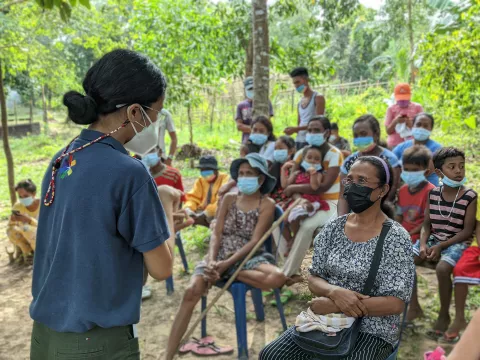
But he stressed that he doesn’t think the tension will lead to physical violence because along with the Barangay Health Emergency Response Team, they go from house to house once a week to deliver important COVID-19 messages to try to help people understand.

Dr. Mary Grace Aquino, head physician of Vitas Health Center in the same barangay agreed that they must do more to get the important information to the community. She shared, for instance, that attendance in the routine immunization for the barangay has dropped 50 per cent since the lockdown.
She also observed that many continue to disregard the government’s order to wear masks.
“Some would tell me they don’t think they’d get infected or that a mask would protect them,” the doctor says. “We need to change this way of thinking if we want to prevent the further transmission of the virus.”
DOH reported 143,749 confirmed cases in the country as of 12 August 2020.
As of 10 August 2020, UNICEF Philippines’s risk communication and community engagement (RCCE) initiatives have reached (among many):
- More than 600,000 people with messages about child protection during COVID-19 on prevention of abuse and access to services
- 4.3 million parents and learners with messages on learning continuity and safe return to schools through mass media and social media
- 193,730 health workers with training on RCCE (including health workers in the Bangsamoro Autonomous Region in Muslim Mindanao)