Silent mode off
The importance of letting girls talk about periods

Almairah, 18, is an aspiring lawyer and active student leader in one of the schools in the Islamic City of Marawi. She practices Islam and has twelve siblings. Her family runs a local restaurant in her hometown. But with tough competition among businesses and the challenges of today’s economic landscape, some days it is still difficult to make ends meet.
Almairah’s hometown is also known to be a religious and conservative city. Discussions of sexual and reproductive health, especially relating to women, are considered taboo. As a result, women tend to feel discomfort when this topic comes up. Even a seemingly normal occurrence such as menstruation is seldom talked about.

Dealing with period taboos
“Although [women] are treated with utmost respect, [the taboo culture] causes girls to feel less empowered or compelled to stay silent. This has made me very sad for most girls. They might be feeling anxious from not having the freedom to express [themselves],” shared Almairah.
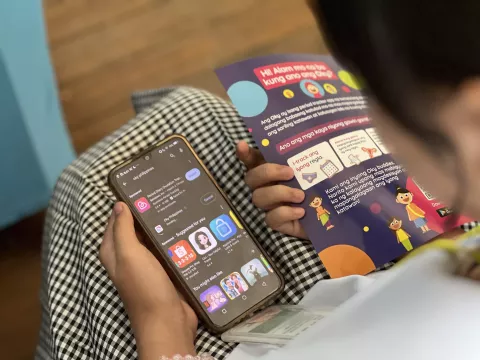
Almairah found a way to potentially spark change for her community when Marawi City was selected to be one of the pilot areas for youth consultations, which aimed to develop and introduce the Oky Philippines period tracker and menstrual health app.
“I still remember how I was first introduced to Oky app. I was still in 11th grade back then when I joined the focus group discussion,” recounted the young advocate. “It was so nice to know that there is an app being developed that focuses on women. This uplifted me with a grateful heart because finally someone has taken a step that may open the ears and eyes of people living in my community.”
I was amazed and grateful to see and know that there is an app that will massively contribute to both men and women’s awareness on the right information about sexual and reproductive health, specifically menstruation.
Through the pilot consultations, girls like Almairah as well as their social circles were able to share their experiences of menstruation and observations on the treatment of sexual and reproductive health in the context of their community. Further, they were also invited to weigh in on the types of content and design they themselves wanted to see in the app.
“I was amazed and grateful to see and know that there is an app that will massively contribute to both men and women’s awareness on the right information about sexual and reproductive health, specifically menstruation,” expressed Almairah.
For her, the experience of getting to know and trying out Oky has thus far been beneficial. With different communities having varying levels of openness when it comes to talking about sexual and reproductive health, the Oky app offers vetted content that is also available with Islamic perspectives.
“Personally, I recommend this app and encourage all young girls out there to download. Aside from tracking our period, we have lots of topics to read and learn,” said Almairah.
The Oky Philippines app, supported by the Australian Government, is a joint product of the Department of Health, Department of Education, Commission on Population and Development, the National Youth Commission, and the Bangsamoro Government, together with UNICEF and in partnership with Plan International.