Promoting COVID-19 vaccination in the Bangsamoro Region
Addressing misinformation and vaccine hesitancy

Saida Diocolano-Ali and Nuriel Huda Haron just wrapped up an urgent planning session with the Ministry of Health (MOH) for the National Vaccination Days (NVD) campaign. Despite their grueling schedule, the women gamely sat with UNICEF to discuss how the Bangsamoro Region is coping nearly two years into the pandemic.
"In everything we do as health workers, information officers, we ask guidance from God," Saida says after a warm welcome. At 49, she is an 11-year veteran in MOH who leads the Communications Management Unit and Health Promotion Unit.
Their excitement for the NVD was infectious, and understandably so. It was the government’s most ambitious COVID-19 undertaking to vaccinate 9 million people in just three days, from November 29 to December 1, 2021. The women were hoping to increase the number of fully vaccinated people in Bangsamoro Autonomous Region in Muslim Mindanao (BARMM) at just 324,246 (11%) of the 2.9 million target.

Both point to misinformation for the low turnout. “Because we are mostly Muslim here, many people were against the vaccines – they believe it’s haram (forbidden in Islam),” says Nuriel, a 28-year-old assistant information officer.
The Bangsamoro Darul Ifta, the Islamic Advisory Council, would later issue a ruling stating that the vaccines are halal (permissible). In a show of solidarity, the Chief Minister of BARMM, the Muslim Religious Leaders, and other officials got vaccinated to reassure people that they were safe.

Fighting misinformation with partners
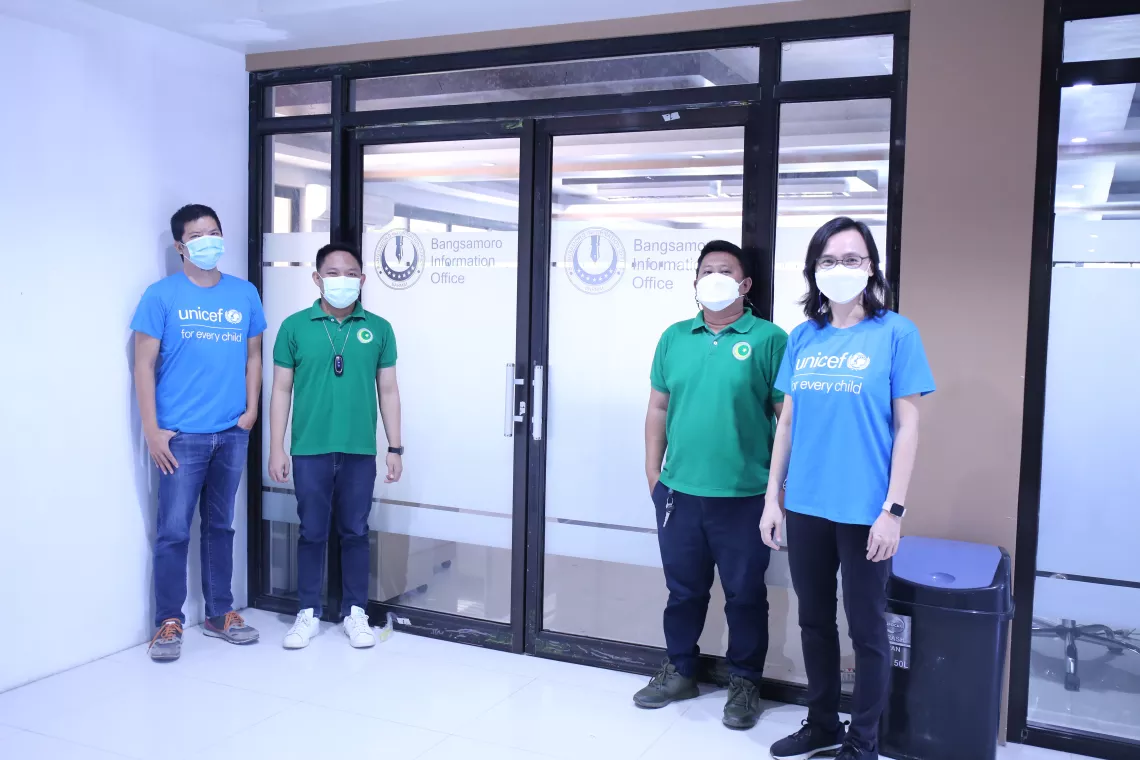
The misinformation was not lost on Jorjani Sinsuat, 25, and Aladin Ido, 29, officers at the Bangsamoro Information Office (BIO). Lacking skills and proper equipment, they felt lost when it all started. "We're like an unfinished bridge, and then an earthquake suddenly strikes," Jorjani says. "That’s how it felt like for us."
Nevertheless, the men worked with what they had with support from UNICEF and the Government of the United Kingdom (UK). "When we came back to the office, there was already a strategy for our COVID-19 communication plan," Aladin recalls.
"UNICEF and BIO were really [working] hand in hand," Jorjani adds. "The UK and UNICEF gave us all the technical support we needed – from the materials, the equipment to hiring extra staff, conducting programmes, advertisements, and collaterals."
The partnership reached not only the cities, but also distant islands.
Located in Southern Philippines, BARMM has an estimated population of 4.4 million as of 2020. Although a relatively small population, they are widely dispersed in islands that are among the most difficult areas to reach.
Because MOH and BIO could not always be physically present in the islands of Basilan, Sulu, and Tawi-Tawi (BaSulTa), UNICEF and the UK have been supporting an information officer for each island to step up outreach activities.
"UNICEF was with MOH all the way. We were able to reach BaSulTa with their help," Saida says, recalling their two-week mission in Sulu to reach the indigenous group Badjao. For communities like this, MOH relies on the diligent barangay health workers. Like their counterparts in the cities, they benefit from the on-site training and materials supported by the UK-UNICEF partnership.

Moving ahead and staying strong
When asked to reflect on their work, Saida, Nuriel, Jorjani and Aladin share that they can now reach more people through their websites and social media. They have also become the trusted authorities for everything COVID-19.
But ever cautious about wasting their gains, they emphasize that improving the other sectors – alongside health and information – is imperative if they want to see BARMM overcome the pandemic.

As of 8 December 2021, following the NVD, BARMM reported that 388,714 have been fully vaccinated, an increase of 20 per cent. Although they hoped for more, a small increase is still a win. “In Islam, we are told that whatever happens, we should not be discouraged,” Aladin says humbly. “God has a reason for making something happen.”