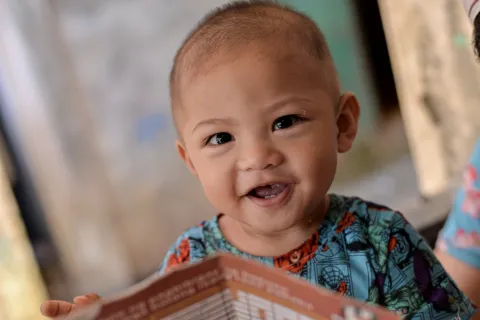
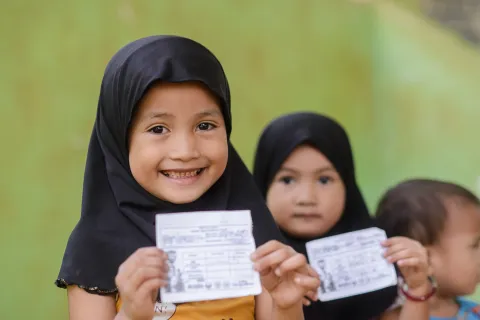
Ending outbreaks through solidarity and community spirit
Greatest act of solidarity during MORI reveals Malidegao’s immense potential

“Start from scratch talaga kami. Walang gamit, walang BP, walang gamot (We really started from scratch. We didn’t have equipment, blood pressure monitoring tool, medication),” Malidegao National Immunization Program (NIP) Coordinator Sarah Krisna Ali said as she recalled the first few months of the transition of Malidegao as one of the newly-created municipalities in the Special Geographic Area (SGA) of the Bangsamoro Autonomous Region in Muslim Mindanao (BARMM). Transitions aren’t always easy, but things get more complicated when you throw a public health emergency into the mix.
"We really started from scratch. We didn’t have equipment, blood pressure monitoring tool, medication"
On March 2024, the BARMM Ministry of Health (MOH) declared a measles outbreak when cases in the region peaked to more than 500 in the first quarter of 2024, which is half of the cases reported for almost the entire 2023.
The MOH, supported by UNICEF Philippines and World Health Organization (WHO), implemented the Measles Outbreak Response Immunization (MORI) to curb the outbreak, thanks to the generous funding of the Canada for COVAX – UNICEF GLOBAL COVID-19 Vaccine Delivery initiative.

Leaders and health workers in Malidegao share how they overcame the hurdles in the month-long response.
Turning to allies during crisis
A gargantuan task fell on the lap of Municipal Health Officer Dr. Nymraida Marohombsar when the first case of the measles outbreak occurred in Malidegao. “Immediately, sinabi ko na we have to do vaccination in the community (I immediately called for vaccination in the community) to contain the transmission spread. And then I called for a community assembly to raise awareness of the problem.”

The transition to an SGA left Malidegao without a fully-functioning local health board to establish public health services. It also put the health workers’ salaries in limbo. These challenges were compounded by the fasting for Ramadan and the debilitating heat from El Niño during the MORI.
Marohombsar turned to her closest allies to face these challenges. “The first thing I did was to coordinate with the barangay chairpersons – kasi wala pa naman kaming LGU that time (We still did not have an LGU in Malidegao that time)”, she explained. They provided the transportation and meals of health workers, which boosted their morale even in the long, grueling hours of the MORI.
“Our staff encountered things like refusals. Hinabol pa nga ng itak (Some were even chased by machetes). But their commitment to implement the MORI saw them through because they knew things would go out of hand if we didn’t contain the transmission,” she recalled.
“Our staff encountered things like refusals. Some were even chased by machetes."
Winning hearts and opening minds
That commitment had been tested long before the MORI. “Parang hesitant pa yung mga tao nung una, since hindi kami yung mga dating staff na nakasanayan nila (The people were hesitant to trust us at first because we weren’t the staff they were used to interacting with),” according to Ali.
Midwife Donaisa Yasin said that going house-to-house won the trust of the residents, especially those that lived in far-flung areas: “Inaakyat talaga namin. Aware naman sila, pero kailangan mo lang talaga puntahan (We go up to the mountains to visit them. They are aware of the benefits of vaccination; you just have to visit them).”

These extensive visits would not have been possible without barangay leadership support. Barangay Health Worker (BHW) Roselle Villanueva says that Barangay Batulawan Chairman Loy Batugan lends his personal vehicle to health workers’ trips to far-flung areas.

To allay the parents’ fears over potential side effects of vaccination, he also rallied local leaders to ensure supply of paracetamol. “Gi-petition niya ang members ng barangay local government unit (he petitioned members of the barangay local government) to donate 100 pesos to buy paracetamol for vaccination drives every month to address shortage of paracetamol, which is helpful in managing potential side effects of vaccination,” Barangay Health Worker Roselle Villanueva recalls.

Support from leaders helped health workers like Ali, Yasin, and Villanueva cope with the multiple challenges of reaching communities during a public health emergency.
Setting the stage – the leader as enabler
As a former barangay kagawad, Barangay Chairman Loy Batugan knows that health workers are the first point of contact in the community for health-related concerns. To reinforce their mandate, he joined the health workers in their house visits to personally convince parents to have their children vaccinated.

Batugan’s brand of leadership is built on collaboration, support and trust. He staunchly supports Dr. Marohabsar’s plans not just for Barangay Batulawan, but for the entire Malidegao because he recognizes her vision and expertise. “Kung ano ang programa ni doktora, itutuloy namin. Malaki talaga ang tiwala namin sa kanya kasi nakita namin na very active siya (Whatever her programs are, we will implement them. We really believe in her because we see how active she is). Hindi lang para sa barangay, para sa kung sino ang nangangailangan – serbisyong Bangsamoro ang ginagawa natin (Not only for our barangay but to whoever needs it – this is the Bangsamoro kind of service,” Batugan emphasized.
It Begins—And Ends—With the People
Public health emergencies expose fragile institutions and weak health systems. Fortunately, the people of Malidegao chose a different narrative. Their health care workers persevered during the MORI even if odds were stacked against them because they had leaders that accompanied them to the farthest of sitios to protect every child from life-threatening vaccine-preventable diseases.
Eventually, their resolve paid off. “We did a household profiling and based on that, we were able to exceed our target. The MORI opened our doors to what is possible,” said Marohabsar.
Indeed, vaccines don’t save lives – vaccination does. Without leaders and health workers to go an extra mile to reach children and their communities, these vaccines will merely be vaccines in vials.
UNICEF, in partnership with the Government of Canada, supports outreach activities of social mobilizers and health workers to reach people in remote communities, help them understand the importance of vaccines, and guide them in managing their health concerns.
“We did a household profiling and based on that, we were able to exceed our target. The MORI opened our doors to what is possible”