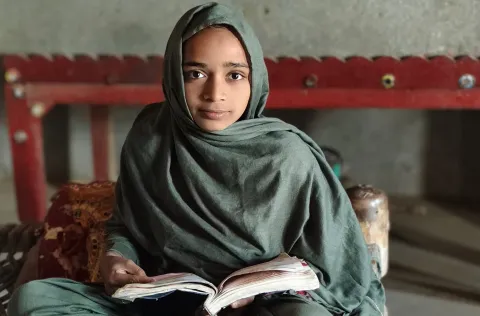
Empowering girls to learn
UNICEF’s Temporary Learning Centre in a village in Sindh is enabling out-of-school girls to attend school for the first time in their lives

Khairpur District, Sindh: It’s a hot and humid day in Malang Khan Mangrio village of Khairpur District, Sindh, an area famous for date cultivation. The sound of children singing nursery rhymes drifts across the fields from a large white tent surrounded by date palm trees.
Inside the tent, around 200 girls aged 3 to 14 sit on a plastic sheet, cheerfully singing the nursery rhyme along with their teacher who stands in a corner next to a large blackboard. While it’s hot outside, the temperature inside is remarkably lower, two pedestal fans are rotating at opposite ends of the tent. This is the Temporary Learning Centre established by UNICEF last year in the aftermath of the floods.
After the nursery rhyme concludes, the teacher asks for a volunteer to come forward and read a paragraph from the Sindhi textbook. 12-year-old Naheed steps forward with her textbook and starts reading the comprehension exercise out aloud. After successfully completing the task, all the girls clap for her and she sits down with a bright smile.

Although this scene might seem modest to many, this is a dream come true for these girls. Just over a year ago, none of them had ever experienced what it’s like to go to school and learn.
The village is inhabited by the Mangrio tribe who traditionally opposed girls’ education. Most of the girls in the tribe stay at home and learn domestic chores which are deemed essential for them to get married.
Malang Khan Mangrio was one of the worst hit villages in the district during last year’s floods. Water as high as five feet had submerged the village, with most of the inhabitants forced to flee and live by the highway. They were then moved to camps established by the Government for flood-affected people. Finally, by the end of last year, villagers started returning back to what was left of their homes.
Prior to the floods last year, there was only one boys’ school operational in the village. During the floods, it was damaged and when UNICEF decided to set up a TLC, the villagers wanted it to only cater for boys. As fate had it, once the boys’ school was repaired and became functional again, UNICEF together with the provincial government started advocating for girls to study in the TLC, breaking with tradition for the first time.
For teacher Aamina Narejo, enrolling girls in the TLC became a project of passion. Being the first girl in her family to attain a high school degree, she had faced stiff resistance in pursuit of her own education in Khairpur – her hometown. This experience fueled her passion to champion the cause of girls’ education at every opportunity.
Aamina worked extensively to engage the villagers in discussions and listen to their concerns. She successfully convinced them to allow girls in their community to study. “I highlighted that if they want their future generations to prosper then it’s important for educated mothers to raise them,” states Aamina triumphantly.
Opening last December, the TLC welcomed 200 young girls who got their first experience of learning. Among them was Naheed, a young student, who was unusually quiet when she first joined the centre.
Naheed was disturbed by the separation of her family when the floods hit their village. After the roof of their house collapsed, she struggled to survive with her mother and other relatives in camps for three months. When they returned to the village, they had to start from scratch and seek financial assistance from her maternal uncles. When the TLC was established, it provided her with a much-needed respite and a distraction from her situation at home.
While Naheed was initially reluctant to participate in class activities, Aamina says she has now become the most outspoken and confident student in the class.
“The best part about school is learning something new every day. Now I can read Sindhi, English and Urdu while earlier I could just speak Sindhi. I can also do mathematical calculations and I’m much more aware of my surroundings,” says Naheed excitedly.
This summer, Nawab Khatoon, Naheed’s mother, entered into business with a local farmer. She sells the farmer’s dates to people in adjoining districts and gets to keep a portion of the profits. As Nawab Khatoon is illiterate, she planned to rely on her brothers for business calculations but was impressed when Naheed started helping her out.
“The first time I received my share of the profits, I was going out to consult my brother, but Naheed stopped me. She carried out the calculations and told me I had received my due share. I doubted her and still consulted my brother, only to realize that Naheed was right,” exclaims Nawab Khatoon proudly.

Over the last year, UNICEF has established over 1,500 TLCs in flood-affected areas all over Pakistan to ensure children continue to learn. This initiative has helped many children like Naheed to go to school for the very first time. UNICEF estimates that around 40 per cent of the children attending Temporary Learning Centres are first time learners.
“Even before the floods, Sindh grappled with a high number of out-of-school children. The destruction of the schools during the flood has only exacerbated this problem. The TLCs enable existing students to continue their studies while giving others the chance to study for the first time. We need to build on this progress to reach more out-of-school children, and facilitate their integration into the formal education system,” says Khalid Mujtaba Qazi, UNICEF’s Education Officer.