A lifeline to childhood
Singing, games and other activities are giving Syrian children impacted by the earthquakes a chance to rediscover what being a child feels like.

ATMEH, Syria – The main road in Atmeh, a town in northwest Syria near the border with Türkiye, cuts through a busy market. It’s bustling here now, full of traders doing their best to make ends meet as they recover from the catastrophic earthquakes and aftershocks that rocked the region in early February 2023.
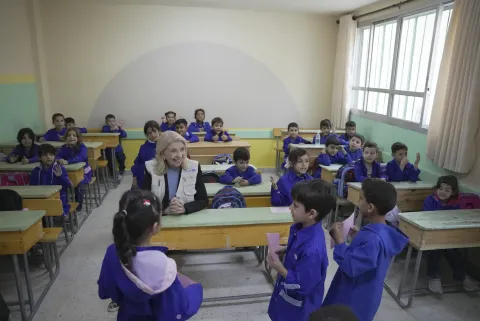
We continue past the marketplace along the main road and then down a narrow side-street where we enter a small compound. As we do so, a new sound fills the air – children singing. The singing is coming from one of a group of prefabricated classrooms. Inside, the children are enthusiastically waving their arms along to an upbeat song about the five senses.
Activities like these are designed to bring some fun, learning and a sense of safety and structure to children attending classes in non-formal education spaces. “All these children have been suffering earthquakes, conflict and tragedies,” says Safa, a teacher who’s leading the class. “This methodology helps them [overcome] psychological issues, have fun, and process information they are given.”
In one activity, Hanan, 10, hones her senses by tasting a pinch of salt from a small bowl at the front of the classroom. “My teachers have given me more courage to be here and to play with other children with no problems or the fear that I used to have,” she says as the class finishes.
Safa says that when Hanan first came to these classes she was finding it difficult to interact with her peers. Like so many children in the region, she has been trying to come to terms with the devastation wrought by the earthquakes. Thinking about children around Hanan’s age – who have lived their whole lives amidst conflict and who now have to cope with the horror of the earthquakes – it’s easy to lose hope. But temporary learning spaces like these are managing to provide a lifeline back to childhood.
“At home I do my homework and then I play a little bit and help my mum,” Hanan says. “After that, I sleep because I really want to go to class the next day.”
Survival – and recovery
The landscape of northwest Syria is punctuated with sprawling camps for displaced persons that pre-date the earthquakes. They now host around two-thirds of the 2.9 million displaced people across the area. Many of the tens of thousands of Syrian families displaced by the earthquakes have already been displaced multiple times during years of conflict.

Jamal* has lost count of the number of times he’s moved his family. But today, he’s just grateful that they’re all still alive. He says that it was cold the night the earthquake struck, so he moved his seven children into his room. When the ground started rocking violently as the earthquake hit, one of the walls of his home collapsed into the children’s bedroom. The warmth of a parent saved his children’s lives that night.

The family is now staying in a tent at a newly formed camp near the town of Jandiris. One of Jamal’s sons, Abdul-Karim, 11, has never had a chance to attend school. “I like playing marbles because I’m good at it and win,” he says when asked about his hobbies. Jamal smiles and adds that the marbles can be a source of daily fights.

Abdul-Karim has just returned with other children from activities being run by UNICEF and partners in the camp. The games that take place are simple, but provide an important sense of normalcy for children whose lives have been upended by conflict and disaster. The sounds of activities at the learning spaces – of children playing and singing together – are also a reminder of what childhood is supposed to be.
“They were very stressed, but they are doing better,’ explains Mohammed, one of the facilitators at a nearby camp. “It’s some relief when we can tell the children are happy.”
*Name changed for protection purposes