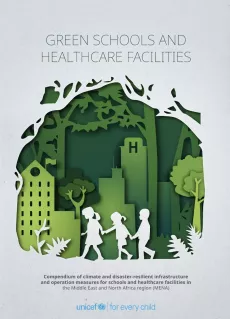
Green schools and healthcare facilities
Compendium of climate and disaster-resilient infrastructure and operation measures for schools and healthcare facilities in MENA
- English
- العربية
Highlights
The planetary crisis of climate change, environmental pollution and biodiversity loss has created incalculable losses across the world – but none greater than to children.
The crisis has already exposed nearly every child on every continent to climate and environmental hazards, with approximately one billion children living in countries considered at extremely high climate risk.
The main objective of this document is to provide technical guidance to UNICEF’s programmes in the Middle East and North Africa (MENA) region on a wide range of climate change mitigation and adaptation strategies and solutions for schools and healthcare facilities, in a very practical and simple manner.
These strategies and solutions are a combination of structural and management (non-structural) recommendations and are derived from a literature review. These are presented as a reference document to aid UNICEF Country Offices in discussions with Government and development partners on climate-resilient educational and healthcare facilities.
The document includes a brief description of each technical solution, its suitability to either one or more climate risks, the operational and maintenance requirements, and an estimate of capital costs.
WHY CLIMATE CHANGE IS IMPORTANT?
UNICEF’s Sustainability and Climate Change Action Plan (SCAP) is designed to galvanize climate action to protect the most vulnerable children throughout the world.
The SCAP is a critical document that maps out how UNICEF will focus its strategies, operations, and partnerships to help governments and communities build low-carbon, resilient essential services for children; to equip young people to be champions for the planet; and to accelerate a just transition to a nature-positive and carbon-neutral world. It also reflects an ongoing commitment to fulfil the promise of the Sustainable Development Goals (SDGs).
There is an urgent and increasing need (and an opportunity) to invest in climate-proofing health and education facilities, especially in the Middle East and North Africa (MENA) region, which is among the world’s most vulnerable regions when it comes to climate change.
The region faces an increase in overall temperature, heat waves and dust storms, increased water scarcity, decreased food security, increased physical and environmental threats, and climate-linked population movement.