Closing the Gap
The pivotal role of community health in the Middle East and North Africa Region
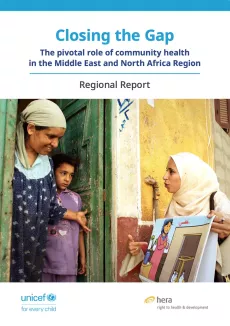
![(Left-right) Saida Ali Suleuman and her daughter speak with Tahany El Zanfly in Masara Village, in Mit Ghamr District. Ms. Zanfly is a health worker conducting home visits to teach families how to prevent the spread of avian influenza from domestic poultry. [#5 IN SEQUENCE OF FIVE]](/mena/sites/unicef.org.mena/files/styles/hero_extended/public/UNI2434.webp?itok=OYruJLIC)
About
This report presents a mapping of community health across the Middle East and North Africa (MENA) region, commissioned by the UNICEF MENA Regional Office. Covering 12 countries — Algeria, Djibouti, Egypt, the Islamic Republic of Iran, Iraq, Jordan, Lebanon, Libya, Morocco, Tunisia, Sudan, Yemen — and the subnational area of Northwest Syria (NW Syria), this mapping offers a baseline snapshot of existing community health resources, policies, and infrastructure in each country or area. The mapping, carried out between August 2023 and November 2024, aims to support policymakers and multisectoral stakeholders, including civil society organizations (CSOs) and donors, in identifying systemic gaps, setting strategic directions, and responding to specific country needs for strengthening community health to achieve better outcomes for children.
Objectives and scope
The primary aim of this mapping is to show the availability of community health components across the selected MENA countries, rather than to assess their quality. This mapping provides an inventory of policies, structures, and community health workers (CHWs), establishing a neutral reference point for future actions. The scope of the study encompasses key health system pillars — governance and accountability, including community engagement; health management information systems (HMIS); health workforce; service delivery; medicines and health commodities; partnerships and financing; and cross-cutting issues including gender, emergency response, and internally displaced persons (IDPs) and refugees.
Methodology
Data collection involved desk reviews, surveys, key informant interviews, and co-creation workshops held with national ministries and other stakeholders. Findings are synthesized into this report and an interactive MENA Region Community Health Dashboard, offering a tool for regional stakeholders to visualize current structures and track updates over time. This tool is intended to aid policymakers and stakeholders in monitoring the evolution of community health, should data be updated in future years.